Master tournaments in central London occur rarely, but their occurrences are often notable in the game’s history. For decades, the Gambit Café in the now vanished Budge Row, opposite Cannon Street station, provided a lunchtime meeting place for City office workers, with weekly lightning tournaments where first prize was the “Gambit Guinea”.
The Gambit’s finest hour came in June 1946, when its cramped basement provided the venue for the Great Britain vs USSR radio match. The target for the British team was to at least equal the 4.5-15.5 scored by the USA the previous year, and this was achieved with a 6-14 total on the men’s boards, highlighted by the Bletchley codebreaker Hugh Alexander’s defeat of the then world No 1 Mikhail Botvinnik, as well as William Winter’s quick victory over the future world title challenger David Bronstein, and Gerald Abrahams’s win against Botvinnik’s coach Vyacheslav Ragozin.
Since then, central London hotels have hosted several international tournaments and even the first half of a Garry Kasparov vs Anatoly Karpov world championship match, while currently the annual ChessFest in Trafalgar Square attracts more than 20,000 visitors. In the 1970s, free use of such venues as Islington schools and the Mary Ward Centre helped train England’s talents for future encounters with Soviet grandmasters.
In London’s clubland in Pall Mall, the RAC clubhouse has hosted the Oxford vs Cambridge Varsity match for almost half a century, while the Athenaeum was the venue for a dramatic match in 2023 where the record-breaking prodigy Bodhana Sivanandan defeated the former British champion Peter Lee.
Now there is an excellent new venture, the Army and Navy Club Pall Mall Masters, played last weekend and sponsored by Chess England, whose popular tournaments are organised frequently in north-west London and the surrounding areas.
Several players came from the Samarkand Olympiad with only a few days’ break, and this seemed to have had a particularly negative effect on the Spectator chess columnist GM Luke McShane, who was in contention for an individual medal with the England team in Uzbekistan but was in poor form in the Pall Mall event. In contrast, GM Jules Moussard won the Super Rapid with GM Gawain Maroroa Jones a strong second after both performed well in the Olympiad. The Frenchman also won the Blitz tournament.
Speed chess produces more checkmate finishes than slower time limits, due to players continuing to the bitter end in the hope of a blunder or simply not noticing the mate threat.
Here are two examples from round two and round six.
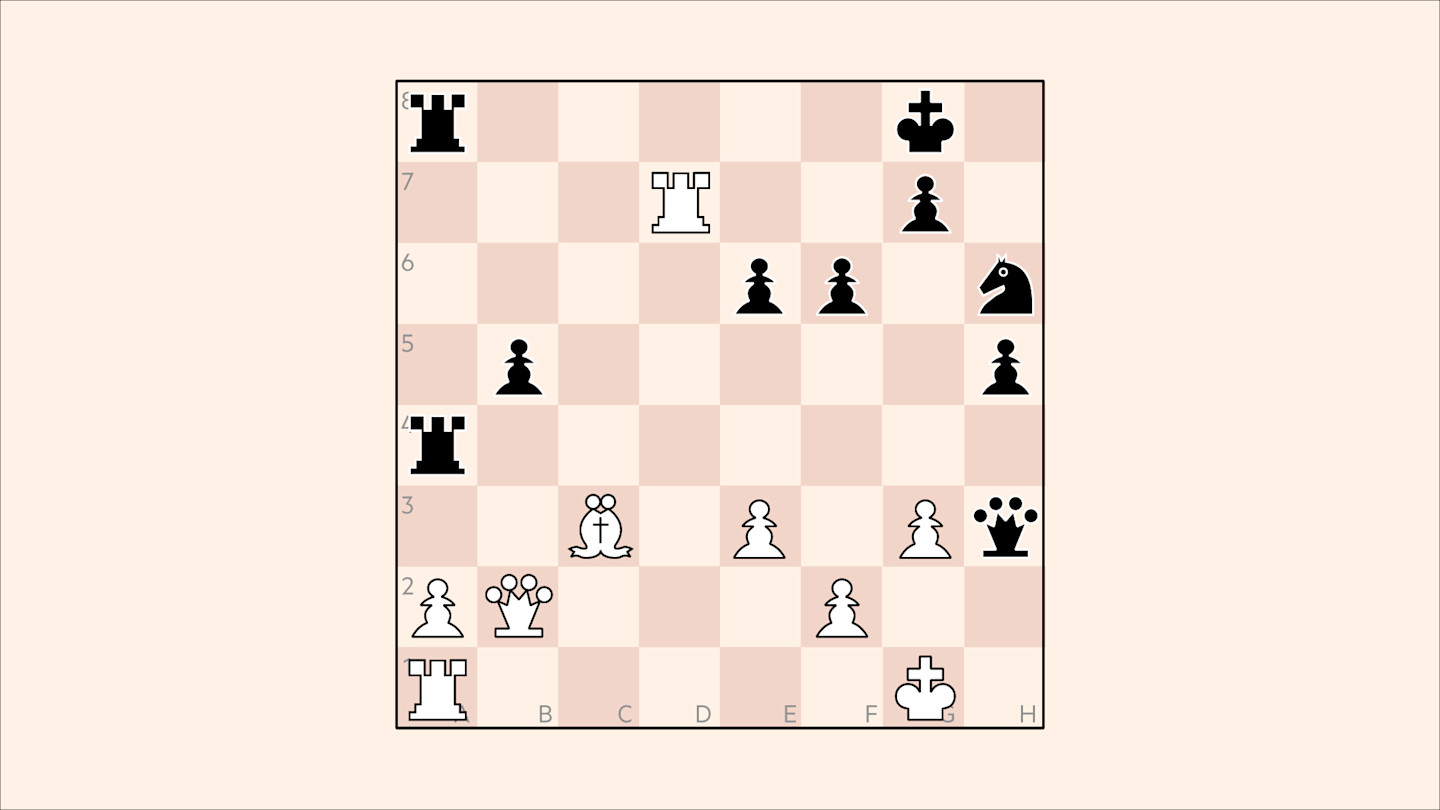
Puzzle 2695
Niaz Murshed vs Nigel Short, Dhaka vs London, World Cities Team Championship 2012.
White confidently played the apparently winning 1 Bxf6 gxf6, but instead of following up with the expected 2 Qxf6, sank into deep thought for several minutes and then resigned! Can you explain?
Click here for solution