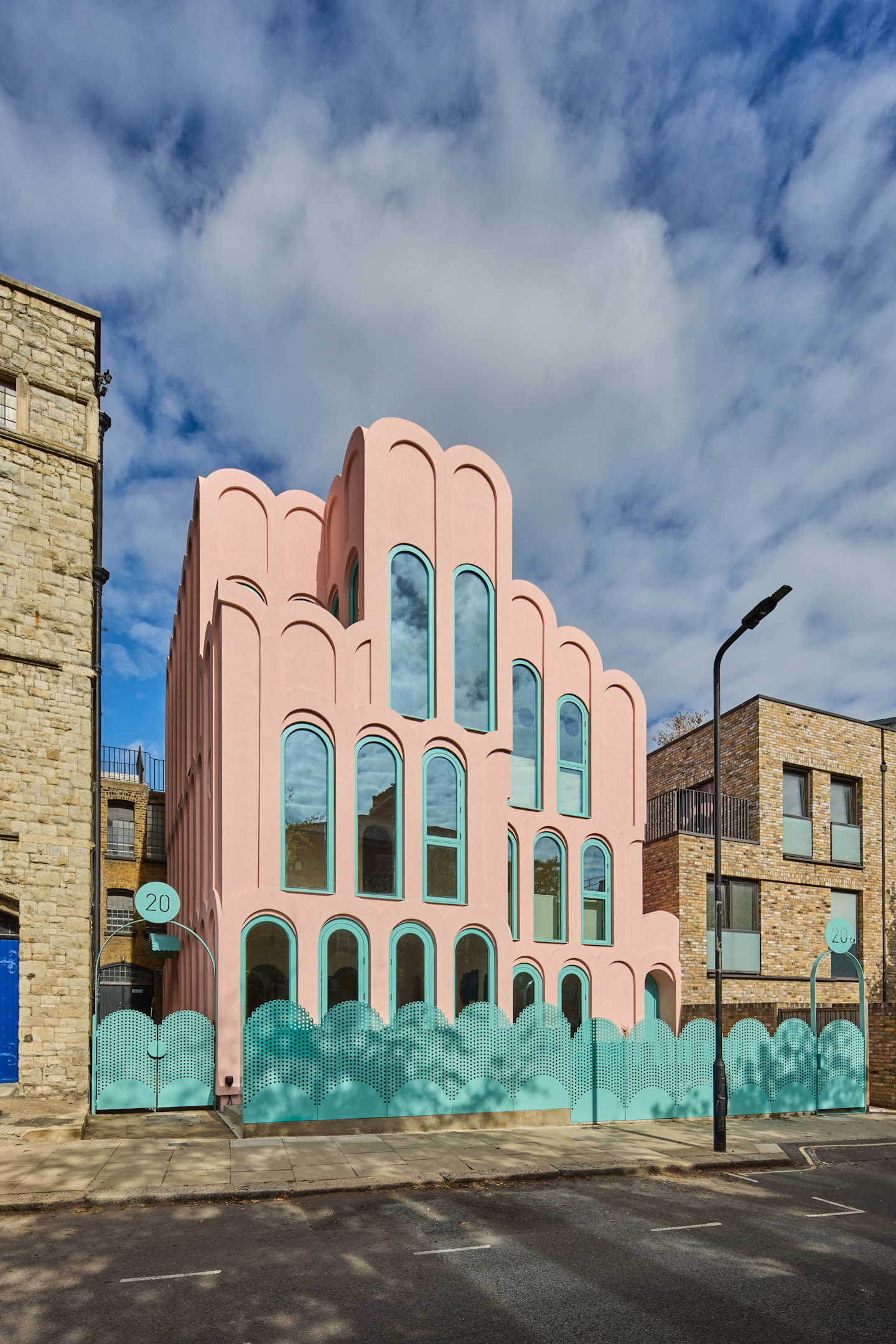
A visit to the Cloud House, an extraordinary architectural testament to flamboyance recently completed in north London by architect Peter Morris and his wife TV producer Emily Kennedy, calls for dressing the part.
I arrive at the candy-pink curved confection in electric blue trousers, floral shirt and bright green jumper. Nonetheless, when Kennedy opens the front door, I feel like an undertaker. Her black smock dress is electrified with pink tights, neon yellow ruff and pink hairband. Morris sports a pink-and-blue-polka-dot scarf, pink trousers, yellow-laced red leather boots and an azure overshirt pinned with a badge that reads “Why not yellow? — Derek Jarman”. The pair wear matching black, thick-framed round glasses.
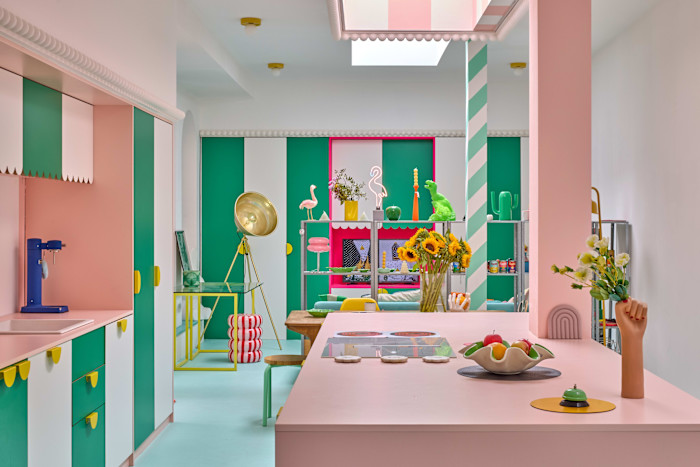
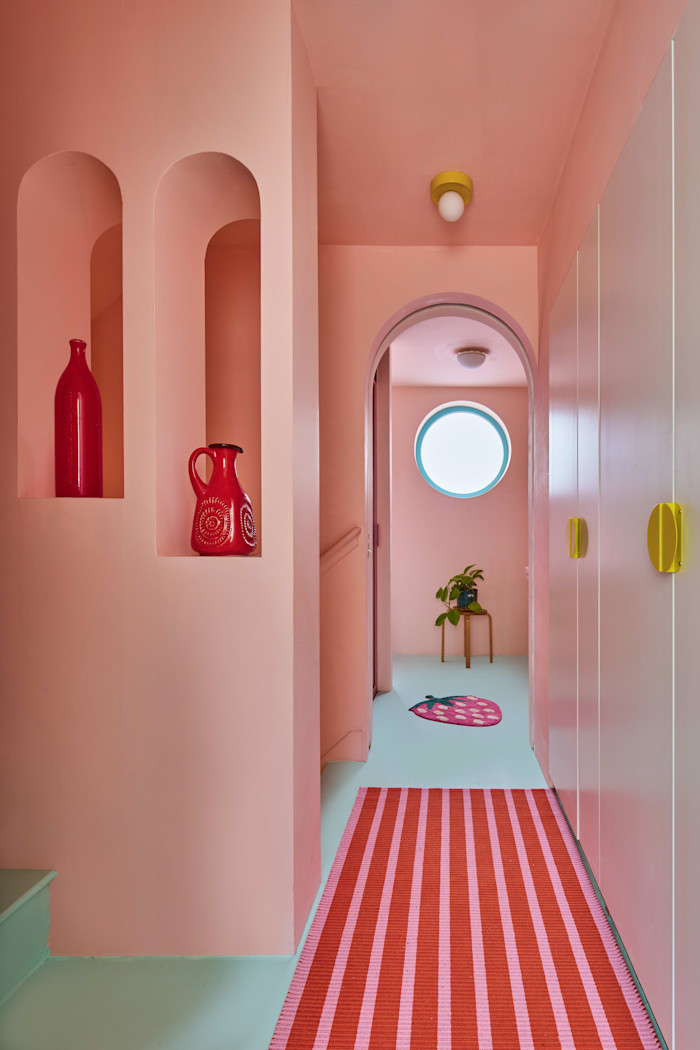
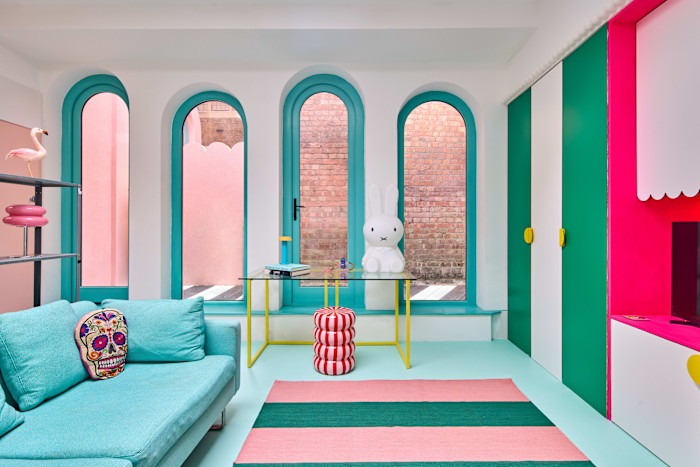
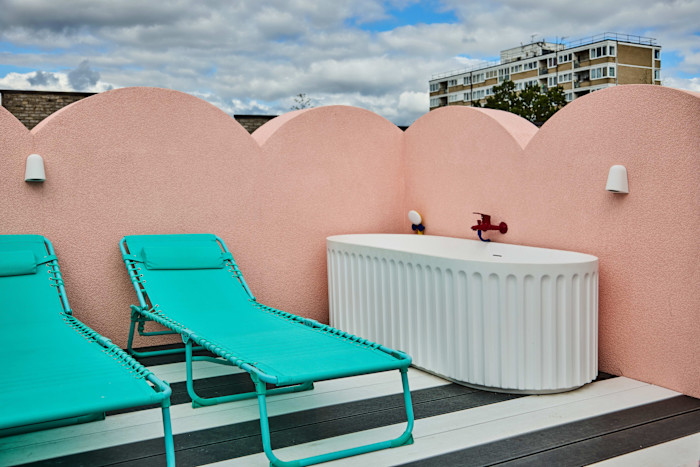
Inside, the main ground floor room looks like Wes Anderson has designed an ice-cream parlour. The concrete floor is sky blue. The kitchen and living room cupboards, end wall and sections of ceiling are pink-and-white and green-and-white stripes. The entire kitchen island is bright pink, as are a number of surfaces. Sphere cornicing from British Mouldings, which makes decorative plasterwork in Georgian and Victorian styles, is generously distributed.
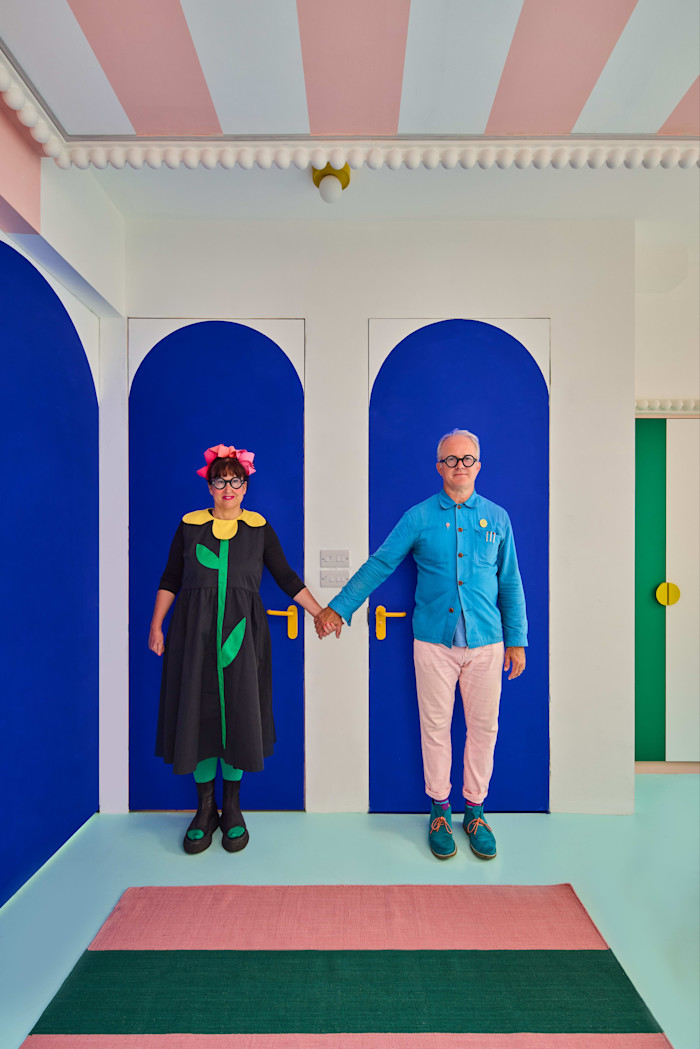
“It’s a sort of visual joke,” says Kennedy of the stripes and plaster baubles, “like a canopy, a bobble-edged stripy towel or a deck chair from the 1970s.” “Ice cream parlours, sweet shops — things that generate joy, you know, happiness,” Morris adds. It’s working: whether it’s the clothes, the decor or the obvious joy the couple have in each other’s company, I feel elated.
Kennedy’s father is an artist, and she grew up in colourful homes; in each of her own she has painted the floors pink. When the couple met through a dating website 11 years ago, her passion for colour “liberated” Morris’s. Soon after, they moved into what was a tired Victorian two-storey house, and started planning two semi-detached homes to build in its place — financing the £700,000 cost to build their home by selling half the plot, which would contain the second house. On their honeymoon to Miami in 2017, the city’s art deco shapes and exuberant colours provided inspiration.
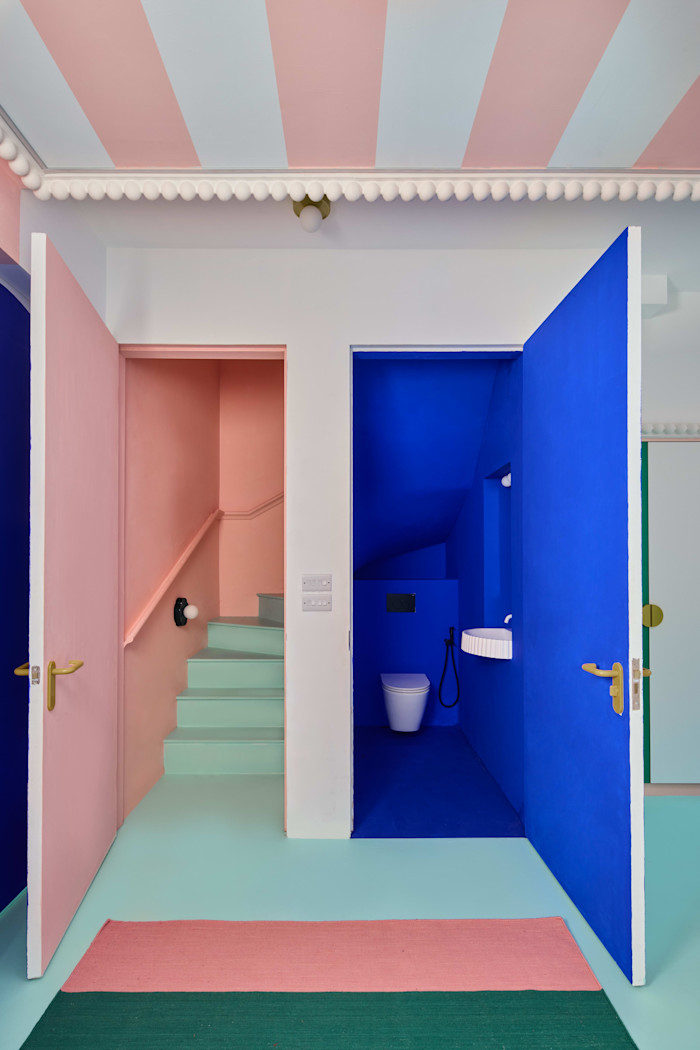
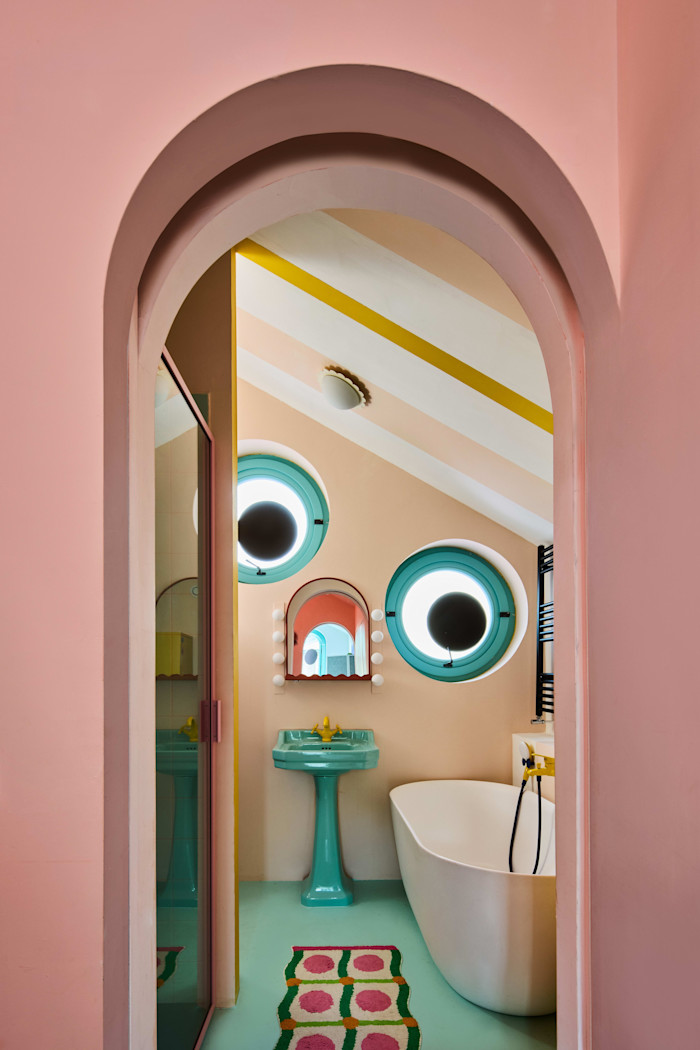
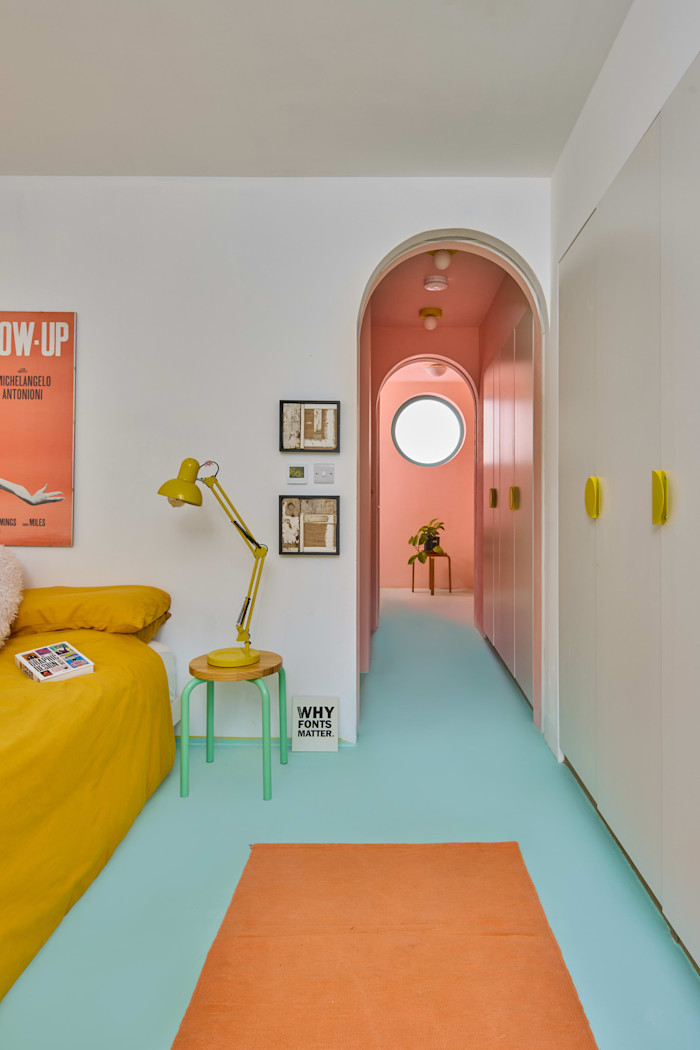
“Everything is a scallop, a circle or an arch,” says Kennedy, who helped manage the build. Semicircles are painted on doors; arches painted on walls, hemispherical cupboard handles are fitted in opposition to make a circle; sliding doors, drawing dual-aspect light through the house, allow the alignment of doorway arches with circular windows on the home’s front and back.
Some of the motifs are savvy design hacks — painted patterns rather than structural interventions, or Ikea finishings that have been adapted or repainted. Others are more complex, such as the computer-carved high-density polystyrene attached to the building’s breeze block — an imitation stone that was used to shape the more than two dozen arches on the facade; there are also 28 arched windows, their turquoise frames matching the steel front fence.
“It’s very simple shapes: arches that stagger, and that’s it, those are the rules,” smiles Morris.
Camden Council used its panel of architects to judge the planning application. The couple pointed to the mishmash of styles in their area, Kentish Town. Arches and round windows were partly inspired by the Victorian gothic St Martin’s Church, opposite the property, which architectural historian Nikolaus Pevsner had described as “the craziest of London’s Victorian churches,” says Kennedy. Next to their plot, a Grade II-listed building from the late 1800s, complete with imposing wood doors and bulky stone facade, conjures a medieval castle — “it’s absolutely bonkers,” she says.
The couple made the argument for diversity: “You’re in this street with these two really eccentric buildings, and every single other building is from a different era. We said we can take the spirit of those buildings and create something really special.”
Local residents rallied, including Timothy Hill, 91. He had lived in the nearby Oak Village conservation area since 2006 and attended an open day that Morris and Kennedy hosted at the church in 2019 to publicise their plans. “Emily was serving cupcakes with the home’s facade on the icing. What impressed me was how unique it was in the street — possibly in London — and the council’s vision to want something so avant garde,” he says. The clincher, says Morris, was that the panel believed in the couple’s commitment to seeing their vision through. And actually living there. “I wasn’t going to be an architect who would just clear off and let the contractor do a bodged job. They realised how much we cared about the design [and] knew we would obsess over every detail,” he explains.
The project began in earnest in summer 2023. But, much as their enthusiasm is infectious, major projects typically mean drama and heartache. This was no different. There were budget overruns, the building’s planned wooden frame was abandoned in favour of breeze block, miscalculations by the contractor meant Morris and his team had to hack into the polystyrene arches with Stanley knives to make them fit. The general contractor was sacked and the whole project mothballed for nine months. Meanwhile, thanks to an industry downturn, Kennedy, who has produced award-winning series including The Piano for the BBC, ITV, Channel 4, Channel 5 and Sky Arts, spent six months out of work. Through it all, they had to persuade the young couple who were relying on the same contractor to complete the home next door for £800,000, that everything would turn out fine. The house was finally finished this summer.
The hiatus was the low point. Money on renting alternative accommodation and £500 per month on storage ate into their savings; they had to call on family for loans to complete what proved to be the £735,000 build; and the creative compromises weighed on Morris. The couple took turns in despair, but each time one lifted the other out of their hole. “There weren’t moments when we were both really depressed and crying. It could have done us in,” he says.
We have returned to the front garden; a passer-by congratulates Kennedy over the perforated turquoise fence, his face straining with the Herculean effort of a middle-aged Londoner offering a compliment to a stranger. Morris is an extrovert — “I’ll be in the street telling anybody my woes” — and the low-slung fence is intended to facilitate exchanges like this. It’s 11.30am and the admirer is their seventh of the day. Lunch, which they take most days on the front garden’s lime green steel table, will be punctuated by a steady stream of compliments, inquiries and requests for a tour.
Showing the home at London’s recent Open House Festival, they received 4,000 visitors in three days, with only a single steward for help (if anything was taken, they haven’t noticed yet). “We probably don’t mind being on show,” says Morris. You don’t say.
Find out about our latest stories first — follow @ft_houseandhome on Instagram