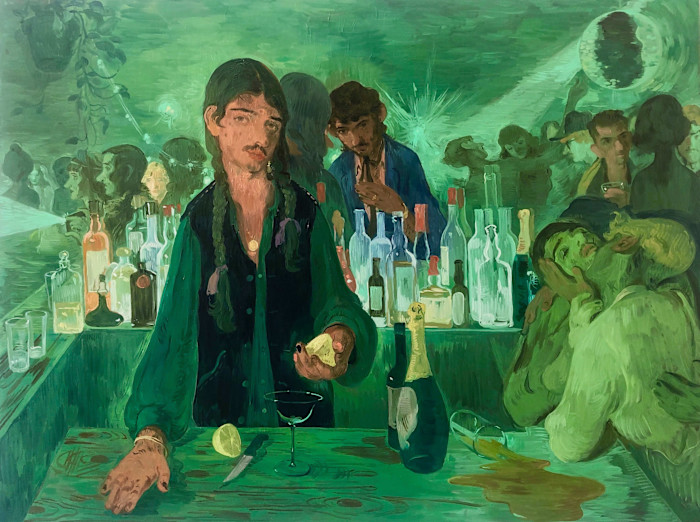
In Salman Toor’s captivating oil painting “The Bar on East 13th” (2019), a goateed bartender with black nail varnish and plaits tempts a hesitant customer, visible over his shoulder in the bar mirror, with a freshly cut lemon. Beside them, two other men — one dark, one blond — swoon in flagrant embrace. The disco ball in place of a chandelier, and a glowing smartphone in the reflected crowd, mark this compelling composition as light-years from its Belle-Epoque inspiration: the enigmatic barmaid of Manet’s “A Bar at the Folies-Bergère”. Yet Toor’s eager newcomer, luscious citrus, warning blade and spilled beer create narrative intrigue every bit as arresting and ambiguous.
Poised between sensuality and danger, liberation and guilt, the work is on show from October 2 in Salman Toor: Someone Like You at the Courtauld Gallery in London — where Manet’s 1882 painting hangs felicitously in the next room. This is the first solo exhibition in Europe of the fast-rising Pakistani-American artist, introduced here as a leading figure in a resurgence of narrative painting. Born in Lahore in 1983, he moved to the US in 2002 and lives in New York, where his first major solo show was at the Whitney Museum of American Art in 2020.
Drawn to 17th- and 18th-century European painting, and driven by storytelling in art and fiction, Toor cut his teeth on naturalistic portraiture. His 2007 student portrait of the teenage Zohran Mamdani (not in this show) was widely circulated online in the run-up to last year’s mayoral election. The beguiling oil paintings here — all 19 made since 2019 — with 16 drawings downstairs, reveal a mature, looser style, inflected by autobiography and his detailed study of Old Masters. Yet faces lit by technology — evident in the 2022 charcoal drawing “Phone Watcher” — and New York quotidian queer life laced with humour and anxiety, give these painterly homages a sharp contemporary edge.
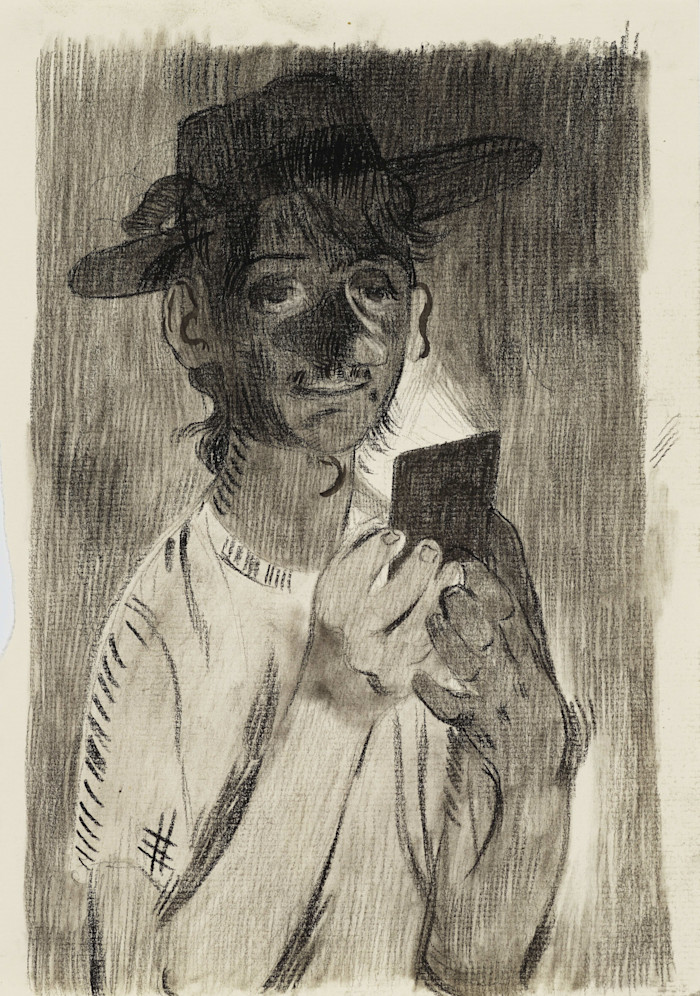
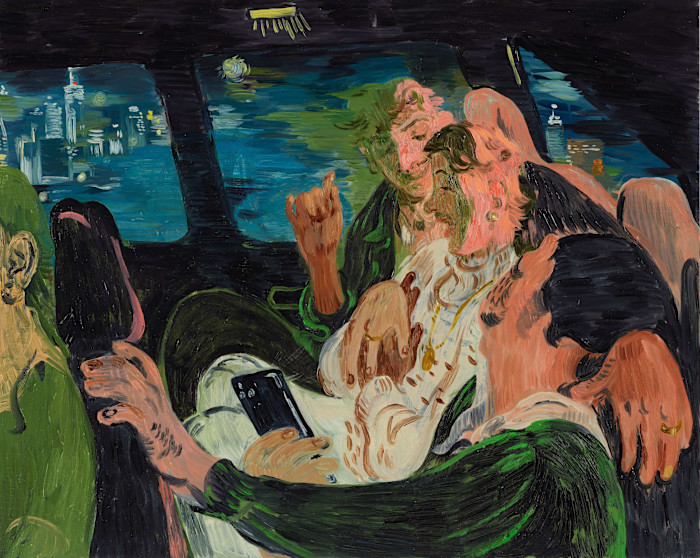
“Bar Boy” (2019), sparked by Flemish and Italian tavern paintings, centres on a pretty-boy ingénu in a Dutch broadbrimmed hat, his saintly face illuminated by a smartphone. While the show’s curator, Elena Crippa, likens him to Watteau’s “Pierrot” (1718-19) in the catalogue, other figures in the bar quote myriad paintings, from finely delineated seducers to shadows like the top-hatted silhouette in Toulouse-Lautrec’s lithograph, “Moulin Rouge: La Goulue” (1891). Toor’s signature green palette (also reminiscent of Toulouse-Lautrec’s ghoulishly uplit faces) both attracts and unsettles, whether emerald or poisonous absinthe — highlighting a pervasive ambivalence in his work. In “Three Friends in a Cab” (2021) with its nocturnal skyscrapers, a hand is draped companionably around a shoulder, while another guides the viewer’s eye to the cab driver’s ear, hinting at the threat of being overheard.
“The Bar on East 13th” was Toor’s “coming out through painting” — still a dangerous act in many parts of the world, the artist tells me. “I made a decision I was going to tell autobiographical stories of safe spaces; I was imagining milieux that didn’t really exist.” The dynamic large-scale painting “Ghost Ball” (2023), with twirling figures flanked by south Asian musicians and a vogueing dancer from New York’s club scene, welds together perhaps irreconcilable worlds. Its composition was inspired by the Pahari watercolour “Dancing Villagers” (c1730), attributed to the Hindu court painter Pandit Seu. Toor’s postmodern approach freely mixes Renaissance perspective with narrative conventions from miniature painting, where, he says, “you can see all parts of the story at once.” In “Back Lawn” (2021), beside an illuminated house, forbidden lovers under a draped tent are flanked by a family gathering and resting drivers beside a pale-blue car — tense elements of a tale the viewer might construct.
Toor, who paints without preparatory drawings, is keenly aware of south Asian precedents, from the Bombay-born painter Bhupen Khakhar, the first Indian artist to address his homosexuality in his art, to the photographer Sunil Gupta, who documented the gay scene of 1970s New York, and who is now the subject of a survey at Kettle’s Yard in Cambridge, Sunil Gupta: Life with a Camera (to January 31). “It’s very important for me to know the story of another generation,” Toor says. “It was my story, too, till I decided to be more out.”
Some paintings evoke a Lahore boyhood in a loving but conservative household. “The Women” (2021) marks a threshold of self-recognition for a boy at his mother’s dressing table. Another key series explores post-9/11 border patrols. In “Man with Face Creams and Phone Plug” (2019), a darkly stubbled traveller bares his personal effects including a pink make-up bag, exposing the absurdities of racial profiling. Like Paula Rego (whose own narrative art stubbornly bucked fashion), Toor’s paintings dramatise power relations. Here, the viewer stands in for the immigration officer deciding the man’s fate. A sketch of a man after a shower acquires political charge through the ironic title, “Towelhead” (2024).
Yet the humour is more often gently self-deprecating or joyous, with the cartoonish pathos of elongated clown noses or marionette-like limbs offsetting the glamour. In the comical drawing “Deluxe Flyer” (2022), an almost supine first-class air traveller tucks in to a meal, his high heels kicked off. The painting “Museum Boys” (2021), in which two ill-clad outsiders peruse a vitrine containing human figures, applies this self-mockery to the artist’s obsession with European painting — whose imperial history he knows.
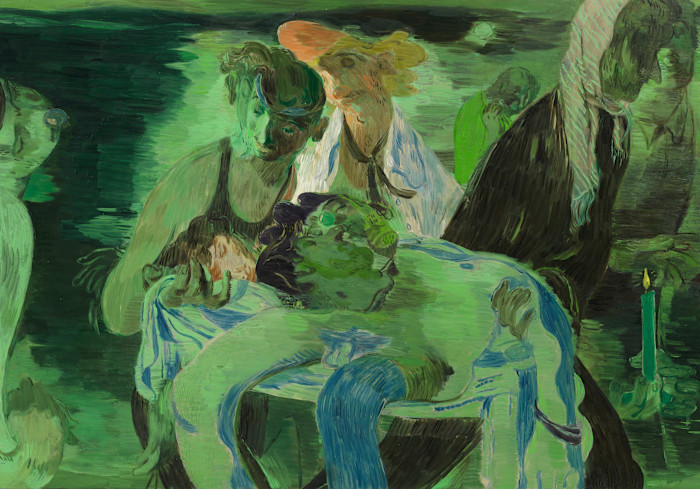
Toor, who coined the term “fag puddle” for the “heap of camp exhaustion and gorgeousness” his paintings frequently depict, gives the term a sombre new inflection with a work made for this show. “Fag Puddle with Carriers” (2026) was inspired by Lorenzo Lotto’s tiny oil painting downstairs, “The Entombment” (1550-55), with its turbaned carriers of Christ. “I felt paralysed by the live-stream coming out of Gaza,” Toor tells me, “so I tortured my way through completing these paintings.” His modern-day moonlit vigil, in which grieving mourners carry a bundle of body parts, extends an already impressive range.
Until January 10 2027, courtauld.ac.uk/gallery/