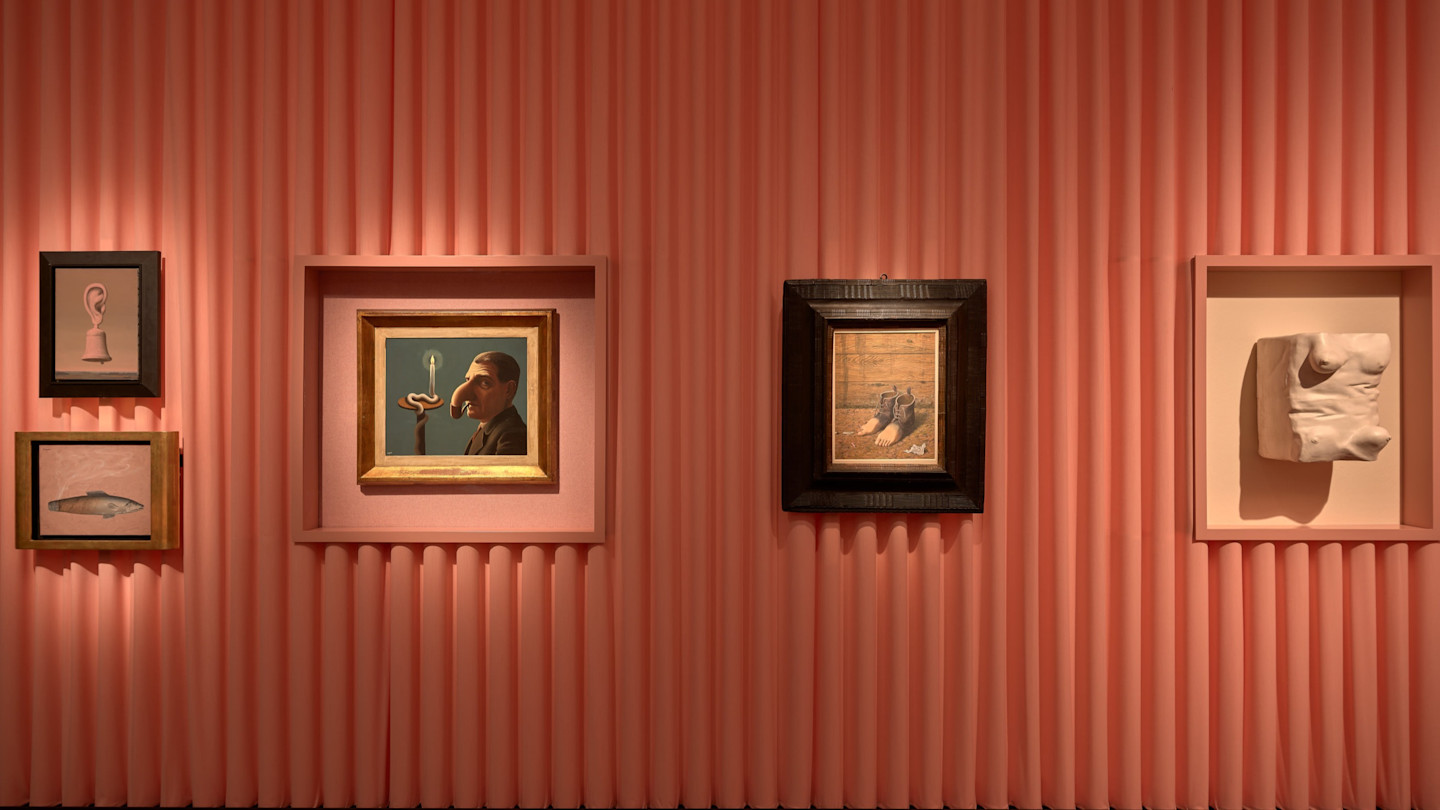
The bowler hat. A pipe. Puffy white clouds. Few artists lodge themselves in the mind quite like René Magritte. “We’re exactly a hundred years on from Magritte making his first surrealist works in 1926,” says Bernard Lagrange, director at Gagosian Art Advisory. “But when I visit studios and talk to artists in general, he’s the name that crops up over and over.” That realisation led Lagrange and Jasper Sharp — working with the Fondation Magritte — to co-curate This Is Still Not a Pipe: The Afterlife of Magritte, a sweeping exhibition of the surrealist master alongside contemporary painters and sculptors (some represented by other galleries), now open at Gagosian’s Grosvenor Hill gallery in London. Here, six of the show’s artists explain the lure of Magritte’s sublimely impossible pictures — and his enduring hold on our cultural consciousness.
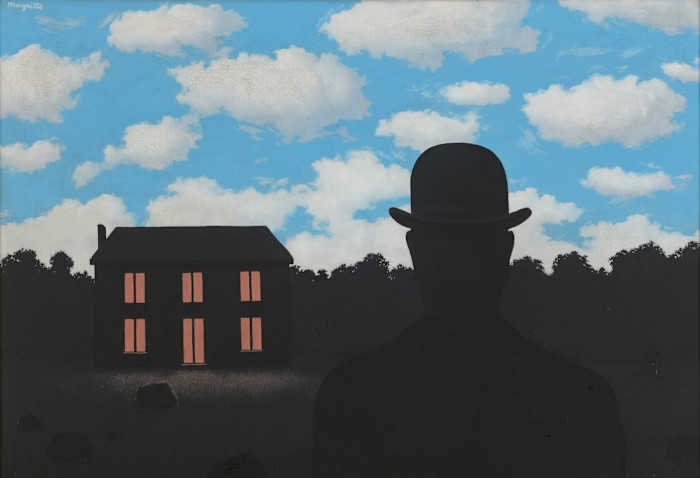
Dana Schutz
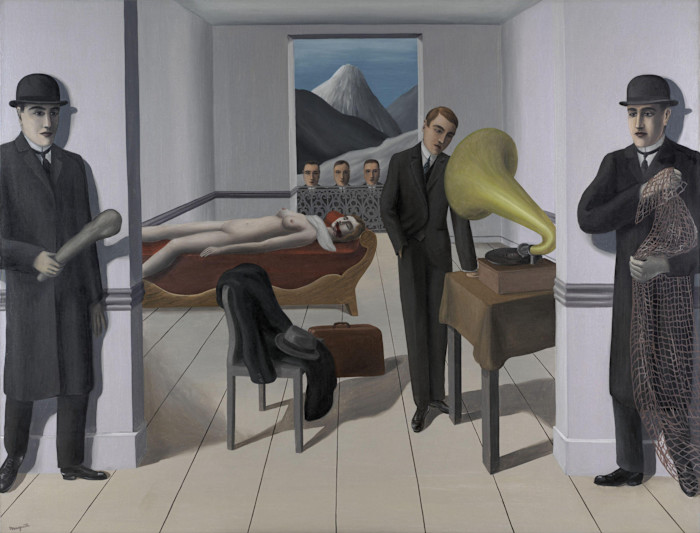
The first time I was struck by a Magritte was as a teenager, in 1993, at the Art Institute of Chicago’s artist retrospective. “The Menaced Assassin” (1927) is such a bizarre, unsettling painting, with a deep sense of paranoia. A dead woman lies on the couch. Two detectives are outside the door. And this man is looking at a phonograph so dispassionately it feels like maybe the whole painting is going on in his head.
Magritte makes a representation of a feeling or a metaphysical situation, and that’s something I’m interested in too. I really love his paintings from 1927 to 1928. They are strangely narrative, with an anxiety to them.
Ironically, while Magritte paints invented subjects, I’ve always looked to him when I need to paint very literal things, like wood grain, pebbles, clouds or water. Having books of his in my studio has been quite helpful over time. I don’t work from photographs and I’m usually painting imagined subjects too. But I turn to Magritte when I’m trying to think: what does concrete look like? What kind of atmosphere is going on in this painting?
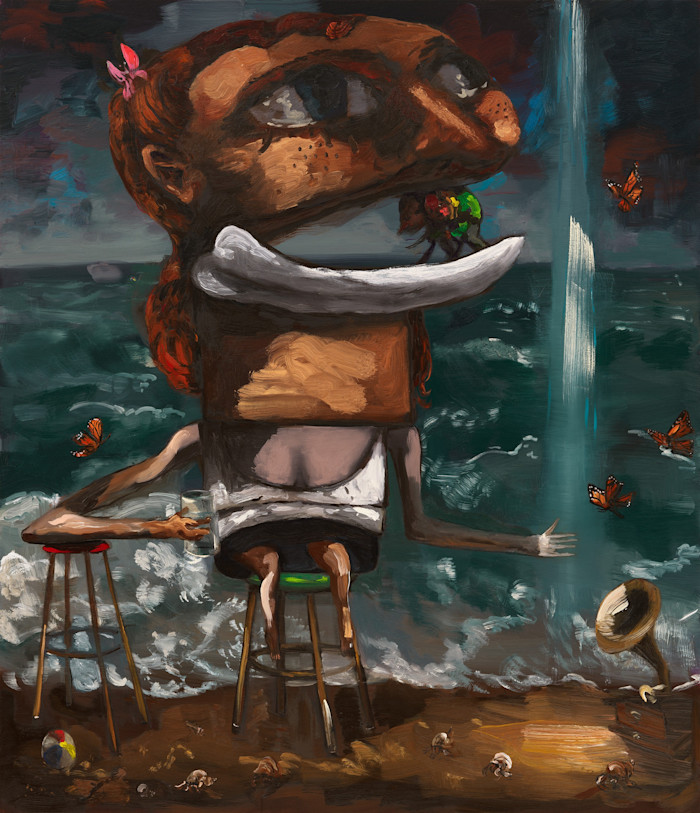
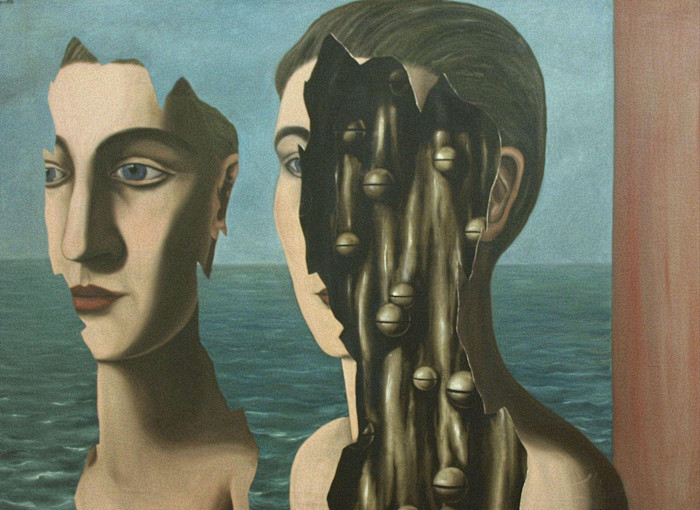
In the This Is Still Not a Pipe show, my painting “The Singer” (2026) takes its palette and setting from Magritte’s “The Secret Double” (1927). Mine depicts a seated woman with a large head and bone for a jaw. She’s like a ventriloquist’s doll, a silent singer. The phonograph is a clear nod to Magritte, but also an allusion to the limits of deception, a kind of voice within a shell.
Anna Weyant
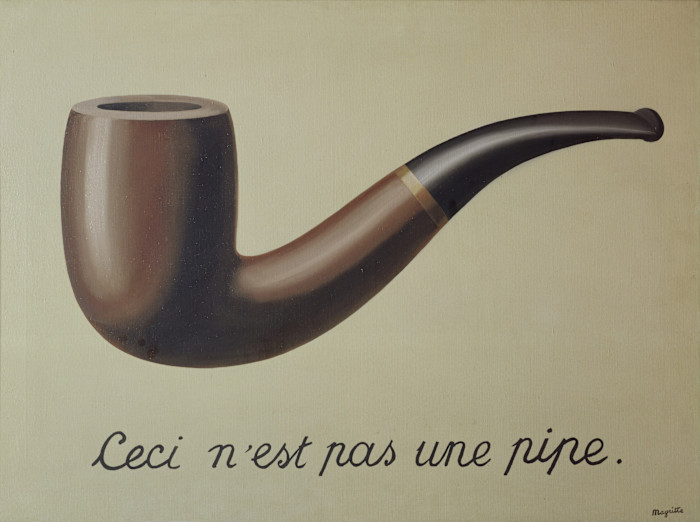
When my younger brother moved into a new apartment, I’d just graduated from the Rhode Island School of Design, and he asked me to make him a replica of Magritte’s famous “The Treachery of Images” (1929). But I couldn’t add the writing “Ceci n’est pas une pipe”. It was too intense for me. Today, that painting feels especially relevant. This isn’t a pipe. But it is a pipe, and we are being told something completely contradictory to reality. We live in an era of political distrust and misinformation. With AI images, it’s also impossible to know what we’re actually seeing and what’s really happening.
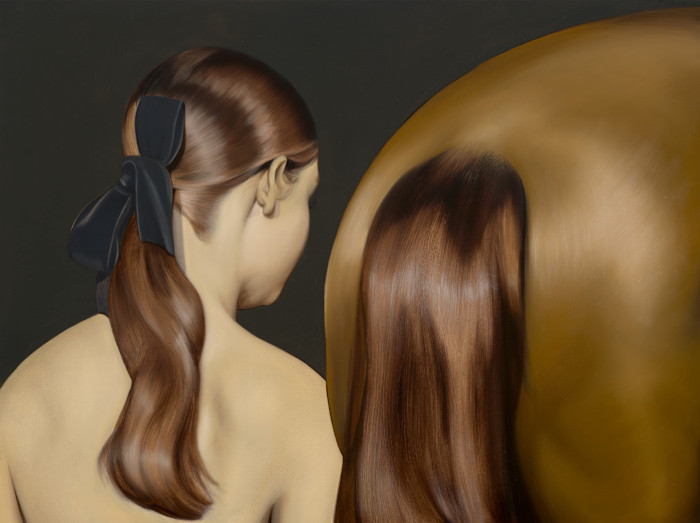
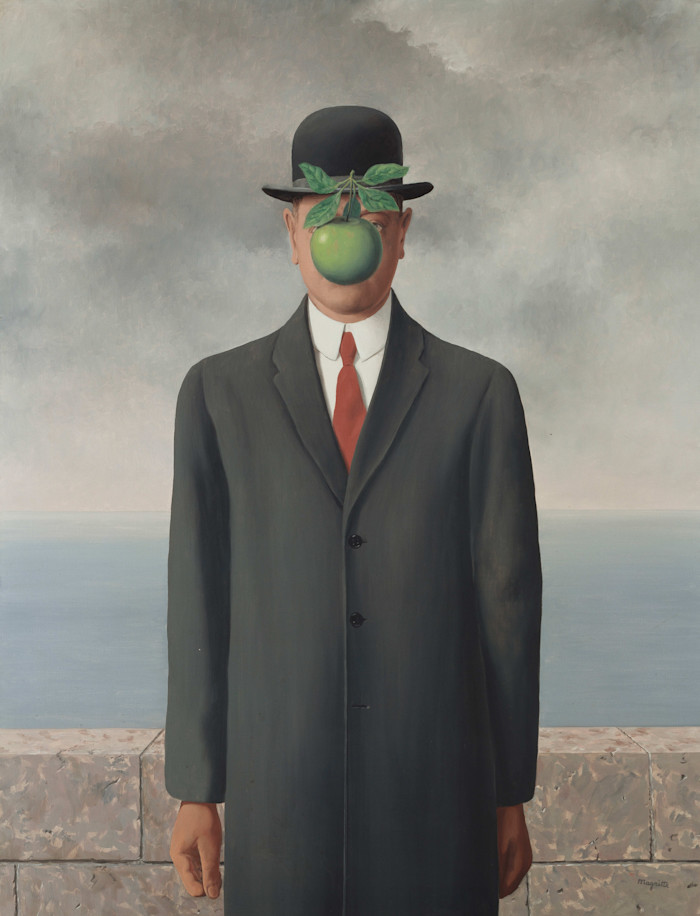
One of my favourite paintings of all time is “Not to Be Reproduced” (1937). The way Magritte paints hair in that image — I will live my life trying to paint hair as good as that. You can see in the work I included at Gagosian, “My Pony” (2019), with the girl’s ponytail, how much I’m influenced by it. The other, “Pilot Episode” (2026), is new for this exhibition. There’s a vulnerable human being, who’s naked and sexualised and needing. I was thinking about a show’s pilot episode. You’re powerless, just hoping it gets picked up. Of course, I was also looking at Magritte’s “The Son of Man” (1964). The green apple floating in front of his face is a physical impossibility. Gravity wouldn’t allow it to exist. It’s an emotional possibility.
Michael Craig-Martin
I’ve never made work thinking directly about Magritte’s. But he plays with the language and conventions of visual imagery — essentially that’s exactly what I do. Of course, when you’re a student you fall on “The Treachery of Images” (1929) and it’s quite an amazing picture. The thing about Magritte is that once you’ve seen it, it’s so memorable, you never really forget it. Every image he’s made is so succinct. He paints in a very matter-of-fact manner but presents things that are absolutely extraordinary.
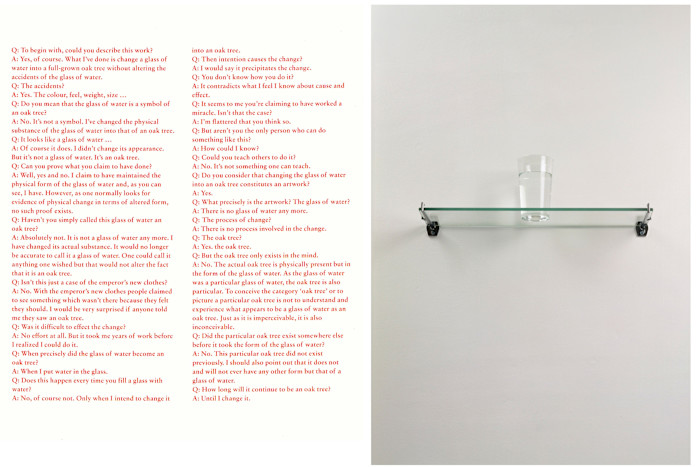
More than 50 years ago, when I came up with “An Oak Tree” (1973), I instinctively knew I’d stumbled on something extraordinary too. It expressed something so complex in such a simple way, a glass of water on a glass shelf. I knew I needed a text to be able to explain what I was suggesting: that the glass of water had, in fact, physically changed into an oak tree. And suddenly I hit on the idea of a dialogue as the perfect way of saying “It can’t possibly be true” as part of the work. The thing that intrigues me about Magritte is how clever he was in using characteristics of an image. Every picture looks like it could be real. An engine coming out of a fireplace, a person looking in the mirror and seeing the back of their head: these are amazingly simple things, and the impossibility of them is so clear. But Magritte presents them in a way that’s completely reasonable. You understand exactly what he’s proposing.
Alex Da Corte
I have a very particular memory at around nine years old, of encountering Magritte for the first time. My uncle, who was the head percussionist at the Philadelphia Orchestra for many years, dressed up for Halloween as the character from “The Son of Man” (1964). He wore a bowler hat and had an apple so you couldn’t see his face.
Magritte famously said that his work was not about dreams, and I maintain that as well. My sculptures are not about dreams, even though people say they’re dreamlike or nightmarish spaces. My work is very much rooted in the world and made of physical materials. But I do think my sculptures embody some of the proposals that Magritte made in relation to objects, when he embeds them in his paintings, as an incomplete slice of the world.
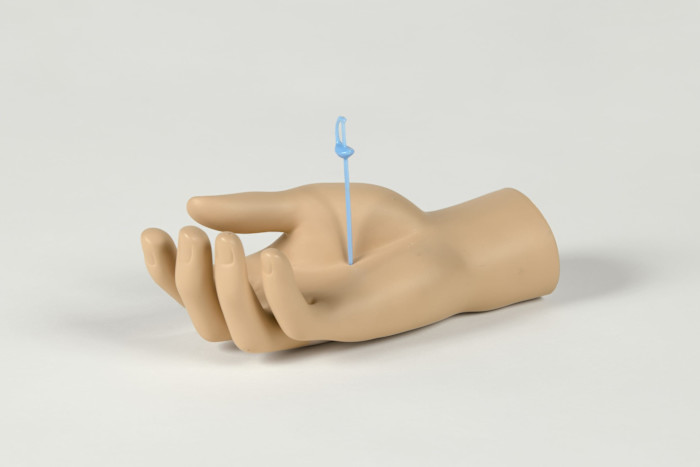
I find Magritte’s work so urgent because it calls into question our relationship to language and its relationship to imagery. Both are always in flux, through our texts to each other and through memes and the introduction of AI. All these issues are baked into Magritte’s practice, asking what an object can do for you and what we do for it. What does technology do to our experience of things? What does the invention of newness do to the old?
Ed Ruscha
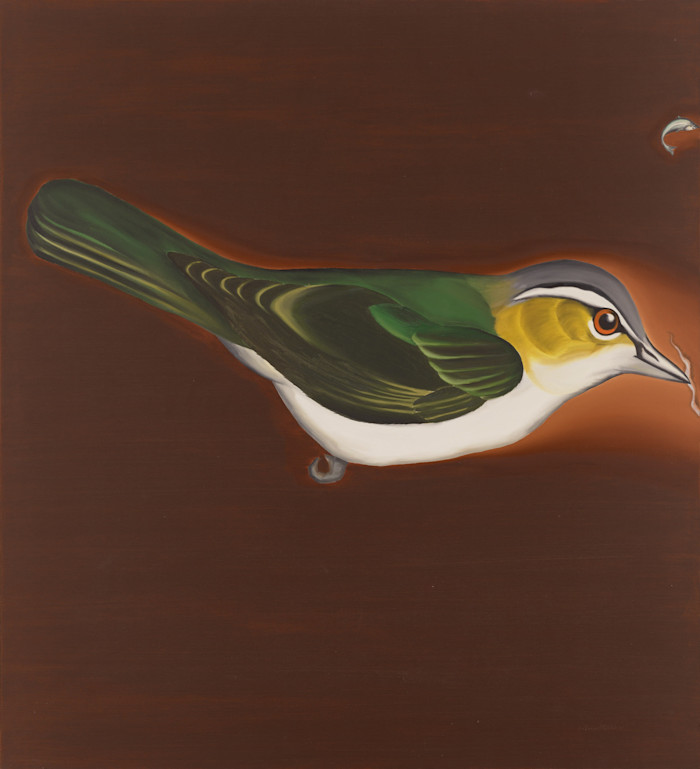
In the summer of 1967, my wife Danna and I were walking over a bridge in Venice, Italy. We looked down to see my art dealer Alexander Iolas in a gondola, passing under the bridge with René Magritte, his wife Georgette and their dog, Loulou. They asked us to join them for lunch. Magritte had a tiny camera which he used to photograph an artist, standing and painting the basilica. Magritte stood behind the artist, much like the Magritte painting “Not to Be Reproduced”. But when we got to Cipriani for lunch, Magritte was turned away for having Loulou under his arm. René said, “Wherever I go, Loulou goes” — after a small fuss, we were seated outside at a very good table in the garden. I recently came across a photograph taken by Lee Miller in the early 1940s of Magritte and a dog, Loulou. This led me to believe that over the years he had several small dogs, each named Loulou.
Maurizio Cattelan
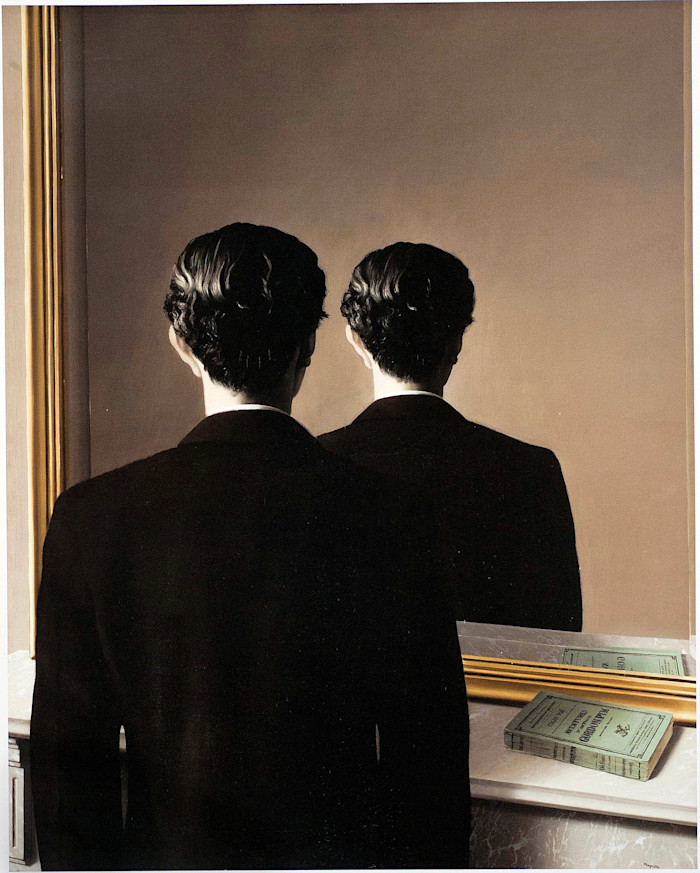
Magritte and I both work with familiar images and objects, then shift their context just enough to make them unstable. Recognition comes first; doubt arrives a second later. I keep returning to “Not to Be Reproduced” — a man looks into a mirror and sees the back of his own head. It’s almost nothing, but it breaks the contract of the image. Magritte was very good at that: changing one rule and making the whole world suddenly unreliable.
To December 12, gagosian.com
Find out about our latest stories first — follow FT Weekend on Instagram, Bluesky and X, and sign up to receive the FT Weekend newsletter every Saturday morning