
Accountants should be whizzes at working out how best to structure and fund their firms. Instead, it turns out there’s a great deal of trial and error.
Take RSM, the fifth biggest of its breed by revenue in the US and seventh globally, now mulling a flotation. It has been here before. The US business spent a decade on the stock market as part of H & R Block. Meanwhile, RSM Tenon, a precursor of the UK sister firm, was publicly traded in London until it met with insolvency and a quiver of fines.
If that doesn’t deter RSM from going public again, there are other things that should at least give it pause — including the tyrannies of regular earnings updates, market gyrations and fickle owners.
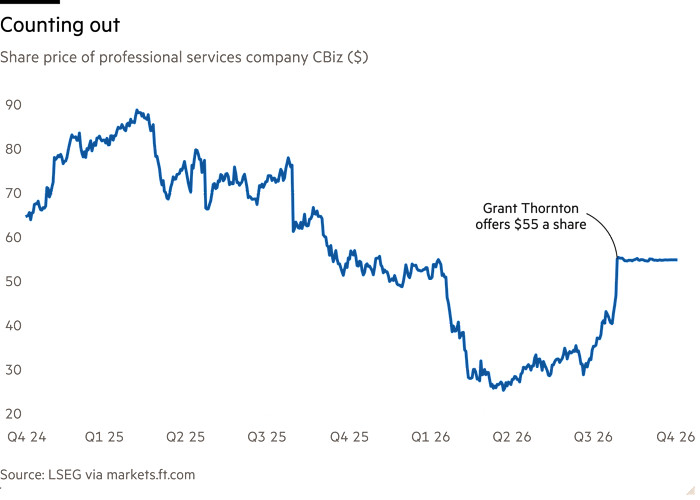
Consider the example of CBIZ, an accountancy firm of three decades’ standing. Its shares have been in a tailspin for much of the past two years, pummelled by earnings disappointments. Grant Thornton in the US, backed by private equity firm New Mountain Capital, swooped earlier this year with a takeover offer. Even that was no higher than the share price just six months previously.
In the broader professional services universe, Accenture and Capgemini have been buffeted by on-off fears of AI detonating a so-called SaaSpocalypse — a reckoning for anyone selling software as a service. Mishcon de Reya, a favoured law firm of the glitterati, abandoned its listing plans twice, initially after partners revolted; smaller DWF languished before private equity rose to the rescue.
Accountancies, and businesses like them, make investors squeamish for good reason. Their main assets are people, and people are liable to leave if they get a better offer. They may be especially inclined to be so if the spoils divvied out among partners must henceforth be shared with outside investors.
Where accountants have an advantage over lawyers, say, is that their earnings are somewhat more predictable. Companies may rein in dealmaking, and thus the fees they generate for their legal advisers, but they still need to be audited. However, that advantage wanes with smaller clients such as start-ups that may fold or be sold. Other clients may use technology, be it AI or simpler apps, to do more of the work themselves.
For companies that want to grow briskly, private equity ownership stacks up better. Look, for example, at the managers who branched out of Big Four firms to launch their own boutiques. Indeed Grant Thornton in the UK, majority owned by private equity group Cinven since 2024, is even pulling ahead in the talent wars by offering graduate trainees higher salaries than they’d receive at the Big Four.
The irony is that it is partly private equity’s role in consolidating the sector that is raising the stakes for other firms: they need to invest more to keep up with their bigger brethren. Shifts towards employing AI and away from the billable hours model mean partnerships are increasingly less sustainable, but there are better alternatives than heading to market.