Good morning. I just spent a very pleasant weekend in Rennes, France — beautiful buildings, amazing food markets, good vibes, rebellious students. Nobody seemed overly troubled by soaring French bond yields, but investors disagree, with wide spreads to German bonds and the euro on Monday sinking to a 17-month low. The Eurozone rates market has been vicious for a lot of hedgies this year, and the Eurozone debt crisis veterans among us are breathing rapidly into paper bags. Meanwhile in Japan, Prime Minister Sanae Takaichi asked bond investors to trust her over fiscal plans. Record-breaking highs in the Japanese 30-year yield suggest this is not going super well. Would you rather hold 30-year France or 30-year Japan? [email protected]
Rock me, Amodei
The upward turn in the dollar last month took quite a few people by surprise, as we pointed out in this newsletter the other day. At 102-ish, the DXY dollar index is now perching at its highest level since the spring of last year.
A large chunk of this ascent is attributable to the rise and rise in Treasury yields. Some of it is about the decline in dollar hedging. But, related to that, some of it also seems to be about AI, which I will refrain from calling SI here even though that would be a nice way to annoy Rob.
The logic here, as laid out last month by another Rob — Rob Subbaraman at Nomura — is elegantly simple. In short, the AI trade, writ large, has been so enormous, and sucked in such huge investment flows from all around the world, that suddenly, the planet is very, very long dollars. The US is the AI trade, and the AI trade is the US capital markets, to a very large degree.
Subbaraman looked at the US’s NIIP — its net international investment position — up to the end of 2025 (so this does not capture this year).
He wrote, in a note alongside colleague Yiru Chen:
US NIIP liabilities (ie, the rest of the world’s holdings of dollar assets) have ballooned because of net capital inflows and extraordinary capital gains from the AI-driven US equity boom . ..
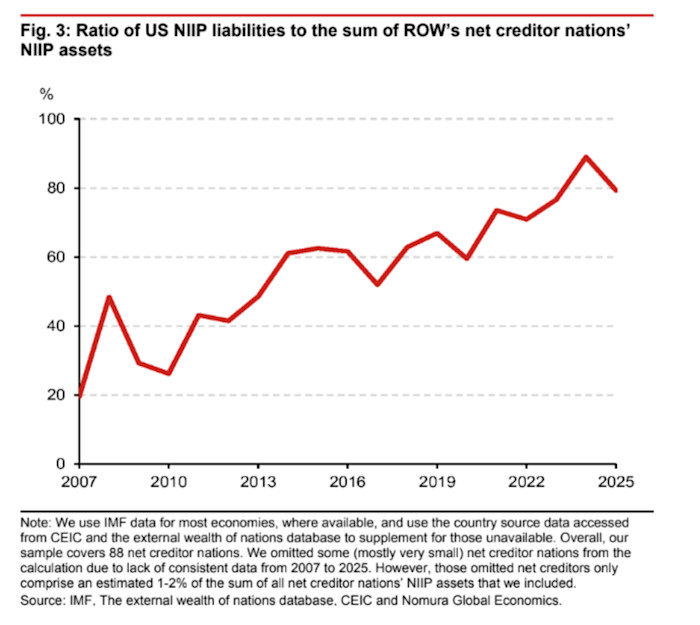
Strikingly, the ratio of US NIIP liabilities to the sum of all rest-of-world net creditor nations’ NIIP assets has surged to 80 per cent — a vivid measure of the concentration of the world’s savings that have been funnelled into dollar investments.
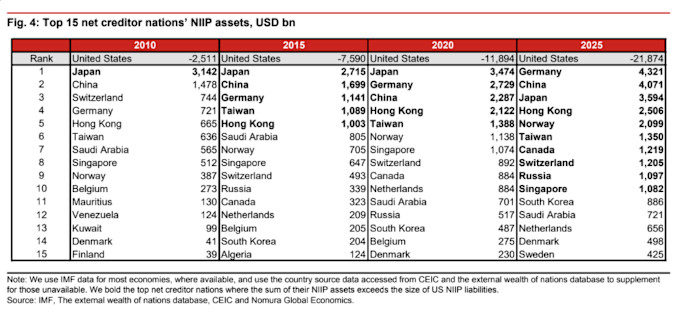
More striking still, in 2010, US NIIP liabilities matched the NIIP asset holdings of the world’s top net creditor nation, Japan.
By 2025, it took the top 10 net creditor nations combined to match the US NIIP liabilities.
For the visually minded/data nerdy among you, that looks like this:
And this:
Now of course, that is all fine until it’s not. But wise readers of this newsletter are all capable of dashing off a list of half a dozen things that could go wrong with the AI trade, from vanishing moats to issues with monetisation to deadly robots and, even more terrifying, lawyers.
If something did go wrong, what would investors do? If they had any sense, they would sell AI-related assets. For non-US investors, that obviously means selling a lot of dollars.
Geoff Yu at BNY makes a similar point, albeit without direct reference to the AI trade, in a report about dollar hedging. From that, this chart shows cross-border US equity and fixed-income holdings net of dollar holdings up to the end of September.
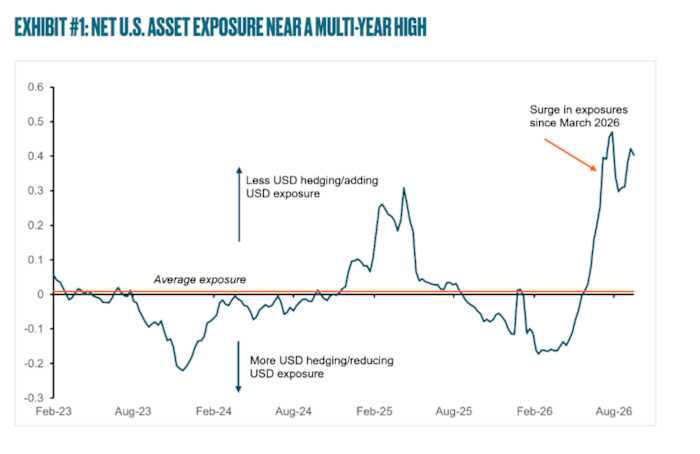
So, again, as we discussed in the last newsletter on this topic, dollar hedging levels have collapsed, very much against the run of expectations. Investors are happily taking on the assets and the currency risk (Yolo!). That means either a reversal in hedging ratios or a big knock to US markets (aka the AI trade) would demand a decent whack of dollar selling by non-US investors.
Normally, the dollar loves a good crisis, even a homegrown one. This type of potential wobble? Not so sure.
This is all theoretical for now, and none of it might crystallise. If it did, we might be talking only about a stumble, and then a recovery. Nonetheless, this all illustrates the power of the world of one trade. Everything is computer.
If you’re keeping score, the things that are borked if AI encounters a serious problem now include:
The entire global stock market
Private markets
The dollar
But on the plus side, it might pull down Treasury yields and maybe stop the robots from killing us? Swings and roundabouts.