Welcome to Trade Secrets. The Trump-Xi meeting recedes into the distance leaving nothing but warm words in its wake and the EU-China conflict comes more sharply into view. European trade commissioner Maroš Šefčovič is in Beijing this week to see how far things have progressed since both sides solemnly agreed to come up with some rebalancing measures. (My bet: not far.)
I’ll get to that issue in future columns and newsletters. Today I’m looking at the shenanigans of President Donald Trump’s threatened export ban on diesel and the subsequent G7 capitulation. Charted Waters, where we look at the data behind world trade, is on equity prices.
Get in touch. Email me at [email protected]
A fuelish endeavour
If you had to design a scenario to show the weaknesses and wrongheadedness of global trade and energy policy at the moment, the diesel saga is it. As Ed Conway, who has just come out with this fascinating book, points out, the global diesel market is much more fragmented and politicised than you’d hope.
Trump’s inane Iran misadventure has driven up global energy prices, with the inefficiencies of the diesel supply chain amplifying that effect. Next, the US president, who never saw a form of intervention that didn’t make things worse in the long run, threatened to restrict diesel exports to drive down the domestic price. As Conway says, it’s not even clear that would work given the fragmentation of the domestic diesel market. For example, the US west coast is quite dependent on imports, so an international diesel shortage might raise rather than lower prices there.
This particular experiment was short-circuited by European governments capitulating — their default response to short-term challenges — by agreeing to release diesel from their strategic reserves. Another win for Trumpian coercion. But in the longer term the US might discover that there is no faster way to encourage your energy customers to diversify than by politicising supply.
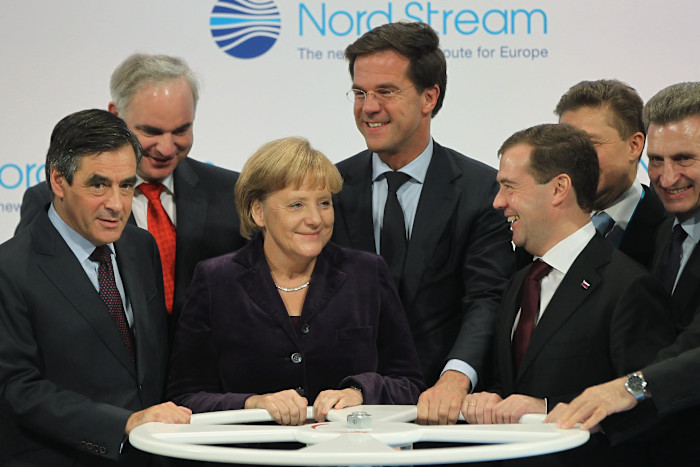
Just ask President Vladimir Putin. Western European countries (well, the pivotal ones) thought it was a smart idea to make themselves ever more dependent on Russian hydrocarbons — anyone studying EU trade and energy policy should have this photo as a screensaver — until they realised it wasn’t, whereupon they moved at a speed few had thought possible to wean themselves off. (Of course, one of the things they replaced Russian energy with was US liquefied natural gas which, as they say, is now item two on today’s agenda.)
As my colleague Gillian Tett points out, the US discovered this phenomenon in the 1970s with an ill-fated ban on exports of soyabeans, which merely encouraged Brazil to emerge as a global soyabean superpower. We might add the 1973 Arab oil embargo, a very similar episode around the same time, which aimed to prevent other countries providing military supplies to Israel during the Yom Kippur war. The boycott did not halt those supplies, though it did kick off a decades-long demand-destruction trend towards reducing oil consumption. Such moves can take a long time, but do happen.
Europe’s responses to challenges are often, shall we put it, non-linear. The continent doesn’t move until a problem gets really big and then it shifts fast, for which see former European Central Bank chief Mario Draghi’s “whatever it takes” approach during the Eurozone financial crisis. The EU has a lot on its agenda, but insulating itself from US diesel supplies in the future has just risen up it.
The UK’s post-Brexit trade deals won’t stop ‘Breversal’
I said I wouldn’t write about the UK again for a while. And yet here I am for the second time in two weeks.
I was all ready, along with a lot of other folks, to scoff mightily at new Prime Minister Andy Burnham’s speech to Labour Party conference. He punted off changes to social care and the electoral system years into the future and sounded fairly vague on EU relations, saying he would lay out options at the next EU summit in November. So far, so fudgy. But the next morning Burnham specified that one option was actually joining the EU. (I’m in the camp that it’s “joining”, not “rejoining”; the UK and EU have both changed since 2016, Heraclitus’s river etc.) Suddenly the debate Labour has tried to stifle has burst free.
You can’t really defer relations with the EU, because the economics and politics nip irritably at your ankles. I wrote last week about the bloc applying pressure on the UK over tariffs on Chinese electric vehicles. The EU may not be right about that one, but it isn’t going to let up the general idea of a common front to China.

One question: do the preferential trade agreements (PTAs) the UK has done since Brexit make joining harder? There’s no doubt that sabotaging joining the EU was one of the Conservative government’s motives for signing PTAs, because it rather childishly said so.
But I don’t think the attempt to create a poison pill has really worked. The homeopathically small effects of said PTAs — for example, the 0.08 per cent increment to GDP from the Australian bilateral deal — have now become well-rehearsed attack lines by Labour. The boneheaded way in which the Boris Johnson government in particular went about signing deals, for example capitulating to Australia to the fury of British farmers, did its image no favours.
Even before Trump’s second term began, the UK public was firmly in favour of prioritising trade relations with the EU over the US. Unsurprisingly, opinion has moved further in that direction since. And while business organisations cheer-led joining, among other things, the Comprehensive and Progressive Agreement for Trans-Pacific Partnership (CPTPP) — they’ll take any win they can — I’d be very surprised if they opposed joining the EU on fears of throwing those gains away.
The benefits of buccaneering PTA-signing were always massively oversold. It’s striking and, in some ways, heartening that the UK public wasn’t fooled by the idea. The priority now should be settling on and pursuing a model that works, despite the many challenges that need addressing, such as the euro. I would only beg for some realism. If we end up back in the cakeism of previous governments — and, thus far, Burnham’s too — there really is no point to anything.
There’s a very long way to go before Brexit might be “Breversed”, and a lot of reasons for opposition to it. But the preferential deals the UK has signed are among the weaker objections.
Charted waters
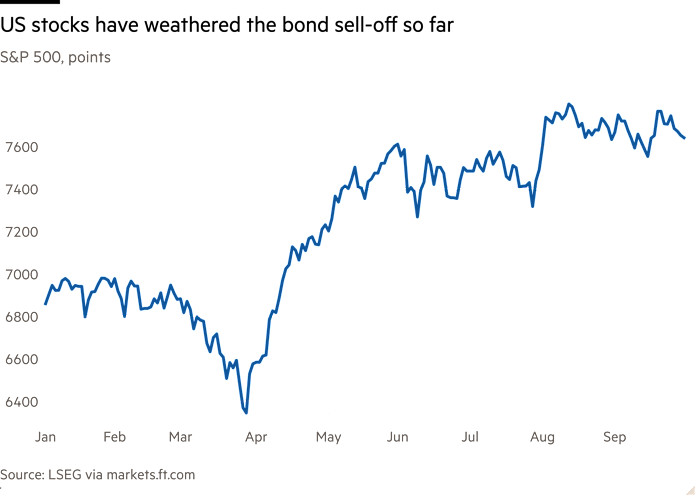
Bond markets are in turmoil and yet equities are . . . fine? Either the bond market isn’t signalling very much about the world economy or stock prices are in their own bubbly world.
Trade links
A Centre for Economic Policy Research (CEPR) paper by Sébastien Jean and Jean-Pierre Landau on global imbalances and the China challenge.
The FT reports that the use of Arctic sea routes by freight ships has quadrupled since 2022, albeit from a very low number, because of melting sea ice and the Iran conflict.
An in-depth look by the FT about China extending its technological and production lead in batteries.
Anyone hoping that the EU-China trade conflict might diminish ahead of the forthcoming EU-China summit was disappointed by Beijing launching a bunch of fresh anti-dumping actions against the bloc in retaliation for Brussels doing the same the week before.
In light of the Manchester City finances saga and the quasi-state nature of its owners, a reminder from 2020 of how the Saudi takeover of Newcastle United was threatened by a World Trade Organization ruling brought by Qatar that changed the English Football Association’s test for owners and directors.
Analysts at ING have published a good piece on the continued vulnerabilities in the US rare earths supply chain.
Trade Secrets is edited by Harvey Nriapia