
It took 20 years for computers to eliminate the typing pool, 30 years for the electric lightbulb to transform factory floors, generations for tractors to erode the agricultural workforce.
Anthropic’s chief executive Dario Amodei contends AI will halve entry-level white-collar work by 2030. Microsoft’s co-founder Bill Gates warned that in a decade “without the right policies, there will be far fewer [jobs] than exist today”.
Most economists are sceptical about Silicon Valley’s doom-laden prophecies, arguing previous predictions that automation would wreak job market Armageddon — including a widely cited 2013 study warning half of US jobs could vanish within a decade — have failed to materialise.
“Ever since numbers started appearing . . . all the numbers have been proved wrong!” noted Nobel laureate Sir Christopher Pissarides, co-founder of the Institute for the Future of Work.
Yet as warnings over AI’s destructive potential intensify, working out its likely effects on labour markets has become “almost the only topic around economics”, according to Simon Johnson, the former IMF chief economist heading the UK’s new AI Economics Institute.
Economists do not see a future without jobs. But they do see scope for rapid, disruptive change in the nature of work — with no guarantee that gains from the technology will be evenly shared.

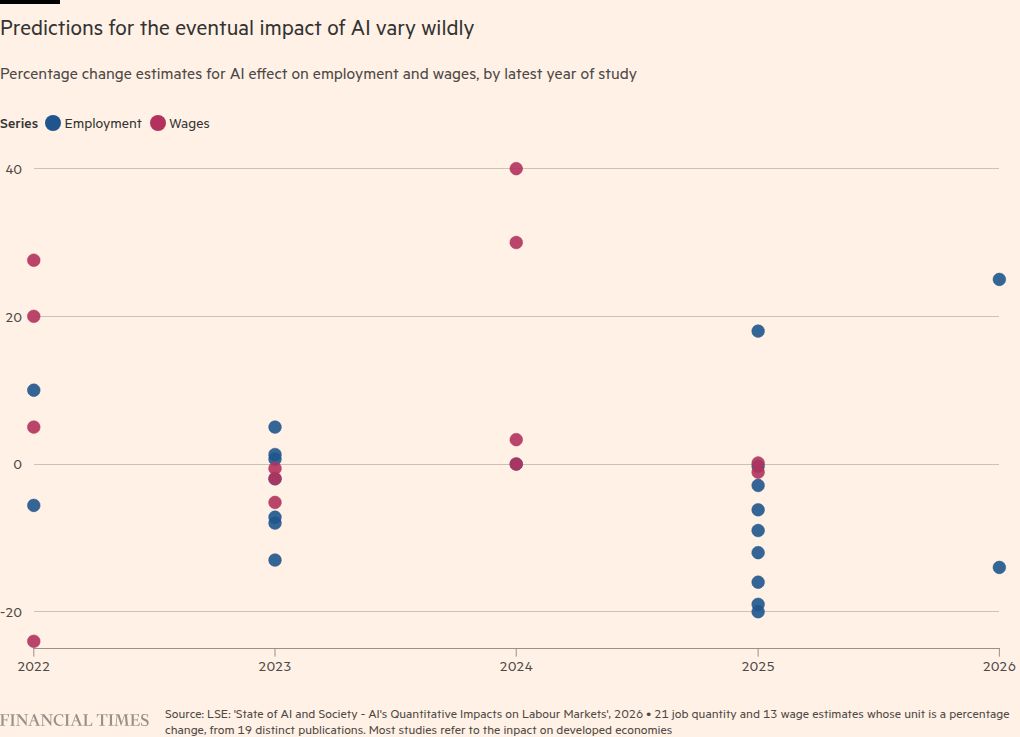
Predictions for the eventual outcome vary wildly.
Research, led by Cosmina Dorobantu at the London School of Economics, analysed 74 studies of AI’s actual and potential impact. The recent report said: “Anyone looking for a figure of AI’s effect on employment can choose from estimates ranging from minus 20 per cent to plus 25 per cent. For wages, the range runs from minus 34 per cent to plus 40 per cent. Selecting a single headline number . . . is a decision about which story to tell.”
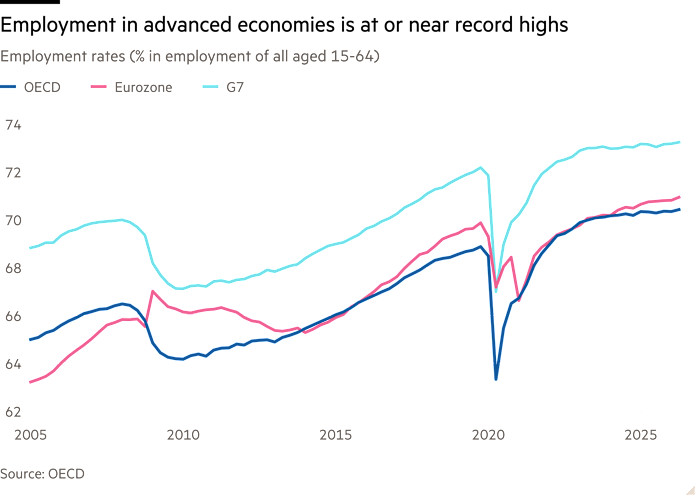
Few signs exist of AI killing jobs across the global economy. Even in the US, where adoption is most advanced and recent data shows payrolls are down in sectors such as finance, the Yale Budget Lab has found no clear evidence of it changing the mix of occupations in the workforce or putting graduates out of work.
“Employment rates in most OECD countries are still near record highs, despite some recent signs of weakening,” noted Stijn Broecke, who leads research on AI’s job market effects at the Paris-based OECD. It has just run a survey of 8,000 employers in 13 countries, which suggests only one in 10 of those adopting AI are cutting headcount — and just one in 100 is doing so mainly because of AI.
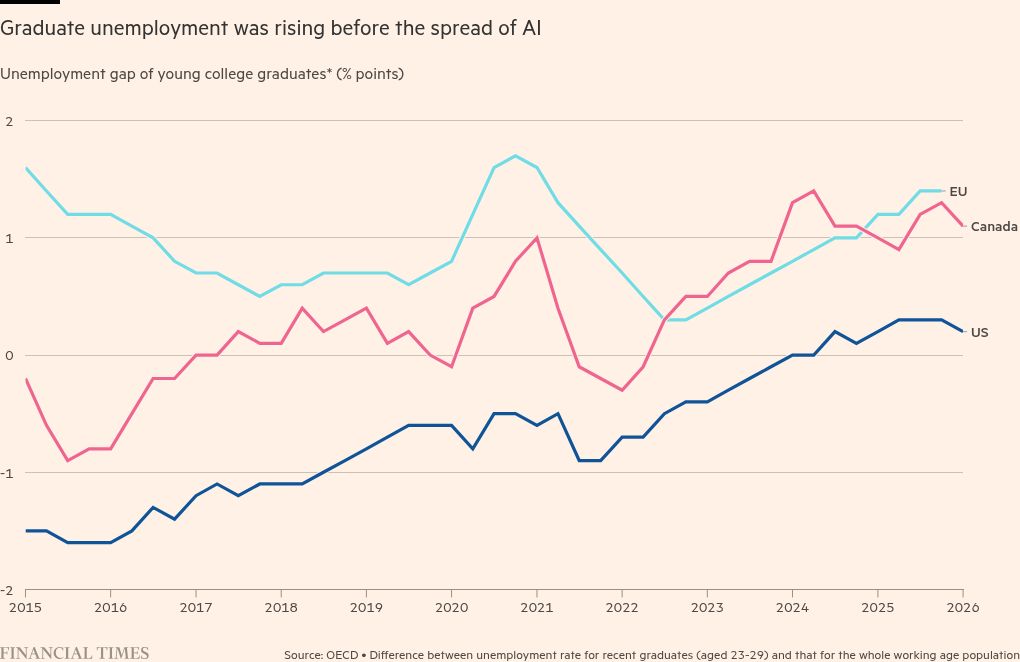
The most worrying development is a cross-country slowdown in entry-level hiring in tech-related occupations — consistent with AI turbocharging the productivity of senior staff while taking over routine tasks done by juniors.
But there is no consensus on the cause. “Unemployment of young graduates has worsened since 2015. It’s a long-term trend. AI is clearly not the only factor,” Broecke argued, citing a potential oversupply of graduates, the rise of remote work and high interest rates.
The absence of aggregate job losses may simply be the calm before the storm.
“Talk to executives in the non-tech sector — those who use AI as customers — and many say they don’t need as many workers as they did before AI,” Johnson said. “It is not yet in the numbers . . . but the automation threat is very real.”
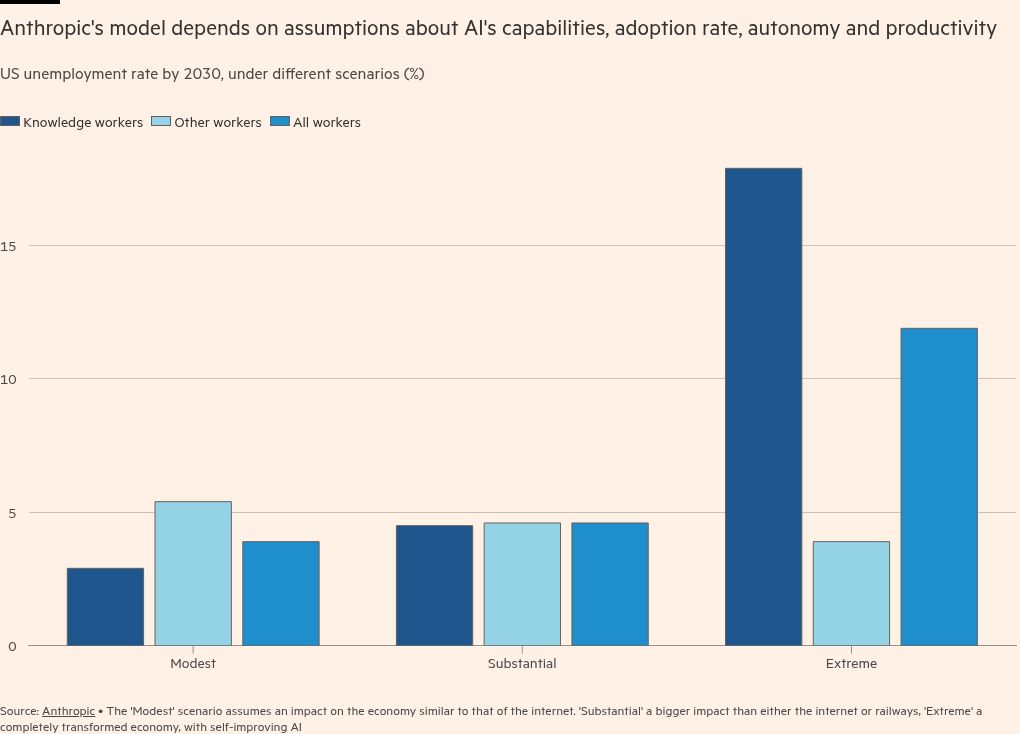
Modelling by the Anthropic Institute, published last month, included an extreme scenario where rapid gains in AI’s capabilities cut “cognitive” employment by a fifth by 2030, leaving one in five white-collar workers and one in 10 of all workers unemployed.
The model is highly sensitive to underlying assumptions. The extreme scenario assumes AI will rapidly become able to perform most tasks without human oversight, will be widely adopted and will generate big productivity gains.
Other scenarios show more modest change, but Anton Korinek, who led the modelling, said he “personally put more weight” on those showing a rapid increase in AI adoption from 2028, with the technology becoming able to rival and replace senior executives, not just entry-level staff.
In practice, companies may be slow to shed workers even when AI tools can do the job.
Broecke of the OECD said: “There is the cost of technology. There are legal barriers, social preferences, ethical issues. There are all sorts of reasons why something that is theoretically possible will not happen in practice.”
More alarming forecasts are generally based on measures of so-called exposure to AI — looking at its ability to perform the many different tasks that make up a role.
These studies of potential exposure to AI are “a good first pass” but they overstate likely job losses, according to Ronnie Chatterji, chief economist at OpenAI, as typically “tasks are not weighted by their importance to the job or the wage” and they do not take account of barriers to organisational change or the way roles can evolve.
“A job is not a task,” agreed Luis Garicano, professor at the LSE’s School of Public Policy.
All jobs comprise “bundles” of tasks, Garicano argued. Some, such as translation or copywriting, may be relatively easy to split up and automate. Others — including nursing or politics — are primarily based on relationships. In the middle are what he calls “messy jobs”, with “tangled sets of tasks that are hard to separate”.

He gives an example of consultants, who might spend two weeks analysing data to redesign a loyalty programme but months figuring out how to tweak it so stakeholders are happy and commit to implementing it. AI can write the PowerPoint presentation — but it reflects “a whole set of meetings”, he said.
Economists argue bleaker forecasts also tend to play down the potential for AI to create new jobs.
This is partly a failure of imagination, optimists say. A 2024 study by economists at the Massachusetts Institute of Technology found the majority of job occupations in the US — including novelties such as tattooists and hypnotherapists — only emerged after 1940.
Employment could also rise in existing occupations that have higher demand because of AI. Telecoms engineers are in high demand for data centres. If AI boosts overall prosperity, people may have more to spend on labour-intensive luxuries such as spa breaks.
Even in areas where AI is labour-saving, the overall effect on jobs could be positive if prices fall far enough to pull in new customers — for instance if legal advice becomes cheap enough for more people to afford lawyers.
“I’m bullish on humans having a lot to do,” Chatterji of OpenAI said, noting countries often spend more on health and education as they become richer, so gains from AI could be “put into lowering class sizes and providing more healthcare”.
If AI does eradicate jobs, though, it could also cut consumer demand — and in gauging the aggregate effect, “it is not obvious which way it would go”, Korinek said.
One area where tech bosses and economists agree is governments do not have to wait for the AI revolution to play out. Gates has argued certain jobs should be designated as “human reserved”.
Raghuram Rajan, India’s former central bank governor, is among many voices arguing for a “token tax” on AI usage, to make sure companies do not adopt labour-saving AI purely “because it costs less in taxes than human effort”.
Others argue governments should worry less about whether AI is killing jobs and more about whether it is deskilling workers, squeezing wages and creating new divisions between winners and losers.
Pissarides’ main concern is that it will worsen existing inequalities if a few dominant players capture the gains. “It is very unlikely that strong monopolies lead to more equality,” he argued. “Who is going to make nurses or hotel employees get good pay rises if AI increases the productivity of managers?”
Data visualisation by Keith Fray in London
How is AI affecting your work and everyday life? Please let us know via this FT survey.