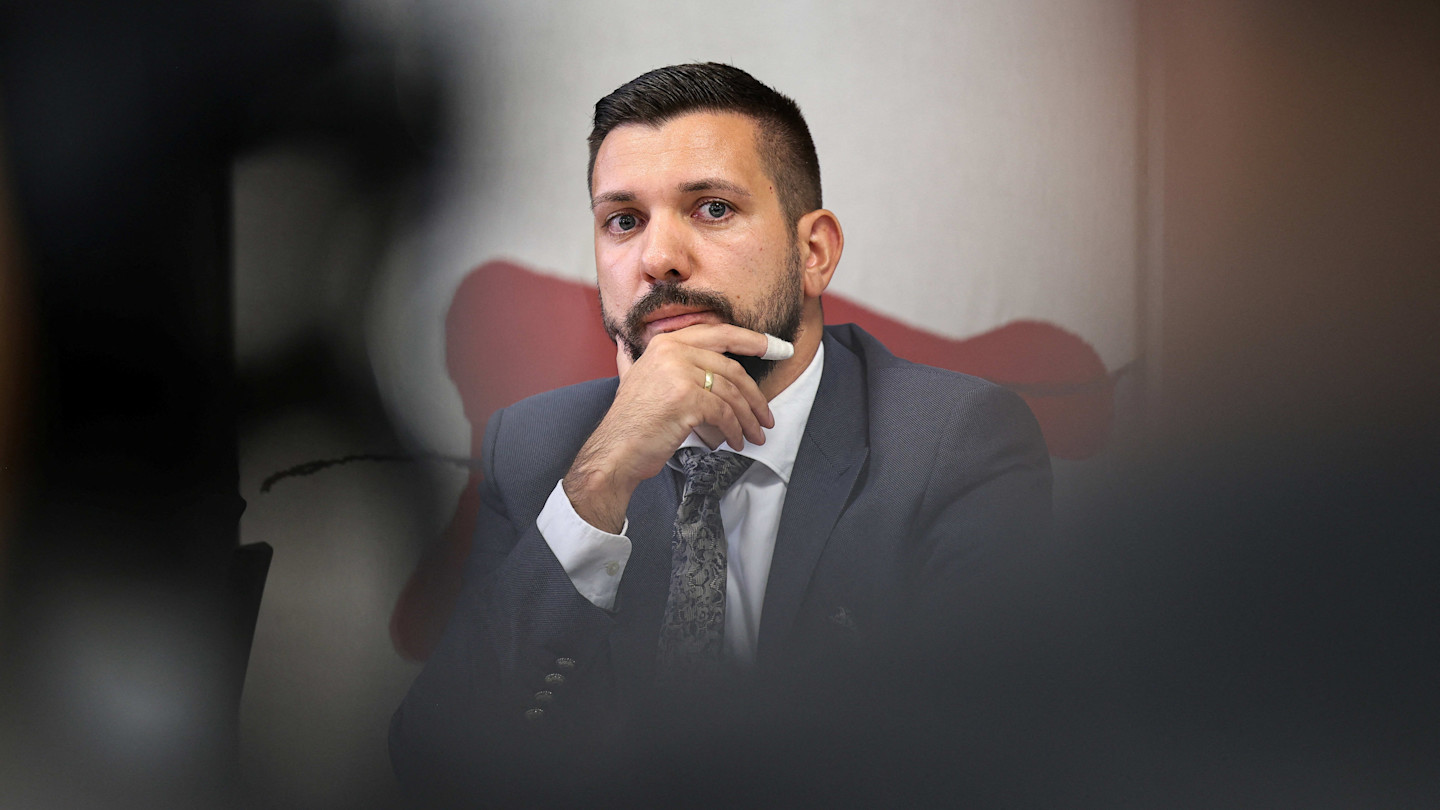
The far-right Alternative for Germany secured its first president of a regional parliament on Tuesday with the help of secret support from four members of established political parties.
The AfD’s Tobias Rausch, a 35-year-old real estate manager who was at the centre of a recent nepotism scandal, was elected as the parliament convened for the first time since his party won a landslide election victory in the state of Saxony-Anhalt.
Rausch became president — a role akin to that of speaker in Britain’s House of Commons — with the help of the hard-left Bündnis Sahra Wagenknecht (BSW), which said beforehand that it would lend its five votes to the far-right party.
Despite all other political parties officially ruling out co-operation with the AfD, Rausch also won the support of four other unknown members of the Landtag, or regional parliament, in the secret ballot. The AfD has 39 seats but he won 48 votes.
That means that, along with the BSW support, he secured the anonymous backing of representatives from one or more of the other four parties in the Saxony-Anhalt parliament: the anti-capitalist Die Linke, the Green Party, the centre-left Social Democrats (SPD) and Chancellor Friedrich Merz’s centre-right Christian Democratic Union (CDU).
Asked where the support for the AfD candidate came from, the party’s regional chair Martin Reichardt told the news outlet t-online that it was “probably not from the ranks of the Left, the Greens or the SPD”.
Thorsten Frei, chair of the CDU in the national parliament in Berlin, said that the unexpected votes for the AfD were a “grave concern.” But he said that any suggestion that they came from his party was “pure speculation.”
In comments likely to put strain on Merz’s ruling coalition, German vice-chancellor Lars Klingbeil said that the result “breaks a taboo”. The SPD co-leader added: “It is not only the BSW but also the CDU that urgently needs to explain how this could have happened.”
The votes from four mystery figures will offer a major boost to Ulrich Siegmund, the AfD’s candidate for the post of minister president, the region’s top political role. Siegmund is seeking to secure the necessary political backing to form a government in the region of 2mn people.
If he succeeds, he will become his party’s first premier of a German state, gaining real power over education, policing and some aspects of migration policy.
Siegmund, a 35-year-old former room-fragrance salesman, said last week that he planned to hold a vote to enable him to take office in December — and that he expected to be elected “with a significant majority” in the first round.
Tuesday’s result will also probably deepen the debate about the longevity of the “firewall” maintained by all major German political parties around the AfD, which has been officially designated as rightwing extremist by the domestic intelligence service.
Although Merz remains committed to ostracising the AfD, he has faced pressure from some figures within the CDU to abandon that stance.
The AfD won almost 44 per cent of the vote in regional elections in Saxony-Anhalt on September 6 after campaigning on a hardline platform that railed against “culturally incompatible” foreigners and promised to deepen ties with Russia.
The record result for the anti-immigration party was hailed as a triumph by the AfD’s national leadership and sent shockwaves through Germany’s political establishment. Alice Weidel, the AfD’s national co-leader, called it “a great success!”.
Rausch’s election represents a symbolic moment for the AfD, which was founded in 2013 and has surged from the political fringes to its position today as the leader in national opinion polls.
He used his inaugural speech to call for “the era of political firewalls” to be a “thing of the past”. Rausch added: “Political conflict is part of democracy. The decisive factor is how we manage it.”
The speech was met with dismay by members of the opposition. The leader of the Green Party in the Saxony-Anhalt parliament, Susan Sziborra-Seidlitz, said: “With the election of a member of a confirmed far-right and anti-constitutional party as president of this house, a line has been crossed.”
Rausch will be the highest-ranking representative in protocol terms in the central German state, representing it externally at ceremonies and events. He will also be in charge of running plenary sittings in the parliament, calling speakers and enforcing rules.
He himself is a contentious figure. He was caught up in the nepotism scandal that involved a string of senior AfD officials in Saxony-Anhalt using an elaborate system to employ each other’s relatives using public funds.
Three of his siblings were employed in the Bundestag office of an AfD member of parliament from the region — an arrangement that he said he had no involvement in.
Hans-Thomas Tillschneider, an AfD hardliner who has called for German schools to teach “more Bismarck, less Hitler,” was also elected as one of the Saxony-Anhalt parliament’s vice presidents.
The SPD’s candidate for vice-president was rejected.