Democrats must focus on affordability issues to win back Black voters who stayed away from the polls in 2024, said party grandee Jim Clyburn, one of the US Congress’s longest-serving members.
Clyburn, a veteran of the civil rights movement, also warned Black voters not to be seduced again by President Donald Trump and his Republican Party, whose policies, he said, had opened up “racial faultlines” in the US akin to “Jim Crow 2.0”.
“Fool me once, shame on you; fool me twice, shame on me,” he said in an interview with the FT. “A lot of Black folks got fooled. They can be forgiven, but [if] they make the same mistake a second time, that’ll be on them.”
Clyburn said only 59 per cent of Black voters participated in the 2024 election, compared with 71 per cent of white voters — and party leaders deserved some blame too. “The failure was probably on our part . . . the motivators,” he said.
The problem with Democrats, he said, was not the “message” but the “methods” — too many television ads and not enough direct engagement with voters to explain how their proposals will improve their lives.
A former House majority whip, Clyburn, 86, is one of the most influential Black politicians of his generation and an important bridge between the civil rights movement of the 1960s and today’s Democratic Party.
He was speaking in his hometown of Sumter just weeks ahead of midterm elections that will determine which party holds power on Capitol Hill and shape the final two years of the president’s second term.
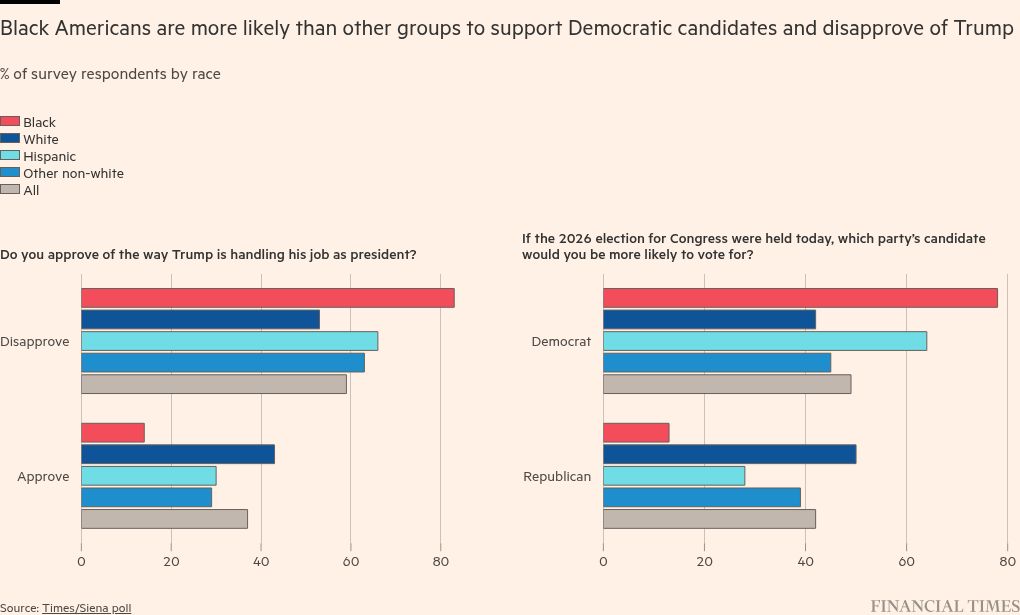
Polls suggest Democrats are on course to wrest control of the House of Representatives and maybe the Senate from the Republicans, with Trump’s approval rating cratering at about 30 per cent according to an FT poll.
Guy Chazan, US national correspondent, discusses with Congress member Jim Clyburn the Black vote ahead of the midterms elections
Black Americans’ votes could prove critical to the party’s success. They tend to vote Democrat, but shifted markedly to Trump in 2024, fuelling Republican hopes of a fundamental realignment in favour of their party.
According to Pew Research, the president nearly doubled his support among Black voters between 2020 and 2024, from 8 to 15 per cent.
An 18-term Congress member, Clyburn has significant sway with Democratic voters. He said Republicans should brace themselves for a backlash over Trump’s policies that had opened up deep racial “faultlines” in the US.
“These people who attempt to exploit racial differences are reaping a reaction that they did not expect to come,” he said.
He took aim at newly redrawn electoral maps adopted by Republican-controlled legislatures in southern states, claiming they were designed to dilute the power of Black voters.
He said Black voters would react “in their own self-interest” when they saw Republicans trying to undermine their “ability to choose their own candidates”.
Mike Marinella, spokesperson for the National Republican Congressional Committee, said he had seen no evidence that Black voters were rejecting the Republican Party.
The party has been working “relentlessly to continue to earn the trust of Black voters in every community through historic tax cuts, safer streets and a secure border”, Marinella said.
“House Democrats have taken too many voters for granted, and families across the country want nothing to do with their radical socialist policies that will make life harder,” he added.
But Andra Gillespie, political scientist at Emory University in Atlanta, Georgia, said Black voters who backed the Republicans in 2024 out of frustration with then-president Joe Biden’s handling of the US economy had been disappointed by Trump’s performance.
Polls show anger at high living costs and inflation — in particular the surge in diesel and petrol prices caused by Trump’s Iran war — has heavily eroded Republicans’ popularity.
“Black voters, because of their persistent socio-economic inequality, are more likely to be sensitive to these types of issues,” Gillespie said. “People who were willing to try something different now have had two years of being dissatisfied with what they’ve seen.”
However, this does not mean Black voters will turn out for Democrats in November. In Michigan, polls show the progressive Abdul El-Sayed has work to do to win over Black voters in the state. Though he won the August Democratic primary statewide, he lost in Detroit, where three-quarters of the population are Black.
Clyburn has been an outspoken critic of Trump’s policies, especially those that he says have had a disproportionate impact on Black households. These include the rollback of diversity, equity and inclusion programmes, drastic reductions in the federal workforce and cuts to food stamps and Medicaid, the US government health insurance scheme for people on low incomes.
But he believes the furore over redistricting could have the most impact on the mood of Black voters.
Clyburn was among the most outspoken critics of a controversial Supreme Court ruling from April that struck down a Louisiana congressional map creating a second majority-Black district, calling it an “unconstitutional racial gerrymander”.
That judgment allowed a number of southern states to try to get rid of their own majority-Black districts. Tennessee’s Republican-controlled legislature voted in May to split the city of Memphis and its surrounding county among three congressional districts, all of them majority-white.
“You may not be suppressing, but you’re diluting” Black votes, Clyburn said — and voters would notice, he added.
Clyburn likened Trump’s rightwing agenda, embodied in the Project 2025 blueprint for his government published by the Heritage Foundation, to a new era of Jim Crow, a reference to the system of laws and practices that enforced racial segregation and disenfranchised Black voters in the American South until the civil rights era.
“Project 2025 is Jim Crow 2.0,” he said.