
A sharp sell-off in US government bonds is starting to reverberate across corporate America, forcing companies to overhaul their borrowing plans and even raising the spectre of defaults among the most lowly rated businesses.
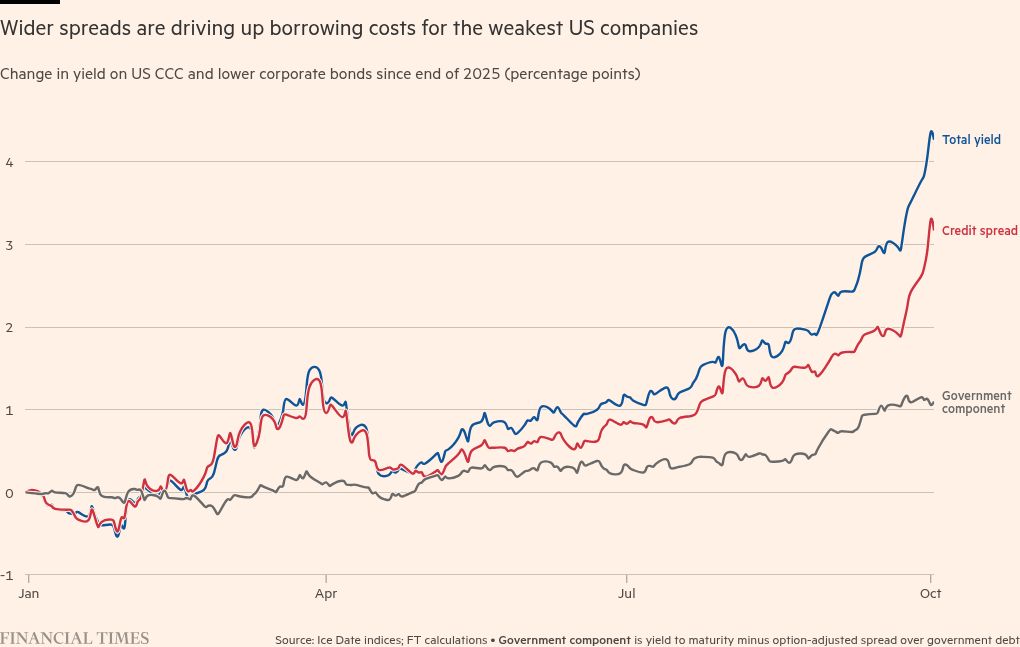
Borrowing costs for companies with the lowest credit ratings hit their highest level since May 2020 this month at 17 per cent, driven by the rise in Treasury yields to multiyear highs and by investors demanding more compensation for lending to such businesses.
The risk premium for companies rated triple C or lower has risen to 12 percentage points, the biggest since 2022.
Analysts said companies with floating-rate loans, and those needing to refinance debt in the coming months, were most at risk from the government bond sell-off, which last week pushed the yield on the 10-year Treasury note to its highest since 2002.
“Investors are increasingly demanding more compensation for taking on the corporate credit risk,” said James Reilly, a senior markets economist at Capital Economics.
In a sign of the chilling effect of the ructions in the Treasury market, Bank of America has cut its forecast for the amount of dollar-denominated investment-grade debt that companies will sell this month to $110bn from about $160bn.
Among corporates, investor nervousness is already being felt on some deals. US media conglomerate Paramount Skydance last week sold $52bn of debt to fund its $110bn acquisition of Warner Bros Discovery.
Unusually, demand for Paramount’s two-year bonds was almost double that of 30-year bonds, according to people familiar with the matter, in a sign of investors’ worries over interest rate rises hitting the value of longer-maturity debt.
As a result, investors were allocated more long-term debt than they had expected, leading to a significant sell-off after the bonds debuted on the market.
“At the margin, we are seeing some deals pulled or delayed as investors become more selective. The weak performance of Paramount Skydance’s second-lien bonds, with the 2036s down several points from issue, is a sign of this,” said James Carter, co-head of fixed income at wealth and investment management firm W1M.
Many companies prefer to sell debt with shorter maturities at the moment to give themselves the chance of refinancing at lower rates in the future.
“They don’t want to lock in high financing costs right now,” said Erin Brown, co-head of global capital markets Americas at BNP Paribas. “Accessing the market now requires more game planning.”
US spice and sauce maker McCormick told investors last week it was evaluating the currencies, duration and ratio of fixed and floating rates for the debt it plans to issue as part of its upcoming mega-merger with Unilever’s foods business, given the recent sharp rise in borrowing costs.
“This is on the mind of investors these days, so we are staying very close to market dynamics as we continue to really evaluate our debt financing strategy,” Marcos Gabriel, McCormick chief financial officer, said on the company earnings call.
The magnitude of this year’s rise in bond yields might typically be expected to hurt the entire market, from the weakest companies to the highest rated.
However, a significant chunk of investment-grade borrowing this year has been unaffected, dominated by companies building out AI-related projects who believe the existential urgency to build data centres trumps an extra percentage point or two in borrowing costs.
But a further rise in Treasury yields could lead to broader pain across credit markets, analysts say. When it comes time to refinance existing debt, higher rates risk jarring the many companies that took on debt when interest rates were at rock-bottom levels in the early 2020s.
Moody’s estimated last year that a record $1.45tn of US investment-grade corporate debt would come due between 2026 and 2030. Rising rates will put pressure on businesses to increase profits at a similar pace to rising borrowing costs.
“That could be a real shock to the corporate debt system if rates stay this high through 2027 and through 2028 into the later half of this decade,” said Michael Zdinak, head of the US consumer markets service at S&P Global.
If borrowing costs remain elevated in the next year, companies would “postpone investment decisions, acquisitions, buybacks, expansion plans, any sort of discretionary investment that they can if the pay-off from that is less relative to the rising rates”, Zdinak added.
Traders in futures markets are betting that the Federal Reserve will raise interest rates three or four more times by the start of 2028, from the current range of 3.75 to 4 per cent.
“If profitability doesn’t grow with the borrowing costs, that’s where you’ll see a real credit issue,” said Moody’s chief credit officer Atsi Sheth.
Additional reporting by Ian Smith. Data visualisation by Ray Douglas