Kirkland & Ellis will stop sharing its financial figures with the legal industry’s flagship ranking of law firm profits and revenues, concluding it is no longer “appropriate or necessary” to disclose results.
The world’s highest-grossing law firm told The American Lawyer, an industry magazine which has for decades relied on law firms to voluntarily produce their financial data for the ranking, that it will no longer share the information. As a US private partnership, Kirkland does not disclose the global figures elsewhere, though its UK business files accounts with Companies House.
In a letter sent to AmLaw on Wednesday obtained by the FT, the firm said disclosing the information did not provide “meaningful value” to its clients and having it included in rankings “could incentivise quantitative metrics over qualitative strengths”. Kirkland lawyers were informed of the decision in a firm-wide email on Wednesday.
It comes at a time when pay for top lawyers has soared, with the most successful earning tens of millions of dollars per year — potentially irking some clients, many of whom earn less than the lawyers whom they hire.
AmLaw told the FT its ranking would continue to provide a reliable picture of the market.
“At every phase, including rare instances where a firm declines survey participation, we draw on the same rigorous reporting methods used in our award-winning journalism: robust engagement with the organizations we cover and serve, independent research, and deep connection with knowledgeable and trusted market sources,” the publication said in a statement. Kirkland declined to comment.
Chicago-founded Kirkland has grown to the largest law firm by revenue — with AmLaw charting its rapid rise. Its decision could encourage rivals to take the same step, a move that would further obscure visibility into the financial performance of an increasingly lucrative but opaque sector of the economy.
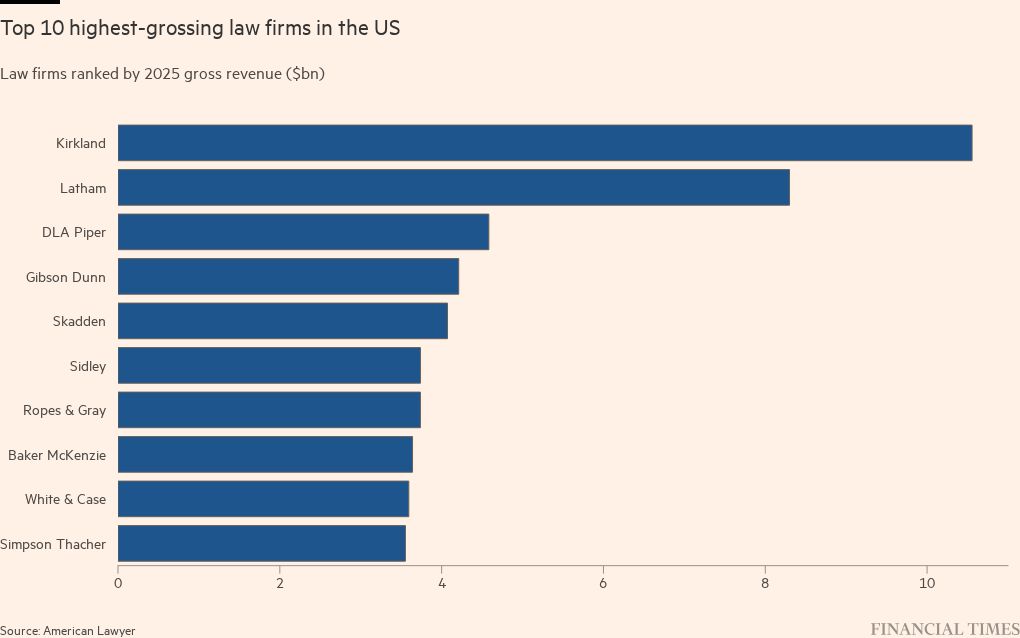
Kirkland’s disclosures for 2025 showed a record $10.6bn in revenue, up from $8.8bn the previous year. The firm’s equity partners, who share in its profits, were paid an average of $11.1mn, a 20 per cent increase on 2024.
Kirkland’s executive committee has for several years considered withholding financial performance data from AmLaw, according to a person close to the firm.
In particular, Kirkland’s leadership was disgruntled with how AmLaw’s metric of average profits per equity partner figure did not account for the wide variance of pay at the firm, the person added.
It is the latest move by a large law firm to shield details of its financial performance. Freshfields announced in 2023, when average per-partner profits were £2.09mn, that it would no longer voluntarily report its financial results.
Freshfields’ global managing partner Rick van Aerssen said at the time that rather than numbers its progress should be “based on the quality of business we’ve built and the client mandates we’re winning”.
However, the firm is still required to publish accounts on Companies House, which means a number of its metrics are publicly available.
New York firm Wachtell, Lipton, Rosen & Katz and London’s Slaughter and May, both of which are general partnerships that are not required to disclose financials, also do not share results with AmLaw or other rankings.
Instead, AmLaw has to produce an estimate of the firms’ annual revenue and compensation figures.
Kirkland added in the letter that it would not comment on any future estimates of financial performance.
A decade ago, law firm Dentons got in a spat with AmLaw about its profit estimates, arguing they were flawed. Dentons ran an advertising campaign in rival publications accusing AmLaw of inventing the numbers.
Law firm pay has been thrust into the spotlight in recent years, as firms have capitalised on the expansion of private capital. The growth has fuelled a talent war, with firms poaching top partners from each other at ever-higher compensation rates. Top lawyers have complained privately in recent years about the level of media attention their compensation packages are attracting.