
Let’s not entertain stereotypes. Italian construction companies should be approached no differently from any other companies. The sometimes-fraught environment in which they have operated in the past should absolutely not lead an observer to jump to any conclusions.
The Italian construction company we’re writing about today is Webuild. It’s a civil engineering contractor that employs more than 85,000 people and has operations that span five continents. The company can trace its own history back to 1906, though its current form owes more to Salini Costruttori’s acquisition of sector peer Impregilo in 2014. The stock is listed on Borsa Italiana, where it has a €2bn market valuation.
We’re writing about Webuild because Italian daily Il Fatto Quotidiano published a story last month saying the company “wants €22bn in extra costs” tied to Italian railway projects.
Citing a letter sent by Webuild CEO Pietro Salini to the government in late July, Il Fatto reported that Webuild had variation claims amounting to €22bn across 18 construction sites for contracts with the state railway company’s infrastructure arm, PNRR, that had an original value of around €30bn.
Webuild has since filed a complaint with Consob, the Italian market regulator, that accuses Il Fatto of market manipulation. The company said:
The article contains statements that are manifestly false and entirely unfounded, distributed in a manner liable to have a significant and distortive impact on the Group’s share price, which immediately recorded a decline following its publication. The Company will assess every action necessary to protect its reputation and the orderly trading of its shares on the stock market before the competent authorities.
[ . . . ] The Company has not made any “request for extra costs”: it has sent formal, confidential communications to the relevant institutions concerning contractual obligations that have already accrued — including receivables for works completed and certified, recovery of costs already incurred, and contractual advances provided for by law.
The €22 billion referred to in the article, misleadingly characterised as requests made to the Government, instead represent the total amount recorded in the works accounting registers in accordance with the procedures provided for under public contracts. A substantial portion of these amounts has already been submitted to the Technical Advisory Boards, independent bodies provided for by law and also composed of members appointed by the contracting authority, which are responsible in providing an opinion on the relevant matters. Presenting this figure as a request for public funds addressed to the Government constitutes a distorted and unfounded representation of the contractual and institutional reality of the matter.
Webuild confirmed to us that the letter cited by Il Fatto is genuine. “The Company did not circulate and does not comment on the contents of confidential correspondence beyond what it has already stated publicly,” said a Webuild spokesperson.
Il Fatto is an independent, small-circulation paper that tilts anti-establishment. Its journalists responded by updating its story with more from the letter, which has the subject line: “scaduto, riserve iscritte e recupero anticipazioni. Situazione di grave squilibrio economico finanziario e richiesta di decisioni e di una road map entro la prima settimana di agosto 2026”.
Any translation of legal terminology introduces misalignment risks. Our best attempt with the above text is: “Overdue payments, recorded reserves, and recovery of advances. Situation of severe economic and financial imbalance, and request for decisions and a roadmap by the first week of August 2026”. All the English translations in this post are approximate.
As reported by Il Fatto, Salini wrote in the letter that “the contracts currently under execution are burdened by recorded reserves of approximately €22bn, of which €13bn refer to costs already fully incurred” and that “no decision has been made on this dispute through ordinary contractual channels”.
In Italian law, reserves (“riserve”) are formal claims registered by a public procurement contractor against the state. A contractor has to keep following the site director’s orders, and can’t unilaterally walk off site before the job’s complete, but can claim all potential excess costs by immediately booking a claim in the official accounts.
The goal is transparency. The client learns of potential overruns as soon as they arise, meaning it can top up funding, rework the project, or find an amicable settlement. Contractors must set an upper bound on their overrun compensation claims that cannot be exceeded.
Before any large public project begins, the authority and its contractors appoint a Technical Advisory Committee of representatives and independent experts (“il Collegio Consultivo Tecnico”) that signs off design changes and acts as an informal arbitrator. As work continues, the CCT weeds the reserves book for any claim that has been exaggerated, is unsupported, or was the fault of the contractors themselves.
The state gets its project delivered without intractable decision bottlenecks and stings in the tail. Contractors can avoid pending legal claims that would starve them of working capital. The system mostly seems to work. Very few government contractor disputes end up in court, and only a handful go to formal arbitration.
All that background is because Webuild’s complaint requires some interpretation.
Salini’s letter to the government identifies €6bn–€7bn of “additional costs”. This, Salini says, is 29 per cent of the total value claimed — 29 per cent being the CCTs’ historical reserve recognition rate. It’s a net compensation estimate, in effect, whereas the headline Webuild has objected to was citing the €22bn gross maximum.
The letter also refers to costs “in the order of €10bn” that comprise “additional resources — in terms of both budget allocation and cash flow — required to complete the projects”. The amount is said to cover “price revisions and the actual volume of work needed for completion, neither of which is accounted for in the current financial plans”.
Salini says in the letter that the CCT had been acting too slowly to clear the backlog of disputes. Construction at its current pace “is no longer sustainable in the absence of decisions”, Salini is said to add. He is reported to propose amending CCT regulations to allow the termination of its mandate, “in the event of unbalanced decisions or timelines incompatible with the project’s needs”.
The letter also flags an “immediate cash requirement” of €2.1bn, which could be funded “by rescheduling works not currently underway”. As things stand, Salini says, “the more work we do, the more our financial position deteriorates”.
Webuild said in its Consob complaint:
It should also be clarified that the short-term cash requirement referred to in the news, amounting to approximately €2.1 billion, is directly and exclusively related to the continuation of construction sites currently under execution on behalf of public contracting authorities. It is not related to any stand-alone cash requirements of the Group as a whole, which, on the contrary, confirms its 2026 guidance.
Much of the above may look like typical brinkmanship between a builder and a public authority, while talk of a deteriorating financial position could be dismissed as scaremongering. With €110mn of reported net cash on the balance sheet at the 2026 half-year, and a target for net cash to exceed €300mn by the year-end, Webuild’s short-term liquidity shouldn’t be a worry.
The political angle is much harder to read.
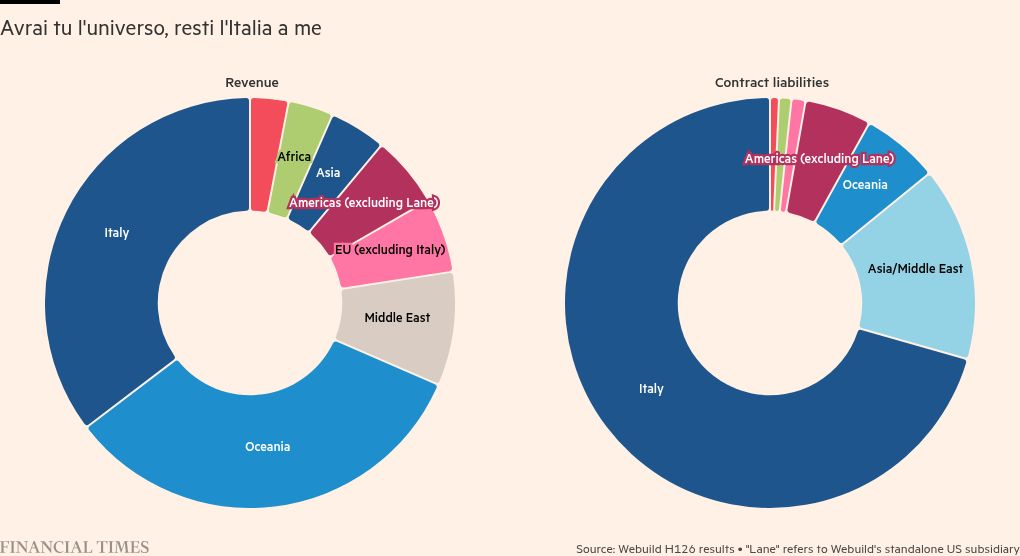
In its half-year results, Webuild reported €5.9bn of contract liabilities (meaning the value of billed work that’s not yet done). Advances for the Italian railway contracts and a new breakwater for the port of Genoa during the period helped offset the loss of Neom’s scrapped Trojena Dam project in Saudi Arabia.
This deepened Webuild’s near-term reliance on its home territory, which accounts for about 34 per cent of group revenue but is 70 per cent of contract liabilities:
Webuild has been a relative winner from Italy’s post-pandemic National Resilience and Recovery Plan, which was heavily reworked after Giorgia Meloni’s centre-right government came to power in 2022. The recovery fund’s single largest recipient is RFI, Italy’s rail network owner, which has thrown money at contractors including Webuild to speed up project delivery and meet an August 2026 completion milestone set by the EU.
Webuild told us:
All PNRR milestones regarding railway projects have been achieved to date. On payments: following the allocation of resources from Italian Ministry of Economy and Finance and Ministry of Infrastructure, and Transport, Employer RFI has started partially settling overdue invoices. We have received partial payments in respect of outstanding amounts. Discussions with Government and with Employer are in progress.
The contract liabilities line of the balance sheet statement is exactly where an analyst would expect to see evidence of pre-payments for high-value, quick-delivery work. All else equal, liabilities would normalise once these exceptional jobs are delivered, while any project cost overruns would be assumed to eat more quickly into the downpayments. And of course, since the cash was collected when the liability was created, revenue recognition for work done won’t generate new cash.
Managing group liquidity through the tumult is no easy task. Any disputes with government officials over expenses incurred would add an unwelcome uncertainty.
As we said earlier, €110mn of net cash should give plenty of flex, even for a company that’s involved in the consortium financing of complex long-term infrastructure projects.
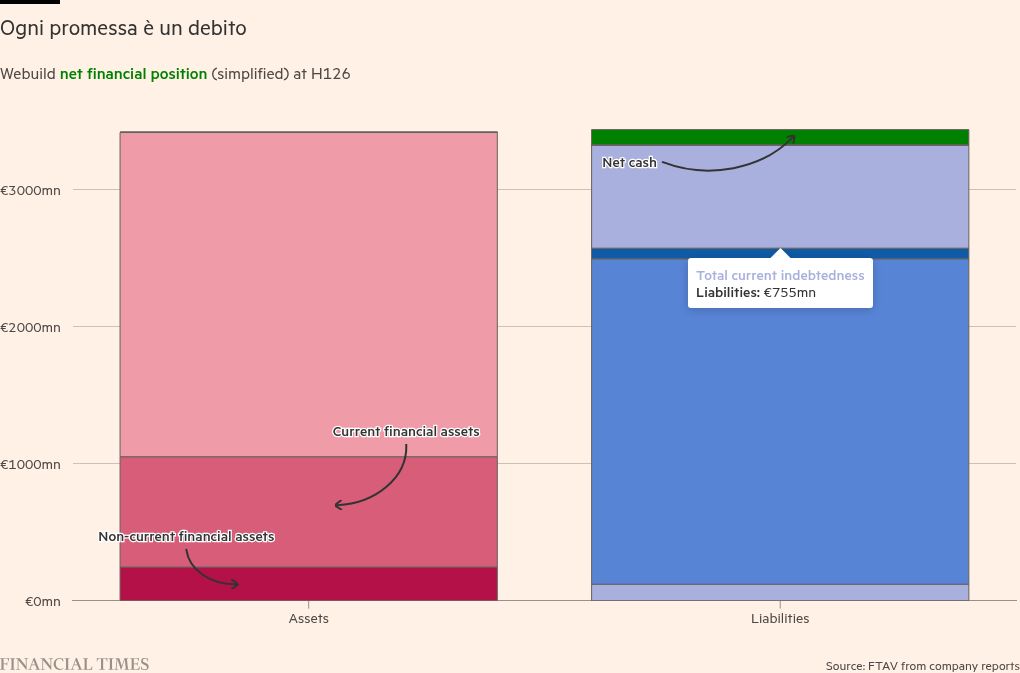
Financial assets are, to state the obvious, on the asset side of the balance sheet. Their recognition and measurement under IFRS 9 are subject to review by an independent auditor. Nevertheless, understanding how easily these assets could be used to pay off debt requires some judgment. It might not be simple for a company to draw on its financial assets at short notice if they are held in escrow or restricted by contractual agreements, particularly when third parties are involved.
Webuild reported at the 2026 half-year that it had €806mn of current financial assets (meaning that they’re expected to be converted into cash within 12 months), nearly 93 per cent of which was in the form of loans and receivables to third parties. Non-current financial assets (meaning they fall due beyond 12 months) were €245mn, mostly in the form of loans and receivables to unconsolidated group companies and other related parties. The sums are not insignificant.
On the liabilities side of the balance sheet, Webuild’s gross debt was €3.3bn at the half-year:
Metrics would look better if Webuild were ever allowed to break ground on the Strait of Messina bridge to link Sicily with the Italian mainland. The country’s audit court last year denied approval of a €10.6bn contract awarded to a Webuild-led Eurolink consortium to build the bridge on the basis that it would breach EU rules on public procurement and the environment.
Critics of the Messina bridge plan say it concentrates political power and enriches private interests for benefits to the region that are unproven at best. The contract award process was also atypical. As the FT reported last October:
The original tender took place in 2006, when Milan-listed builder Impregilo won with a €3.8bn bid. After the project was scrapped Impregilo, acquired by WeBuild in 2014, filed a lawsuit against Rome seeking €700mn in damages — a case WeBuild has now agreed to drop in exchange for Meloni’s government “reactivating” the contract. [University of Messina constitutional law professor Antonio] Saitta questions the legality of the arrangement. “This resurrection of the old project with the old contractors is not possible under the constitution or European law,” said the lawyer.
In June, the Rome Public Prosecutor’s Office said it had launched an investigation into allegations of corruption in connection with the project.
Webuild told FTAV that it “has no ongoing investigation before the Rome’s Public Prosecutor’s Office” and cannot comment in relation to third parties. “The Company maintains rigorous compliance and control systems [ . . . ] and fully co-operates with the Authorities whenever requested,” it added.
None of the above should be news to Webuild investors. Fitch rates the company’s debt on a long-term B+, meaning highly speculative, while S&P is one notch below investment grade at BB+.
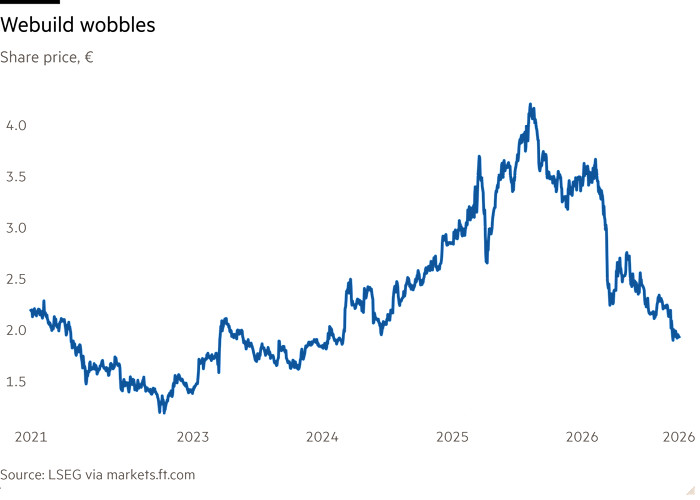
Having hit a 10-year high last August, the shares are down by more than 50 per cent:
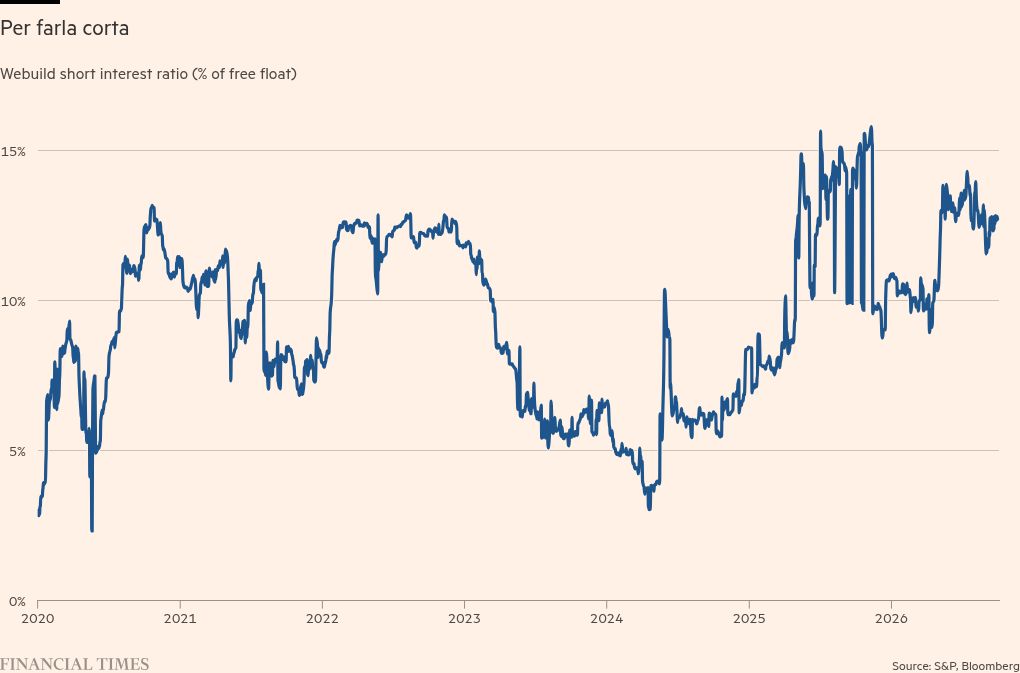
And short interest — a volatile measure due to the stock’s less than 25 per cent free float — has moved a bit higher than the market average:
In an upgrade note published in November 2025, S&P welcomed Webuild’s “strong order backlog, disciplined contract management, and leading positions in key markets in low-risk geographies”, while also flagging a reliance on relatively few big projects, and that advance payments on its balance sheet were “well above the peers in relative terms”. Operating cash flow improvement was uncertain, with management’s ability to deliver unproven, S&P said.
Investors in construction companies are jittery by default about cash. Carillion’s collapse in 2018 gave everyone a lesson in how premature revenue recognition can flatter reported figures, and how aggressive use of supply-chain finance can hide leverage by turning bank borrowing into operating cash flow.
Webuild operates in the same sector that Carillion once did, but shouldn’t be assumed to share any other characteristics. What we can say is that the same sorts of funds who bet against Carillion have taken an interest in Webuild.
It’s a very different proposition. Salini comes from a Roman construction dynasty whose fortunes were built over generations. The company his grandfather founded built Rome’s Stadio dei Cipressi. His father expanded the business into Africa on the back of state-backed development and aid programmes.
Salini, on taking charge in 1994, consolidated power first with the takeover of Impregilo then with the rescue of troubled peer Astaldi, helped by an investment from state-owned Cassa Depositi e Prestiti, which remains a key shareholder. Webuild is deeply entwined with the Italian establishment.
An Italian parliamentary report last month cited figures showing that more than €27bn of Webuild’s €46.6bn backlog at the end of June related to Italian public contracts, the majority in rail. It describes Webuild as having acquired a position of “substantial monopoly” in large public works following the state-backed consolidation of the construction industry. Webuild says it wins tenders like any other company and strongly disputes the characterisation that it has a domestic monopoly.
Rome’s own budget constraints add another layer of complication. Meloni’s government has been cutting spending to ensure that Italy’s fiscal deficit stays below an EU threshold. And while Italy’s railways upgrade spending comes largely from the EU, a public procurement contractor with a large state shareholder can’t be seen to take a significantly different line to government during a cost-of-living crisis.
It all makes Webuild a difficult stock on which to take a view. The story is as much about politics as what’s reported on the balance sheet. As we said at the top, stereotypes can be unhelpful.
Further reading:
— Why Sicilians hate Meloni’s bridge (FT)