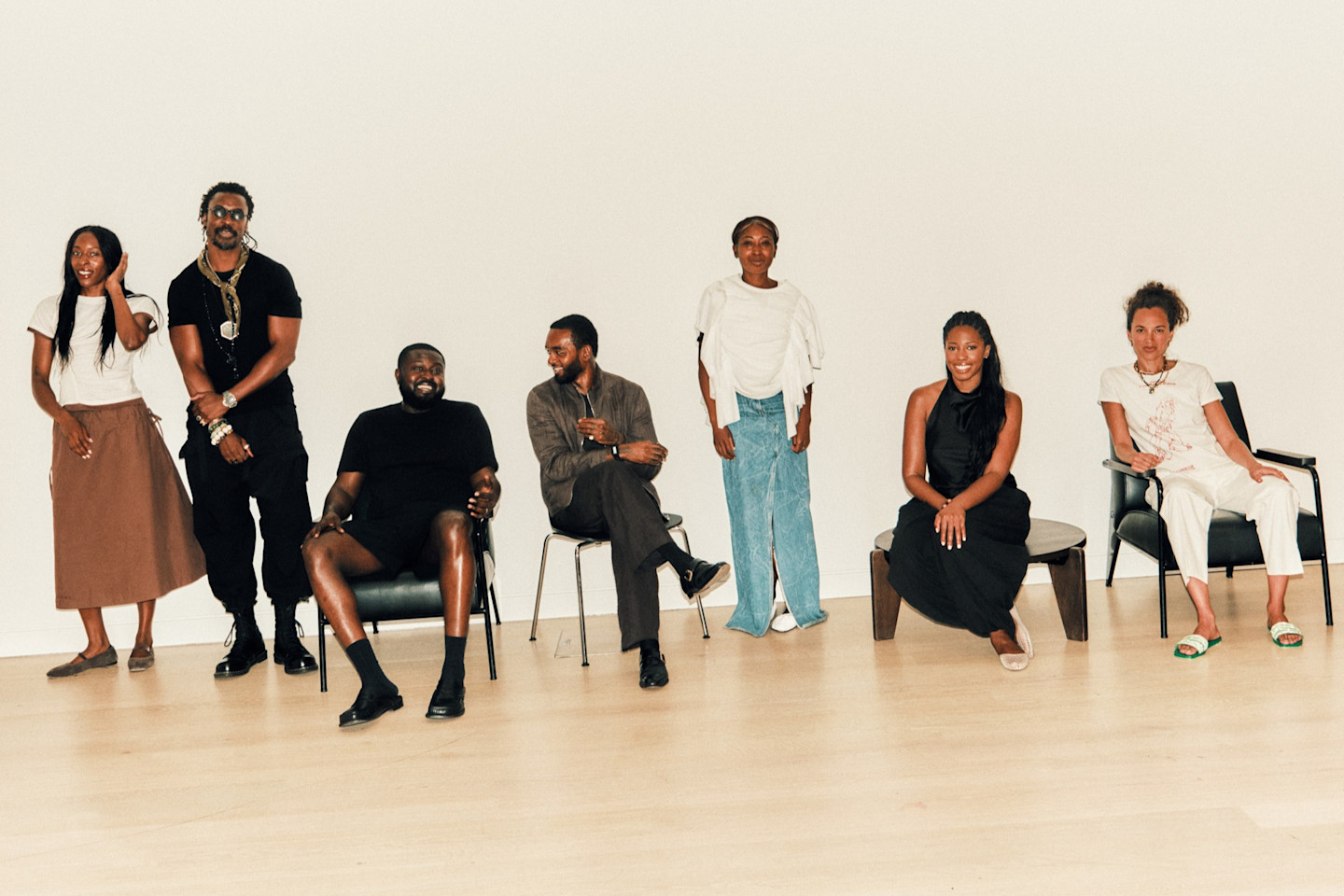
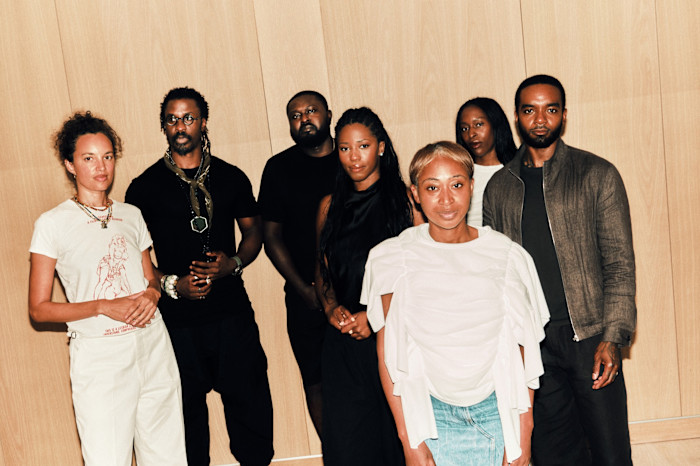
Charlene Prempeh, curator of The Nue Black Aesthetic: What does the exhibition title mean to you?
Phoebe Collings-James: I think about it more as a question, about where we’re at, what’s going on, how everyone is feeling – who are we, and why are we doing the things we’re doing?
Taiba Akhuetie: I think it’s an evolution of how we portray ourselves in society, of how we have been brought up in our culture and how we express ourselves differently, without taking away from our identity.
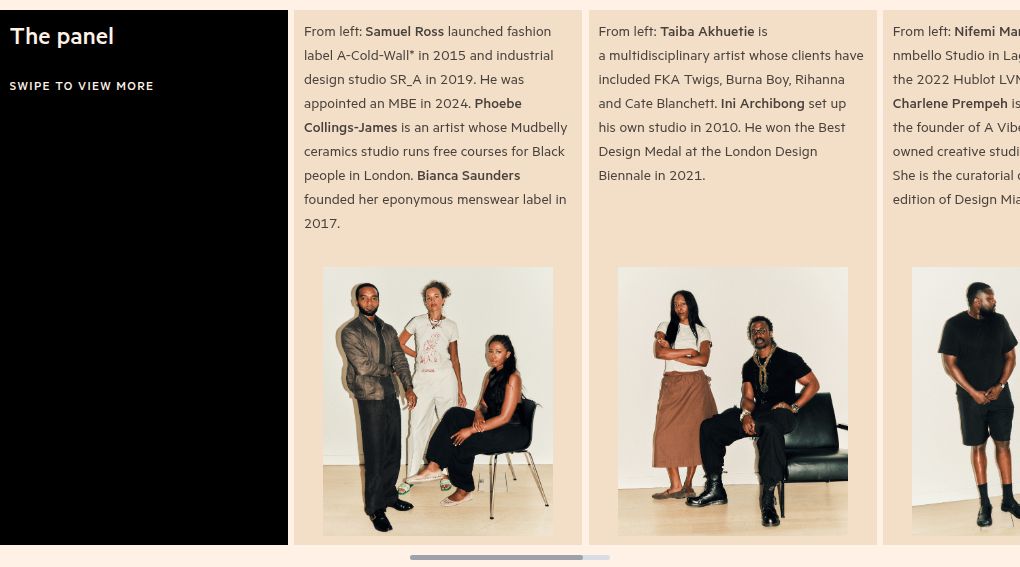
Samuel Ross: It does definitely bring a sense of autonomy. The title made me think about the ability we now have to posit ourselves to the world, rather than the image of the Black in contemporary [culture] being told to us, [as it has been] over the past few hundred years. If we think back to our studies, I can’t remember hearing about any type of Black vernacular tied to design. We always had to frack for it. Now we’re able to have some control over it. And that in itself feels quite new.
Ini Archibong: This is new. There’s a Black aesthetic. But isn’t it somewhat outside of our control by the simple naming of it the Black aesthetic? That means that somebody that’s not Black is putting us as “other”, right?
CP: To me, it doesn’t feel like an external effect. The exhibition was inspired by two texts. The Black Arts Movement written by Larry Neal in 1968, rooted in civil rights, and Trey Ellis’s 1989 essay, The New Black Aesthetic. They are both by Black men coming from an African-American perspective. “Nue” here comes from the French term nuance; the conditioning is that the Black aesthetic now is one where we can take the time to look at very specific experiences of different individuals, and of the diaspora too.
Nifemi Marcus-Bello: I think it’s us dictating our own vision of what the Black aesthetic looks like. Growing up, you pick up books about Africa, and they’re usually written by someone from Europe. This feels a lot more important because you are curating it.
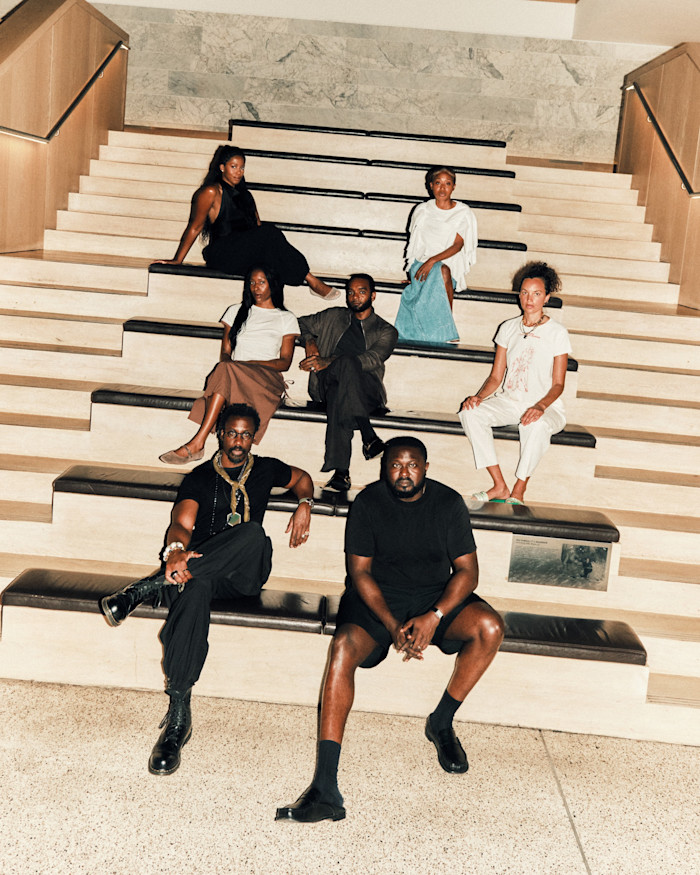
CP: There is an inherent contradiction in doing a show called The Nue Black Aesthetic while arguing that not enough attention has been paid to the complexities of individual Black designers. How do you feel about that?
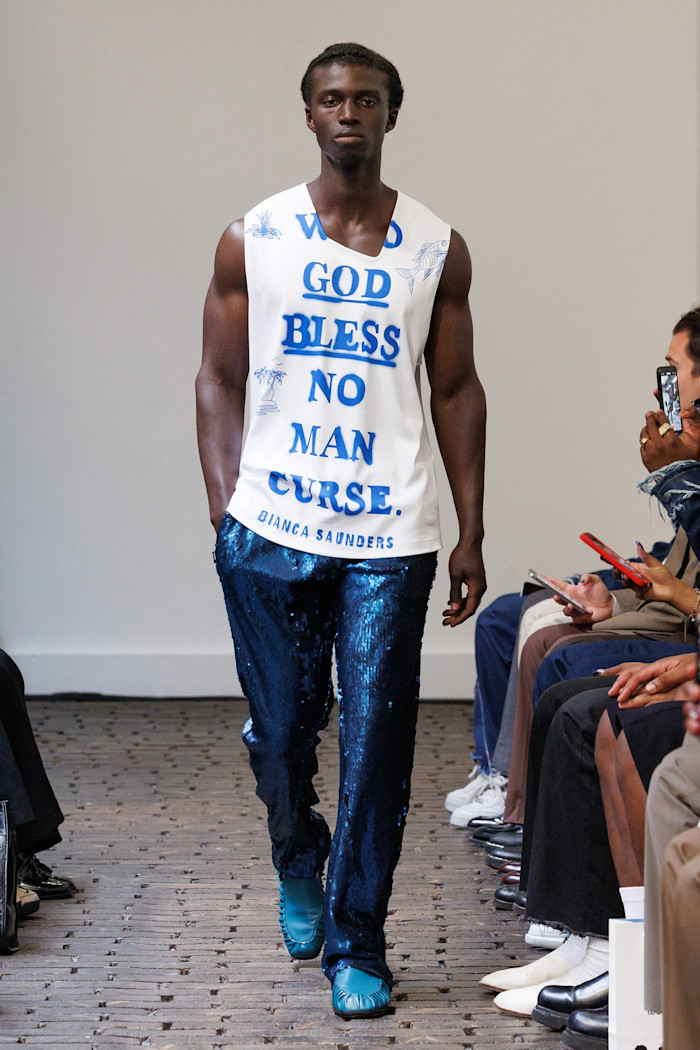
Bianca Saunders: It feels like this is the start of us breaking away from just being a category.
TA: I do think we have to be careful of people always grouping us together. Even when someone introduces me, it’s, “She’s a really talented Black artist”, and that can be frustrating. Why can’t we just be artists and designers? When you’re white you don’t get that. You don’t get: “That’s a white designer from Copenhagen.”
PCJ: There’s a political diversity too. There is massive diversity in how you achieve liberation or what you fight for, and that comes through in the way people choose to make art and design.
IA: During the early part of the pandemic, [people] were searching out designers of colour in the industrial space to have us speak for all of us. I was like, “Yeah, I did a couple of good tables and now I’m talking for Black designers?” There might be things that unify us within the diaspora. I can connect to Nifemi on being Nigerian. I can connect to Samuel on being of African descent in white spaces. But everybody’s coming from wildly different perspectives. You can’t project that we’re gonna have some kind of codified image.
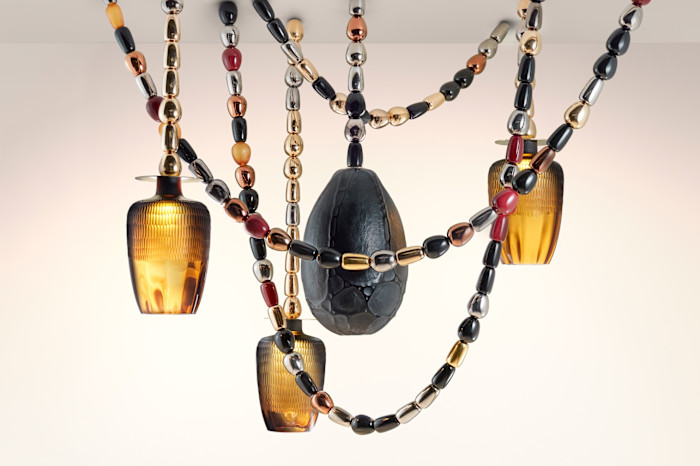
CP: Are there particular elements of Black design that you think should be celebrated?
IA: As much as I want to shy away from being monolithic, I’d describe being of African descent as “we don’t have to count to dance” – I don’t need to sit down and calculate everything. I can just feel my way through it. And I get that feeling when I look at the work of other people of the diaspora. A lot of my commissions aren’t coming from people that are going to understand the animism and the mythology from my region of Nigeria that influenced the piece. But the energy is there, and they’re going to absorb that energy. It’s like it’s a gift from my culture to you and your home.
TA: I think people often celebrate the more outlandish designs that you can visibly see are associated with Black culture, but it’s important to also show the subtlety in design and the freedom that Black people have to just design based on a leaf falling from the tree in Victoria Park, or my grandma’s chair in my house.
BS: That’s interesting because I feel the work that is more subtle is what is getting people paid more – because then it relates to everyone.
TA: But is it celebrated? I think your work is very subtle and chic, it’s beautiful, but that doesn’t take away from your Blackness at all.
BS: You don’t have to relate to everyone, but people need to see themselves in your work, or have some sort of understanding of it, otherwise I don’t think it survives.
NMB: But I think the beautiful thing about being Black and being a designer is that the approach to design is usually contextual. Most Black designers, I would say, are trying to tell the story of the now.
IA: When I [first] started putting my work out there [in 2011], if anybody wanted to talk about my race I was like “I don’t talk to white people about race. That’s it. Look at the piece: it’s a good office table. It’s beautiful and it’s not square.” So when there did come a time when there was a spotlight, then for me personally it became important to start sharing some of the things that were inside me. It’s like, “you’re a Black designer” – then OK, let me talk to my Black people, let me talk to the people that are in school and let them know, “Hey, there’s a way to do this.”
SR: It was a forming of sovereignty, actually. The important part was that Black designers could just speak to one another through their work at a very high level.
CP: Have you had moments when it felt like your work has been interpreted primarily through the fact that you’re Black?
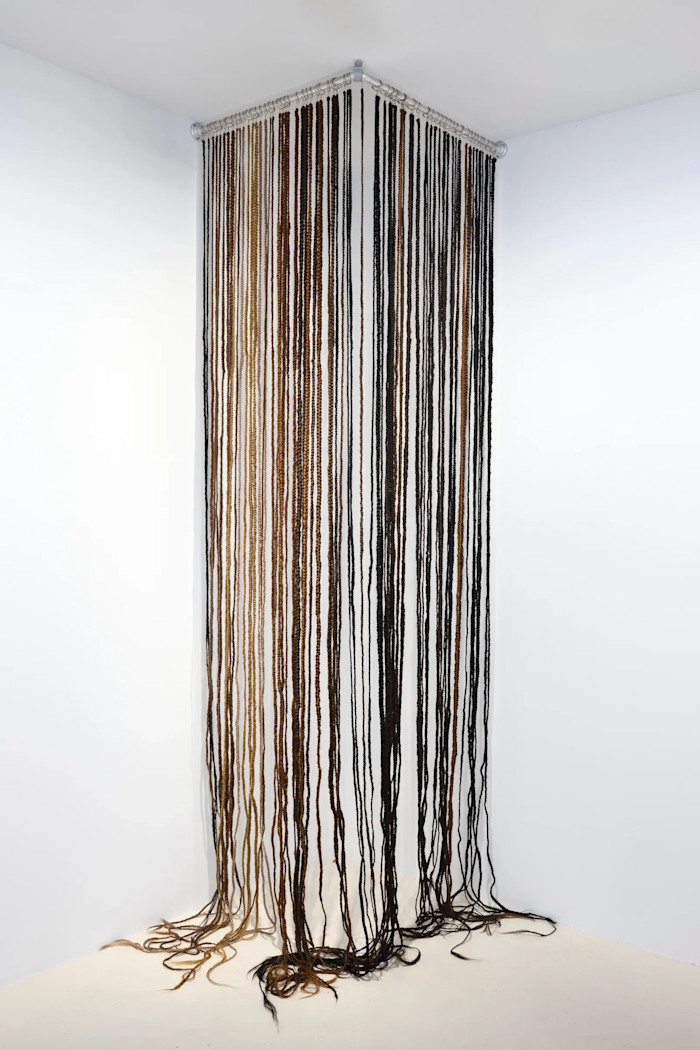
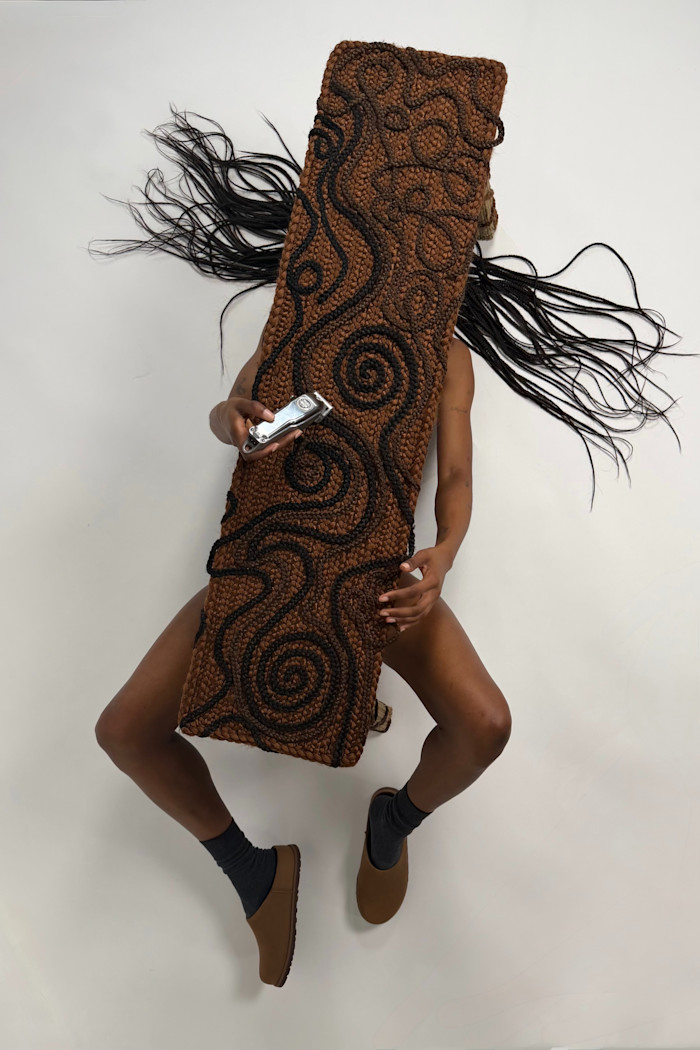
TA: In my work I use hair and braiding, and that is associated with Blackness. I am the artist and I am Black and that is inherent in my work. But I think that sometimes beyond that conversation, people don’t have much to say.
NMB: During Black Lives Matter [in 2020], I said no to maybe five projects because I’m not African American, I don’t have the same experience. I was raised in Nigeria, I’ve lived in the UK for a while; I understand what it means to be Black, but the everyday struggle, I am only just learning.
IA: Some journalists who were trying to ride the wave of being racially conscious [at that time] asked very unconscious and offensive questions. I’m like, “Why would I talk to you about my experience with police brutality? So you could sell more magazines?”
BS: Being a Black designer, you have to always put yourself forward. It comes with it. People ask you to do stuff all the time. It pays more to be visible.
TA: That’s because we are naturally othered and people like the level of excitement associated with telling a story behind it.
CP: But I think it’s universal that people love a good story.
IA: For the first six or seven years of my career, I was the only Black person in the room. Nobody wanted to point it out. People were very careful. And even I was really careful. I didn’t want to stop myself from getting jobs. Like, my ghetto friends can’t come to the party, I’ll wear a tie. Then there was a switch. It was almost like the consciousness of the design industry came to this realisation. They’re like, “Oh my God, we never pointed out that you were Black.”
TA: It is really sad; we have to play a game in the industry till we get into a position where we are more established, then we can relax a bit more.
NMB: I talk too much. From day one, I started to make people uncomfortable.
BS: For myself, I am a good designer first and then I’m Black after.
SR: But is it possible to separate the two? My only interest is communicating the Black experience through design. I don’t split being Black from being good at something.
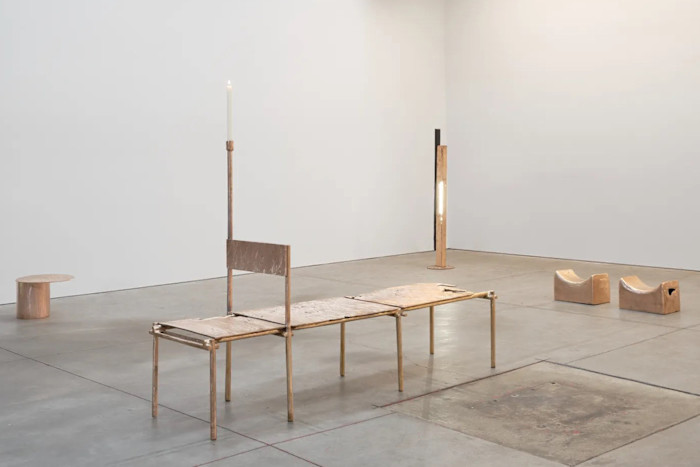
PCJ: There is something about the inherent Blackness in my work that I believe challenges the way many people write about it, because they might not have access to the fluency, or the desire to comprehend it. But Mudbelly, weirdly, has made people absolutely giddy to write things. And I think it’s because it more neatly situates the ability to perceive and experience Blackness. I view Mudbelly as a political way of organising what I believe in.
CP: What kind of support systems do you think are missing?
NMB: I think it’s community among ourselves. As Black people, and even as African people, there’s always a communal approach. That’s why this exhibition is extremely important. It takes a village to raise a child. If I hadn’t had Samuel to hold my hand a few times, to say, “Talk to this person, do this”, I wouldn’t have had as much progression. Being in a community and having those conversations – being as open as we can – is something that sometimes gets missed.
CP: Do you think that’s something that needs to be formalised?
IA: I think it’s inherent within us to be conduits for the next [generation].
SR: I wouldn’t say we need a formality, but at the same time, I love structure. And I do think some type of independent board of sorts, where introductions can be made or paid forward, is only an additive because it strengthens the total market share for all.
PCJ: It comes back to unions and guilds and tribes, and all these other different things that have existed throughout time in different ways.
CP: What is the importance of institutional activity?
IA: It’s our imperative. I couldn’t walk into a museum when I was in design school and see anybody that had any similar type of experience to me represented there. Now is the moment for us to put ourselves into the canon and make sure that it’s represented in its full diversity.
NMB: As Black designers, we should also have our own institutions because we’re the ones that can tell our own stories the right way. I used to get excited at the start of my career, you know, “the Design Museum just collected my work”, but right now, I really don’t care.
CP: What would you like people to be discussing after they leave the exhibition?
BS: The pieces of my work that you’ve chosen show the multifacetedness of me as a designer. It’s less about the act of being Black and more about the exploration that we’ve been allowed space to create.
TA: I want people to be discussing the texture and materials of my work and how they might potentially relate to it, wherever they’re from.
SR: I would like my daughters to be able to go through the space and see that it’s not necessarily a male-dominated industry. I think this is a great equaliser.
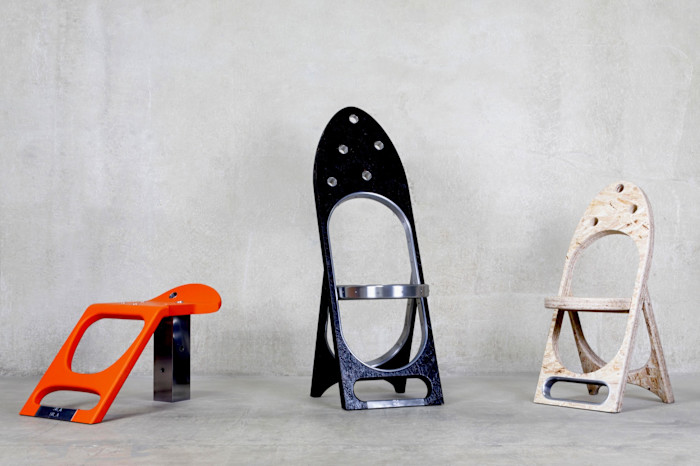
NMB: I find it weird when you’re in England and you go into an elevator and people don’t say good morning. In west Africa, people ask how your day is going, and it’s deep. That’s what I want people to feel.
CP: I’ve always found it offensive how Black design has been reduced to kente cloth. That idea of Blackness as a superpower to create is something that I feel inherently in a lot of the work being presented here. With music, it’s understood that there’s a rhythm and a texture to Black music that has infiltrated the whole industry and is a real source of inspiration. I want people to feel that same influence in terms of design, how it can be this really ambitious seed for work everywhere.
Conversation edited by Victoria Woodcock
The Nue Black Aesthetic is at the Design Museum, London W8, from 6 November to 8 August 2027