Stepping into the penthouse that is Cindy Sherman’s New York stronghold, I am greeted by a scene straight out of an old heist movie: a silver-haired woman with intense blue eyes, an arsenal of eccentric disguises and, tumbling all over a table in the middle of the room, a fabulous pile of jewels.
Close inspection reveals them to be costume rather than fine: chunks of poured glass and synthetic “paste” set into imitation gold. Still, they catch and scatter light like the real thing, and no wonder: they come from the Chanel archive in Paris and were sent to Sherman, together with a miscellany of vintage fabrics, for her to make free with — shears and all — in the name of new work. With the practised flip of an Ottoman carpet seller, she shakes out her favourites, pointing out twists of gold thread or silk, tiny crystals and your classic wool bouclé, soft as a spring lamb.
Sherman, a conceptual artist around whom reverence has swirled for half a century, turned 72 this year. She has lived and worked in this sleek converted warehouse in Lower Manhattan since 2005. She also has a bayside property in East Hampton, where, since finishing her latest series of photographs — Fabric Matrons will debut at Hauser & Wirth’s Savile Row gallery during Frieze London — she has spent the summer puttering in her garden, tending to her pet chickens and improving her Bananagrams game.
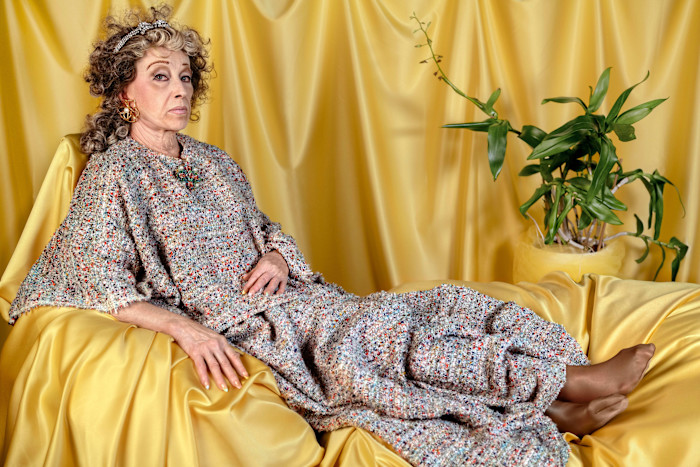
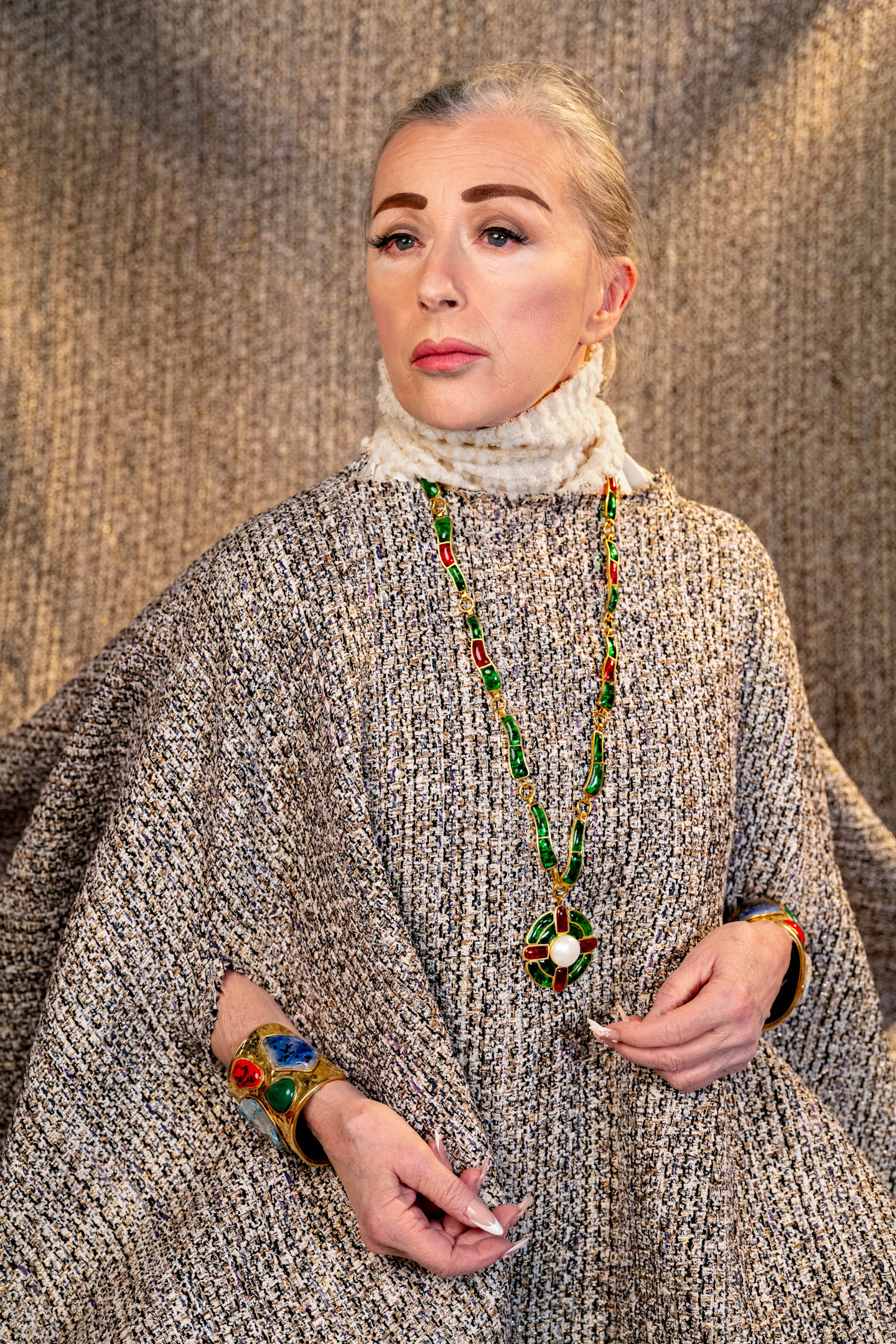
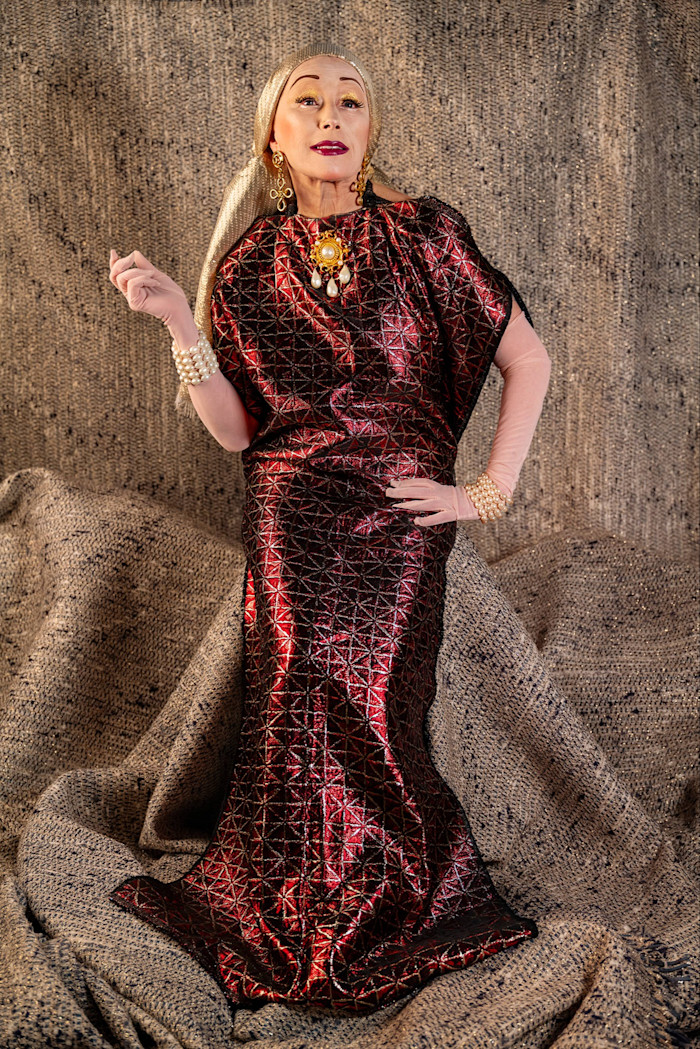
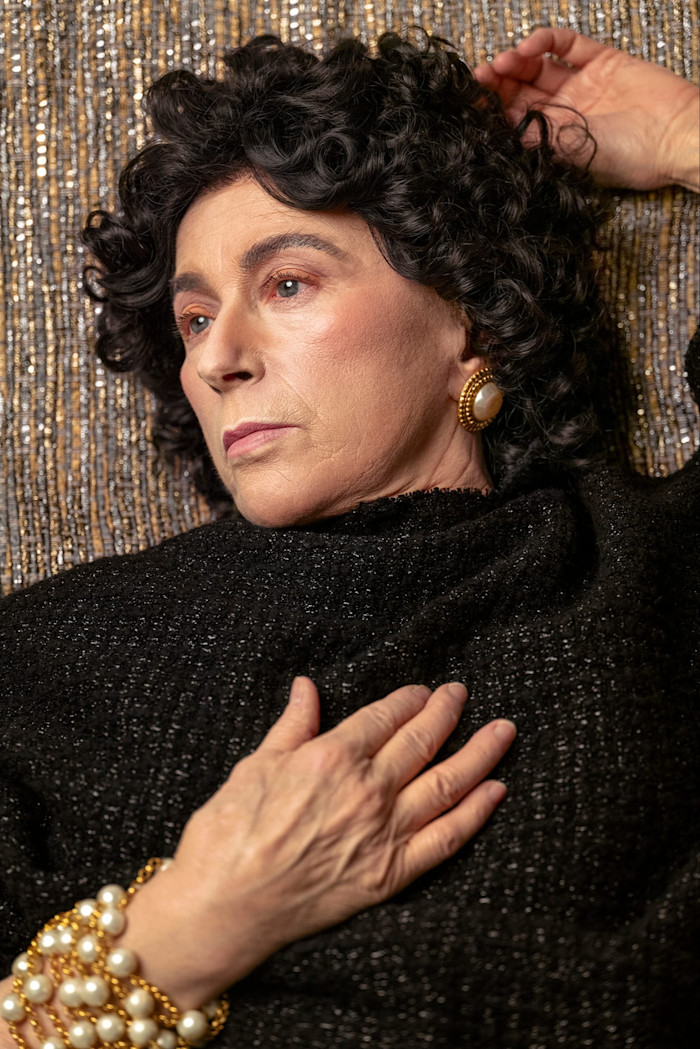
The new work, for which the artist transformed into a suite of older women posing in their finest couture and jewellery, sprang from a magazine for a jewellery shop that’s distributed in the Long Island enclave. Pages torn from it are stuck to Sherman’s studio wall, next to some postcards of early 20th-century portrait paintings with bold, flat, decorative backgrounds that also fed into the work.
The shop sells very pricey jewellery; its magazine features a former Sports Illustrated model in clouds of marabou trim and organza. “It’s just so weird,” says Sherman. “This ridiculous jewellery, the ridiculous poses. I mean, why is she holding her hand up at a mirror? And of course it’s all airbrushed — she’s my age and she’s looking pretty and sexy, so that’s kind of what my idea was: women of a certain age trying to show off their jewels, big diamonds on every finger.”
For a previous project inspired by the Chanel archive (Ominous Landscapes, 2010-12) Sherman zippered herself with some difficulty into full outfits. This time, she simply cut holes into the fabric for her head and hands, tying the smaller scraps into turbans or a corsage. “Nothing’s sewn, it’s just pinned together loosely. You can see the seams and raw edges,” she says. Such jerry-rigged casualness is quite usual in her work, intended to draw attention to a picture’s artificiality. Exaggerated make-up, mannered expressions and leaving the camera’s cable release in shot achieve the same thing. Suspension of disbelief isn’t the point. Her work may be visually pleasing, but its chief attraction is philosophical. How we use clothing and make-up to evoke or disguise ourselves; how the self learns that art of artifice — such questions absorb Sherman, though more often than not she poses them and then gives you the slip, letting them hang in the air like a trail of perfume.
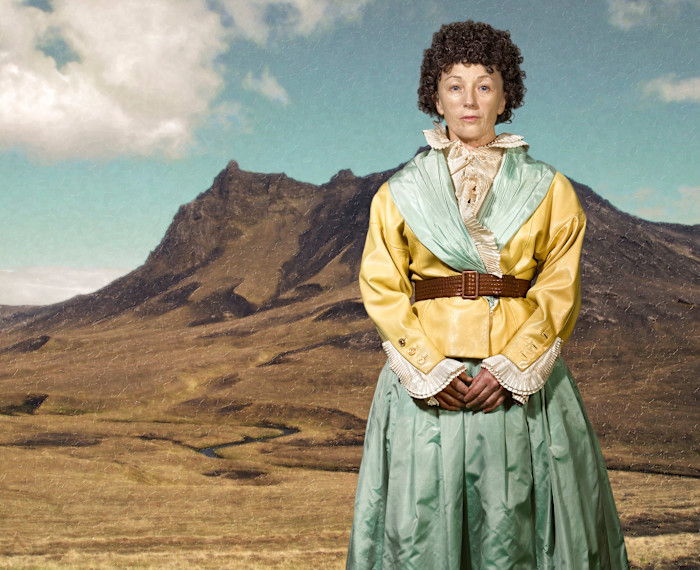
Fabric Matrons is a powerful set of pictures even for an artist who, from the instant she began photographing herself as fictional characters — B-movie star, unhappy housewife, Flemish Madonna, surgically enhanced socialite — in the late 1970s, has unfailingly met the moment. It might also be her most personal, for though she has always been clear that the personas are “everything but me. If it seems too close to me, it’s rejected,” one of the first images she made for this new series, “really reminded me of my mother. She died at my age, and with all the wrinkles there” — Sherman gestures to the neck — “and she had dark hair; she really looked like that. It’s a little freaky.”
Is it the first time that’s happened? “I think it is, although I look back at my older works, when I had a grey wig on or something, and I realise that’s what I look like now. It’s kind of funny. The work I do, it’s made me have to come to terms with my body changing. Most people don’t think about the fact that they have wrinkles on their earlobe, but I do these photos and I see those things, crazy things.”
Sherman’s studio is airy and long with banks of large windows that, in the fine, drifting rain of a humid afternoon, emit a tender light. Fans of long standing could guess the place was hers in a heartbeat: the germ of every protagonist into whose skin she has ever slipped is here in its masks and mannequin parts, Kleenex (bumper size), wigs, lint rollers, tubes of shimmer lotion (multiple hues) and racks crammed with rodeo shirts, ballroom and vintage Ungaro gowns.
Among the more eye-catching items is a fake fire (quite cosy in the winter, she says), but most startling of all is the long mirror from whose silvery depths Sherman has summoned her every character, dressing up and directing her reflection until the likeness detaches from its creator. “Sometimes it’s been kind of chilling, like seeing an apparition,” she says. “I really feel like, ‘something came over me’.”
I point out that, when she describes this process, she always uses the language of the supernatural — does she believe in that sort of thing? “Oh yeah. Sure I do,” she says, going on to describe a recent stay at an old inn in an Arizonan gold rush town where she was convinced her room was haunted. “Even though I would be curious to see a ghost,” she adds, “I would also be so scared.” (Sherman famously loves horror films.)
She was just a child when she began summoning whole characters from pieces of old clothing. When she’d exhausted a closet in the basement of her parents’ house in Long Island, which was filled with her late grandmother’s turn-of-the-century clothing (she still has the bloomers, she tells me), she progressed to a thrift store for the local church, spending precious quarters on tattered party dresses from the 1940s and ’50s. “To me, these were like ball gowns. I had a whole little suitcase of them that my mother let me buy. I discovered that in funky clothes like this, I could see a much more interesting character.” The neighbours humoured her. “‘It’s old Mrs Sherman!’ they’d say, pretending like I was my father’s mother, and I’d be thinking, ‘Oh, I really fooled them’, so it was kind of cute actually in retrospect.”
As an art student at Buffalo State University, she became known for turning up at parties as a man, or the actor Lucille Ball. It was her then boyfriend, the artist Robert Longo, who persuaded her to photograph her transformations, but then as now, she preferred to work alone, “so that I can be more experimental and so, if it’s embarrassing, if it’s terrible, if I don’t like it and I don’t think anybody else would like it, then nobody ever has to see it,” she tells me.
She understood only very recently “how being open to failure, to something looking terrible and then somehow fixing it, has actually been really helpful” — that she might just be better at taking chances than most. “It’s like when I play Bananagrams,” she says, in explanation. “My boyfriend, he’s so afraid to change up his words, change up the letters to incorporate a J, because he feels what he has is already just perfect. And I’ll say, you know, if you just take the chance and change it all, you’ll be surprised at how easily it will all come together.”
October 13-December 23, hauserwirth.com
Find out about our latest stories first — follow FT Weekend on Instagram, Bluesky and X, and sign up to receive the FT Weekend newsletter every Saturday morning