Stephen King’s first horror novel is a slim book, but it has had an outsized afterlife. Filmmakers continue to be drawn to its gruesomely compelling account of female adolescent rage. This latest version comes from Mike Flanagan, who has a record of producing literary television horror which is simultaneously scary and insistently sentimental, from his Shirley Jackson adaptation The Haunting of Hill House to his take on Edgar Allan Poe’s The Fall of the House of Usher.
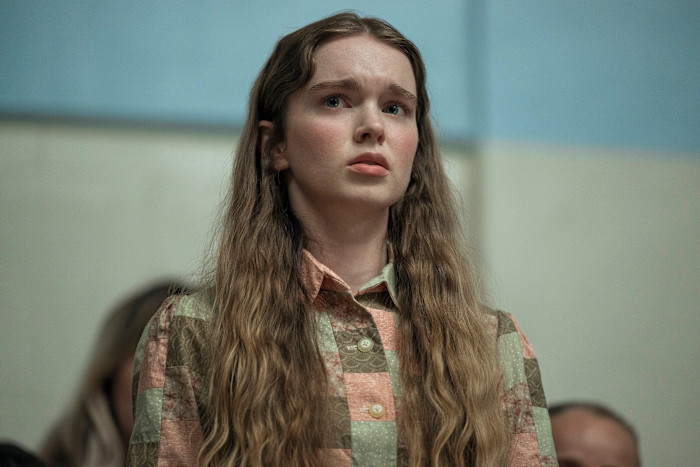
Flanagan updates King’s source material, and Brian De Palma’s famous 1976 movie version, to the present day. Here, Carrie White (Summer H Howell) is a homeschooled teenager whose parents have kept her living in seclusion due to their anti-government, conspiracy theory-driven beliefs. When her father is killed in a workplace accident, her abusive mother Margaret (Samantha Sloyan) is forced to get a job herself. Due to the intervention of social services, she reluctantly allows Carrie to attend a mainstream high school. Upon arrival, Carrie is evidently cloistered and spectacularly naive, and this smartphone-equipped environment becomes a baptism of fire. Under pressure from queen bee Chris (Alison Thornton), who resents the newcomer, Carrie begins to discover her latent telekinetic abilities.
Howell is outstanding as Carrie and plays her with an emphatic tenderness. Her discovery of a new world is beguiling, which makes it all the more dreadful to watch as her sense of wonder slowly ebbs away. The show holds on to the touchstones of the story, from the infamous bullying scene in the gym locker room, to the kindness of Chris’s best friend Sue Snell (Siena Agudong). Also included is the climax of the catastrophic prom, when Carrie finally metes out her bloody revenge on her tormentors.
But over eight episodes, it meanders around various subplots which feel like padding. The decision to expand the universe into stories of other girls with other supernatural abilities is a swing and a miss. It nudges the series towards a comic-book tone, and lacks the focus necessary to build that impending sense of a soon-to-be-unleashed fury.
Flanagan’s approach here is not dissimilar to that taken in his previous adaptations. He ladles on the heart and soul, demanding empathy for all. This is not unappealing, but it does have the effect of dulling some of the story’s viciousness. It denies Chris and Margaret, who should be the story’s true villains, the nastiness required for audiences to really root against them. Even when Carrie finally reaches its operatic finale, it leaves us with a strange suspicion that something is being held back. As a result, this is more of a watchable high-school drama than a fresh take on one of the horror greats.
★★★☆☆
On Prime Video from October 7