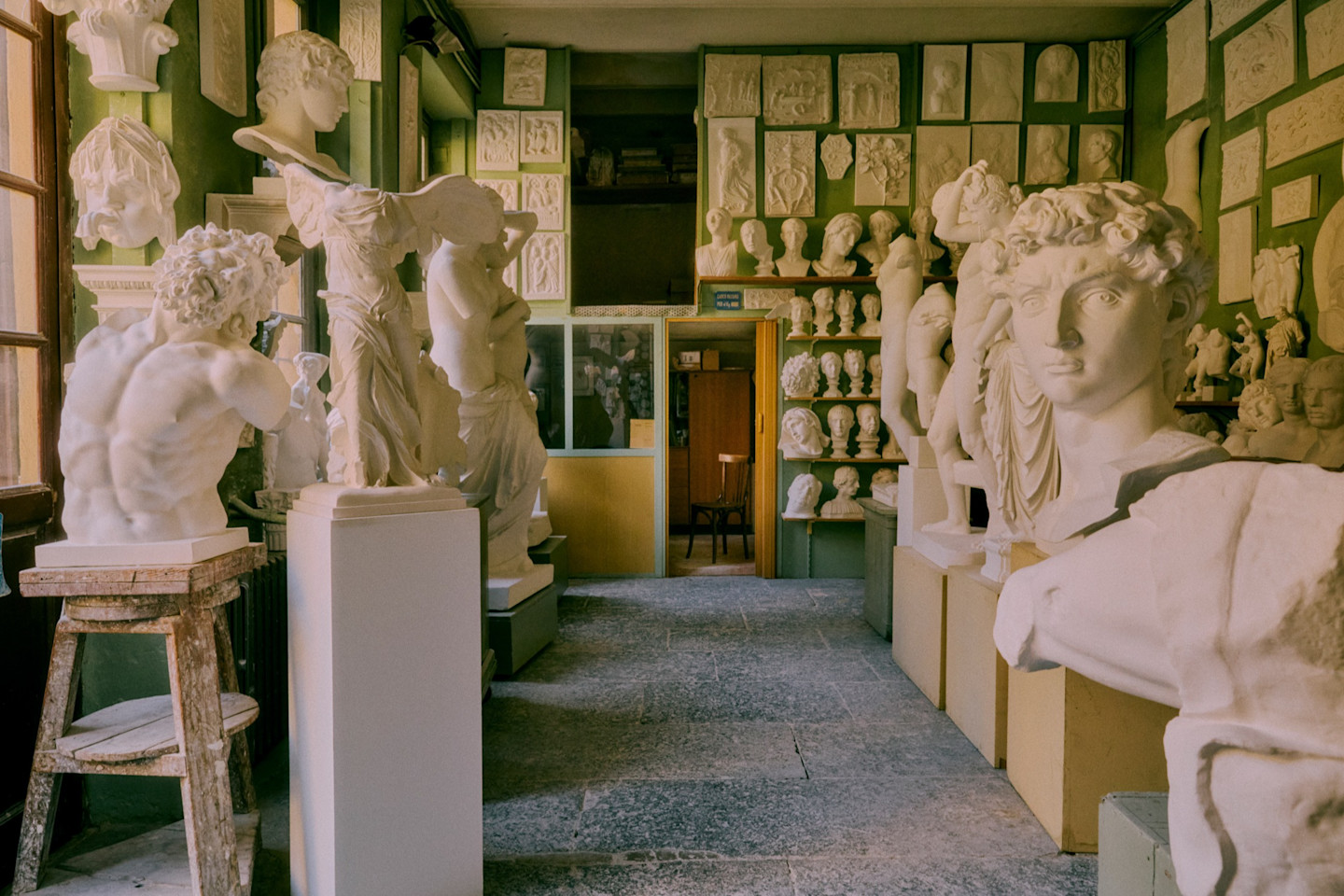
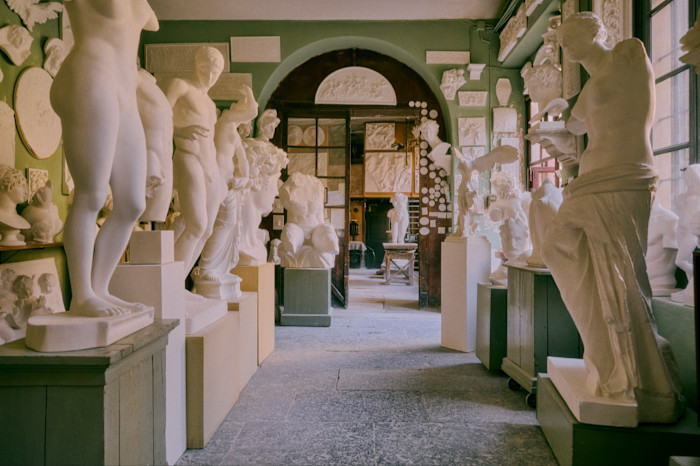
It’s an unassuming entrance for such a rarefied enterprise. The portone on Viale Montello looks like the door of any other residential palazzo on its street; the courtyard is full of modest cars, and laundry suspended from balconies swings in the hot breeze. It’s only when you venture further in that you spot the pair of old glass-panelled doors leading into the atelier of Roberto Fumagalli and Mario Dossi – a two-room wonderland, once the palazzo’s stables, now full to its ceilings with figures and fragments of all shapes, sizes and historical eras. Here are full-size sculptures, monumental busts, medallions, friezes, tracery and more, many of them painstakingly rendered in white plaster of Paris using traditional casting techniques.
Fumagalli & Dossi is the largest gipsoteca (from the Greek gypsos – plaster – and teca – collection or repository) in Italy. It is also the last remaining from what was once a grand commercial tradition in Milan. It has its roots in the neoclassical period, when the vogue for collecting Ancient Greek, Roman and renaissance works begot an industry of affordable copymaking. Today Fumagalli & Dossi is the largest provider of plaster casts to the country’s arts schools. The partners also do a fairly brisk trade to private collectors and designers from their catalogue, which is one of the most comprehensive in Europe.
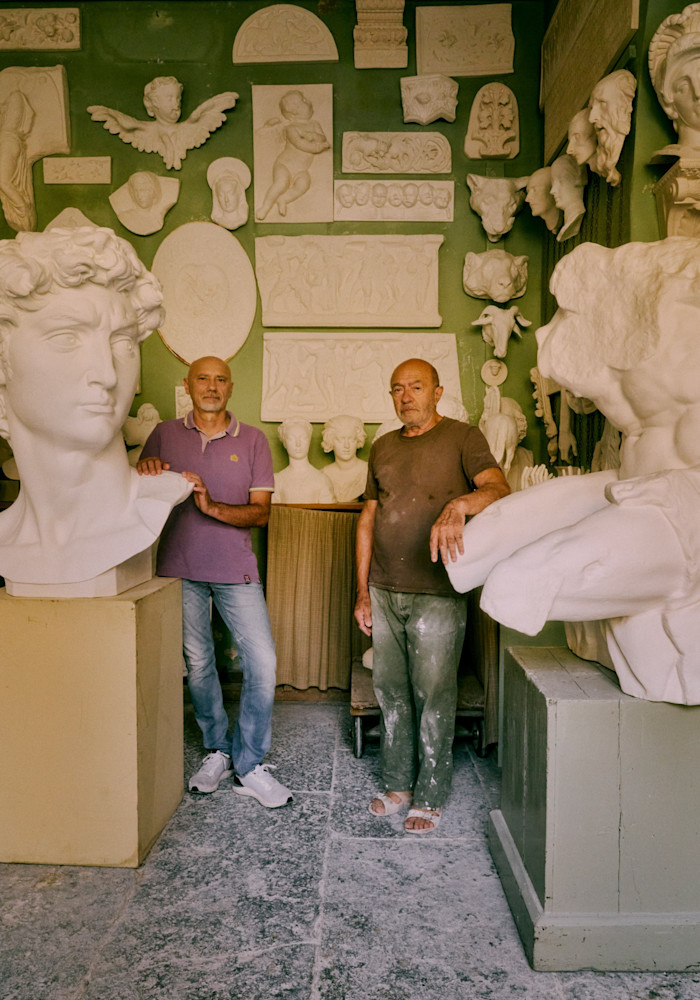
The atelier has operated with its current duo of maestri for several years, but its roots stretch back decades further. “Agostino, who was Roberto’s father, had been in the atelier since 1946,” explains Mario Dossi – a seventysomething dressed in faded-grey work trousers and T-shirt, both liberally splattered with white, his face and head covered in silver stubble. “He had worked for years with his own master, Bertolazzi, and essentially took over the business.” Dossi joined in 1969 aged 17. “Agostino and I officially created Fumagalli & Dossi in 1974,” he says. Later, Roberto became an apprentice and when his father retired he took on the partnership with Dossi. Nine years younger than his partner, Roberto is also his nephew, Dossi’s sister having married Agostino along the way. Are you keeping up? says Dossi’s faint smile.
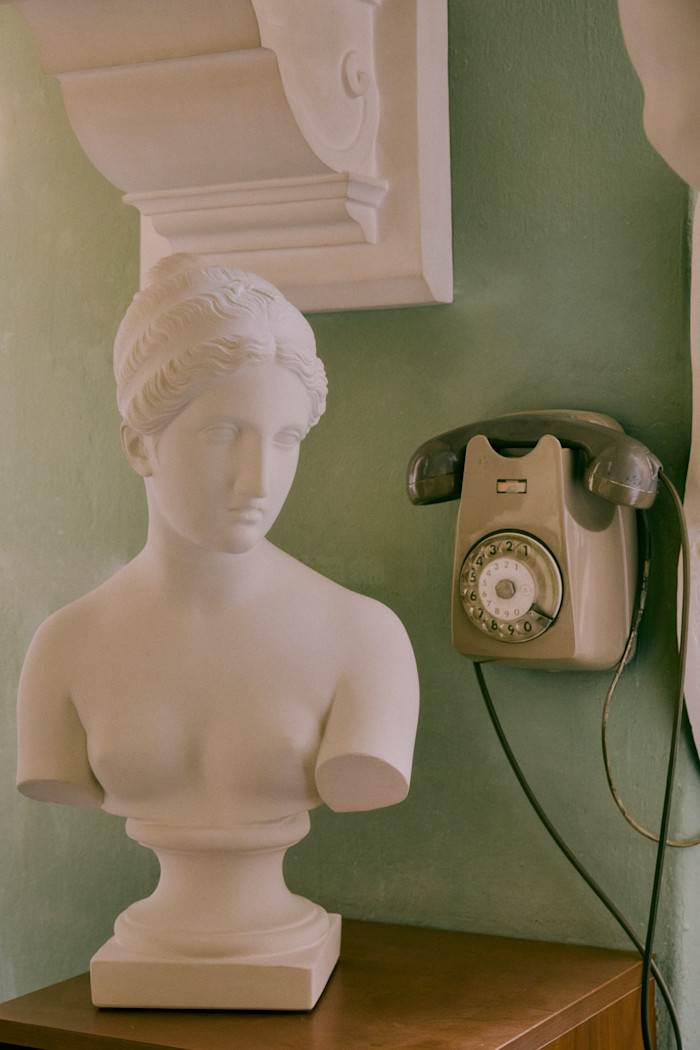
I think so; but meanwhile I am distracted by the extraordinary breadth and variety of the inventory. “There were gipsoteche in Milan for two centuries,” Dossi explains. “Most of what you see here and in the catalogue was made in the latter half of the 19th century or the very early 20th.” Once in a rare while, they will make a new cast of a specific work for a client. “But predominantly we work with casts of works from museums, all made back then.”
Says Fumagalli: “It’s our great good fortune to have the catalogue we do,” noting that some of it was inherited from his father’s maestro, Bertolazzi. “The process [of making casts of historic works in institutional collections] hasn’t been permitted for years and years.”
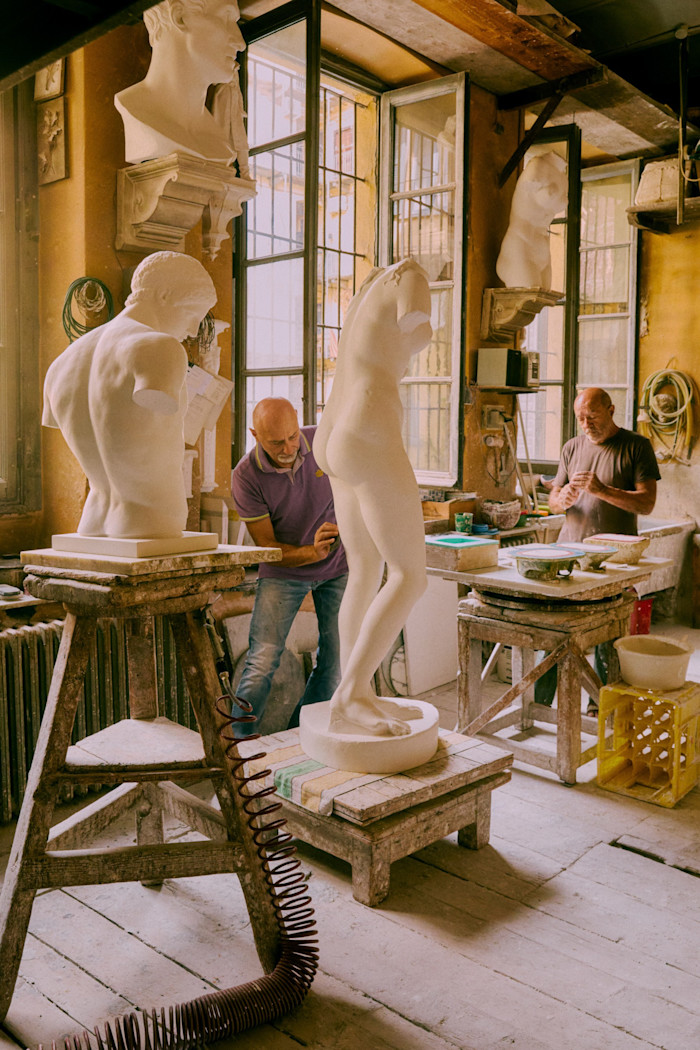
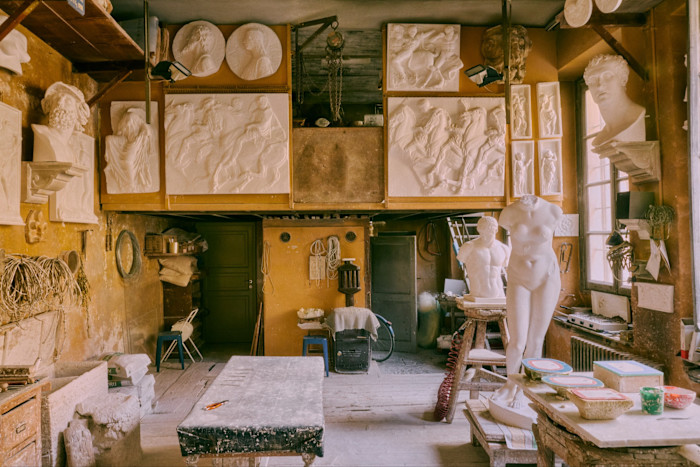
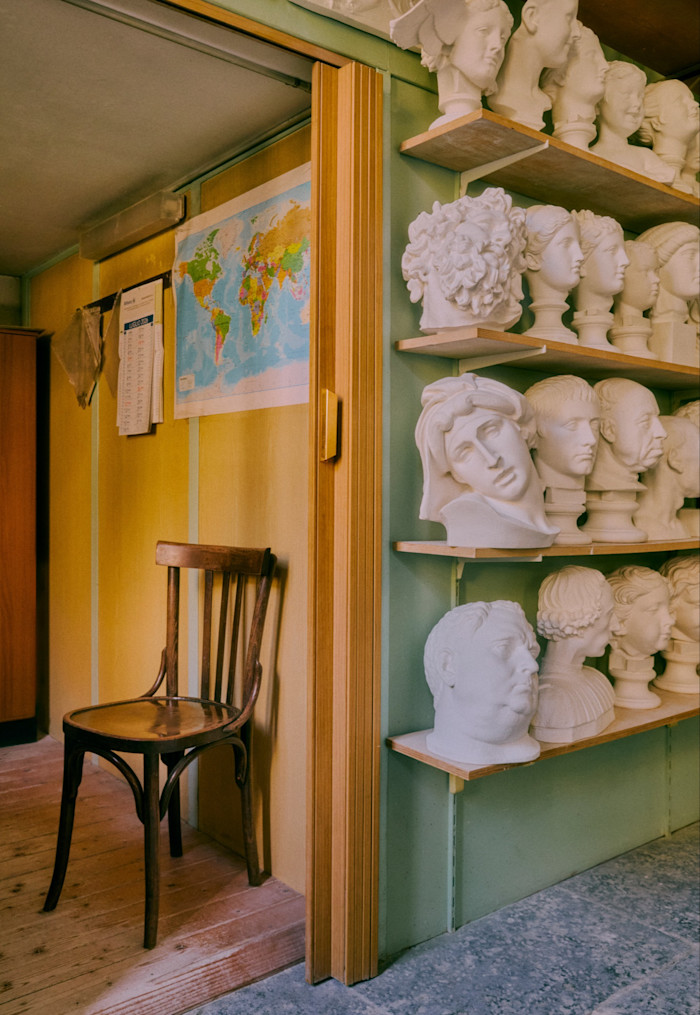
A walk around the perimeters of the two spaces –the front one, more of a showroom, painted a soft eau de nil green; the back one dustier, cluttered with equipment, its ochre-impasto walls hung with friezes – reveals faces and forms that are familiar. There are the heads of Achilles, Niobe and Nike; the ruler-straight, Ancient Greek physique of the British Museum’s 2,500-year-old Strangford Apollo; the scene of the birth of Aphrodite from the sea from the Ludovisi Throne, a 460BC marble bas-relief now in the Palazzo Altemps museum in Rome.
“They come from all over,” says Dossi. Some of the baroque and neoclassical ones are from the Galleria Borghese and many of the Greek and Roman antique pieces are from the National Archaeological Museum of Naples (“the most beautiful museum in the world”, we say in unison).
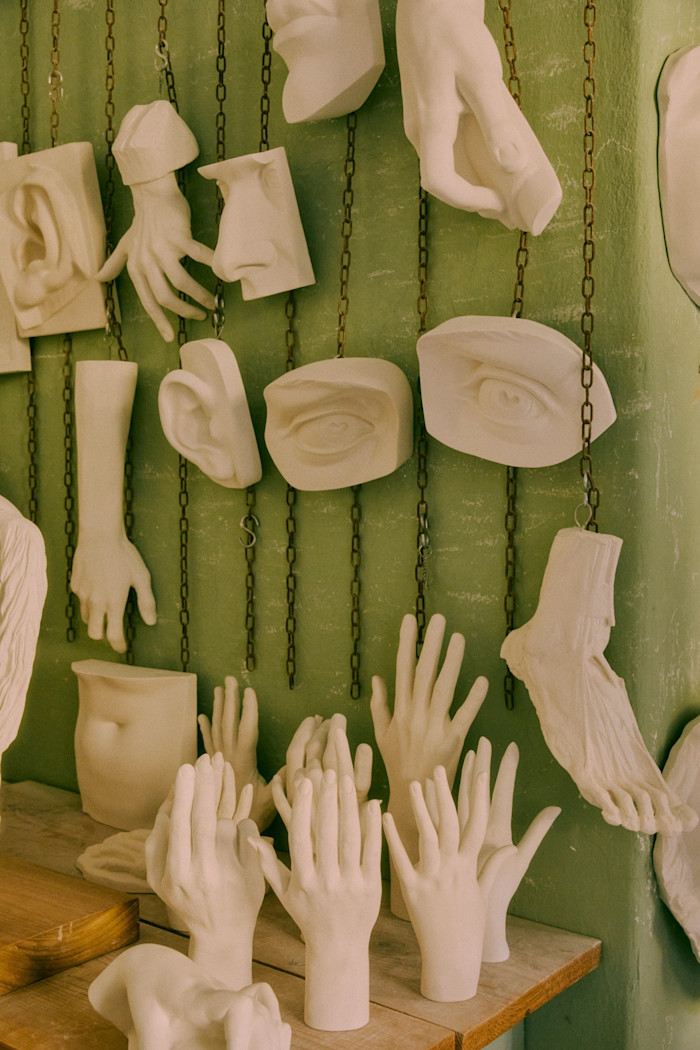
There are also shapes of a more prosaic nature: half a dozen studies of male and female hands, in various expressive gestures, sit in a cluster on one shelf, below a single foot suspended on a heavy chain. Eyes the size of palms, the brows clearly etched, float disembodied in their own neat plaster discs.
“Our work isn’t just to make new casts, but also to replace or repair old ones,” explains Dossi. Fumagalli walks me briefly through the process: a layer of rubber, no more than a centimetre thick, is applied to the original, then covered with an even thinner layer of resin, which is divided into halves. The whole is then separated into two pieces, the rubber precisely positioned inside the resin. A preliminary layer of plaster is applied to its inside, followed in some cases by a second, reinforced with pieces of jute for sturdiness; then layer upon layer of plaster, which has to dry before the next is applied. “If it’s a life-sized bust, it takes a few hours,” Dossi says. “A whole statue can take a few days.”
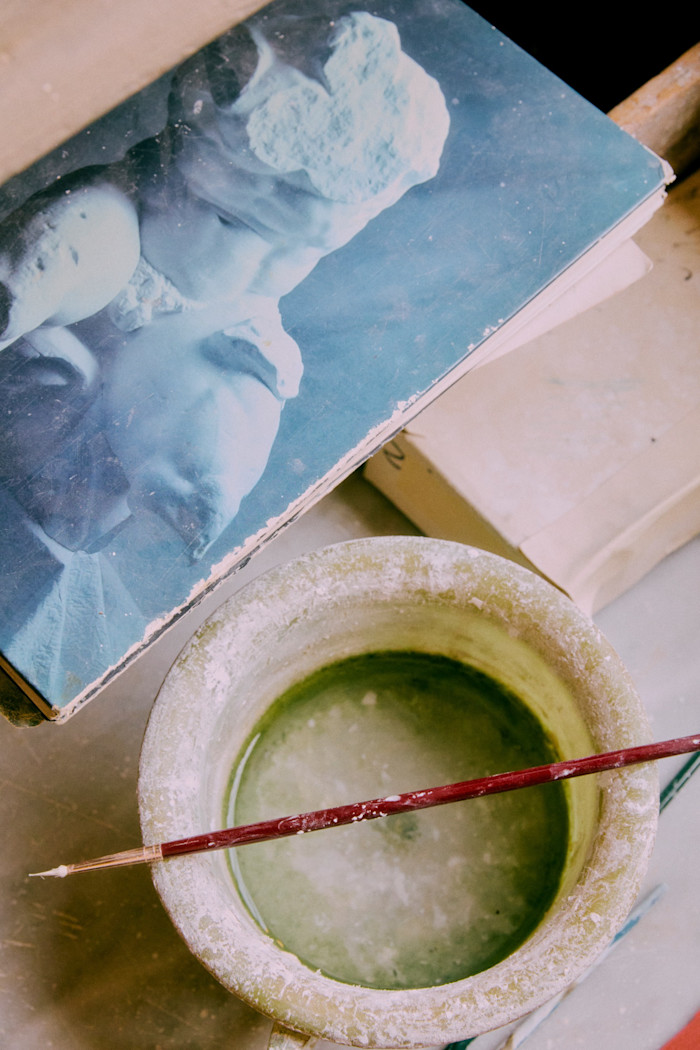
We consider the two enormous heads on one of the tables, made that morning from a bust of Athena that sits open next to them; the original bust is in a museum in Bologna. The plaster is still damp to the touch; Dossi traces his finger along the faintly visible seam on each one, like the neatest of threads, explaining how hand-workmanship always comes into play to finish each piece.
There was a time, says Fumagalli, when some of his clients were artists looking for casts on which to model bronze sculptures. That’s rarer now, and many of their private clients are design and fashion houses – “they buy or rent sculptures for shoots or shows”. The quantity they make for art schools is down compared to just a few years ago. “They don’t have the budget, more than anything else. But it’s also the advent of the information age; they work in a digital ambit more than ever before, so that of course affects demand for what we do.”
The private clients they enjoy most are what Fumagalli calls “the super-appassionati: the architects, interior designers and collectors. Of these, there are more than there were in the ’70s and ’80s” – although fewer than there were in the go-go ’90s, “when there was the lira and there weren’t as many [economic] concerns”.
A young man and woman come in and stand waiting patiently. After a moment we pause our chat while the man explains he’s looking for small models for students to train with at his art school. Dossi smiles and excuses himself to tend to them, leaving me to browse through his flawless facsimiles of history.