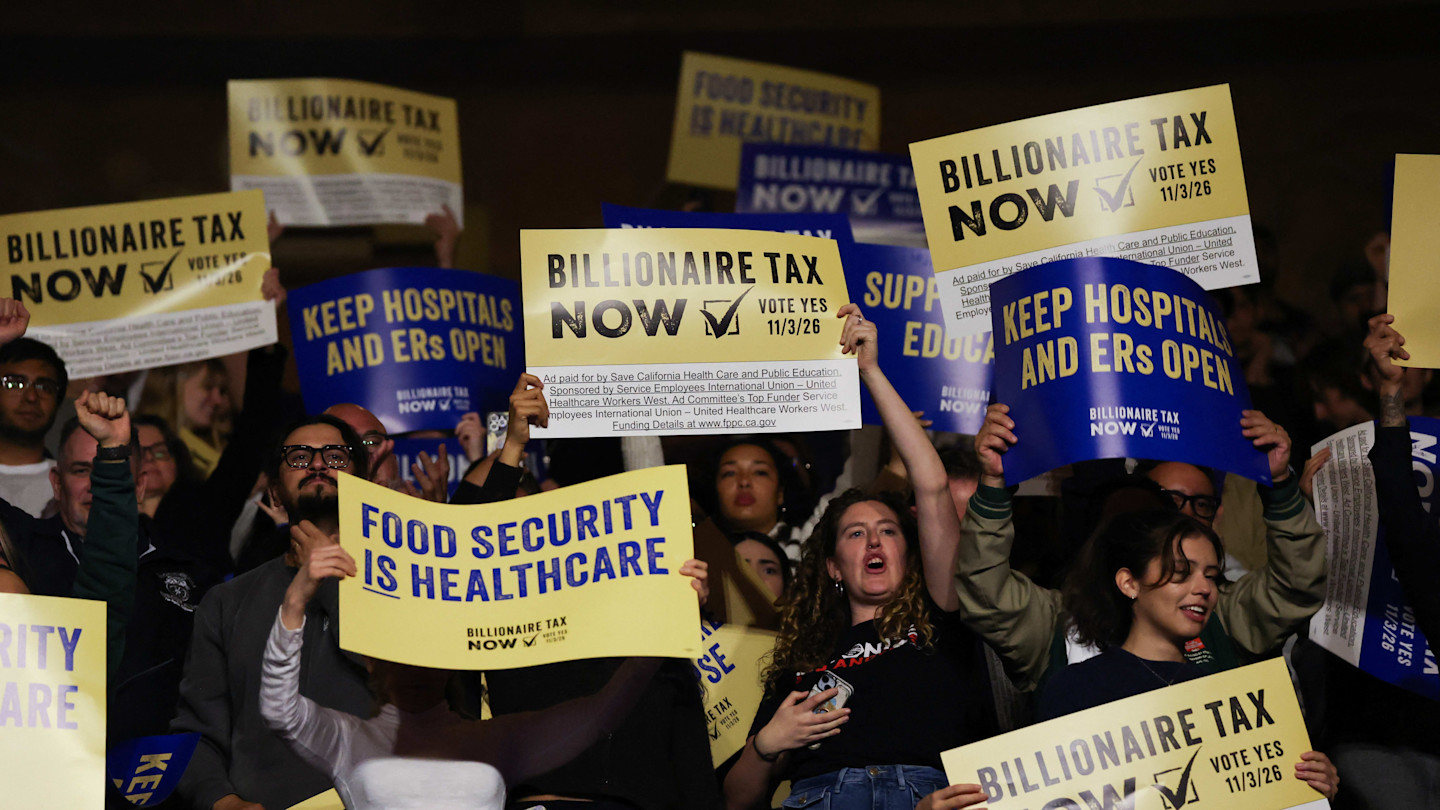
What happens in California rarely stays in California. Should the state’s voters pass a wealth tax on its 246 billionaires next month, some of them might flee to Texas or Florida. Yet the idea (known as “Prop 40”) — a 5 per cent windfall tax on wealth above $1bn — might also spread. America’s future will be deeply affected by either result. At stake is whether the US super-rich’s largely unimpeded ascent in the last generation will continue uninterrupted. The tax’s goal is thus political, not budgetary.
In fiscal terms, Prop 40 is badly designed. One-off taxes are a headache for accountants. By earmarking its roughly $100bn in revenues mostly for healthcare, it limits California’s leeway. Anyone wanting genuine reform would propose a minimum tax on those above a certain net worth (say $100mn). That would permanently shift the burden and give California’s legislators control of how to spend it. On both counts it fails.
Prop 40’s political framing is nevertheless smart. America’s anti-tax reaction began in California in 1978 with the victory of Prop 13, which put a strict lid on property taxes. That backlash spread to the nation via the presidential victory two years later of California’s Ronald Reagan. Prop 40’s goal is to trigger a corresponding backlash against untaxed exorbitant wealth. The aim is thus to shift the so-called Overton Window that dictates what is politically possible. In that respect, a yes or a no could be just as momentous for America’s future as the widely forecast Democratic midterm win on the same day. That is how California’s most vocal billionaires see it.
Chief among these is Sergey Brin, co-founder of Google, who compares Prop 40’s intent to the Soviet system that his parents fled in the 1970s. Supported by Peter Thiel, America’s most influential libertarian, Brin has spent more than $100mn of his own money to defeat it. Billionaires have also devised another measure, Prop 42, that would ban any new taxes on personal assets other than real estate. Since this would be a state constitutional ban, its approval would seal off any kind of wealth tax.
Plebiscitary democracy being what it is, Prop 40 and Prop 42 could both pass, which would trigger rampant confusion. Any such train wreck would be down to two factors. The first is the opposition to Prop 40 of Gavin Newsom, California’s Democratic governor, who leads many prediction markets for his party’s 2028 nomination. Newsom says that the tax would only make sense if it were federal. He has a point. But this stance also serves his campaign needs. Chris Larsen, the billionaire co-founder of the blockchain company Ripple, and an opponent of Prop 40, has promised to boost Newsom “any way we can”.
The second cause of defeat would be a disinformation campaign, which says the tax is really an “everyone tax”. In a recent ad, a Trojan hog filled with scowling bureaucrats is unleashed on a middle-class Californian neighbourhood. They assault old people and children in a scramble to seize assets such as bicycles, televisions and surfboards. Their message is pure demagoguery. Prop 40’s tax threshold could be lowered only with a two-thirds majority of California’s assembly and within the legal spirit of the measure. Conflating billionaires with ordinary Americans is a bold sleight of hand. But the campaign has depressed support for Prop 40, which is now too close to call.
Brin is no fool. Though America’s top income and capital gains tax were both close to double the rates in the 1970s of what they are today (at just under 40 per cent and 20 per cent, respectively), his Soviet analogy strikes a nerve with other wealthy Americans. Their fear is that Prop 40 is the thin end of the wedge. Brin also claims that the money would be squandered by a failed bureaucracy. That point has some merit. To anyone who thinks California’s state is efficient, I have a high-speed Los Angeles-San Francisco rail link to sell you.
Yet Brin, Thiel and others would be more convincing if they were championing any idea of government reform. Their true goal appears to be to disable it. The line from the US Supreme Court justice Oliver Wendell Holmes Jr that “taxes are the price we pay for civilisation” is as true today as when he made it a century ago. A rational billionaire would see the merits of buying social peace. An enlightened one would acknowledge his debts to federal science, public education and chance.
Alas, there are few such super-rich to be found. Should Brin get his way on November 3, it could turn out to be a Pyrrhic victory.