
The enduring financial market story of 2026 is the rise in long-term government borrowing costs. The median rise in 10-year sovereign yields in G7 countries has been one percentage point, causing a nasty shock for finance ministers.
The big question is why yields have risen so much. Is it because investors want more compensation for perceived fiscal unsustainability? Does it reflect expectations of much faster growth? Is there a global war for investment funds and limited lenders? Has the Iran war raised the prospect of continued high inflation? Is it that central banks signalled the need for persistently higher short-term interest rates and markets are parroting this back? Have monetary policymakers lost inflation-fighting credibility? Or are bond markets now dominated by flighty hedge funds that can make huge returns if they get a negative narrative to stick?
Everyone has their own answers. Federal Reserve chair Kevin Warsh said there were three broad reasons at a press conference in September: US economic strength, competition for capital and difficult geopolitics.
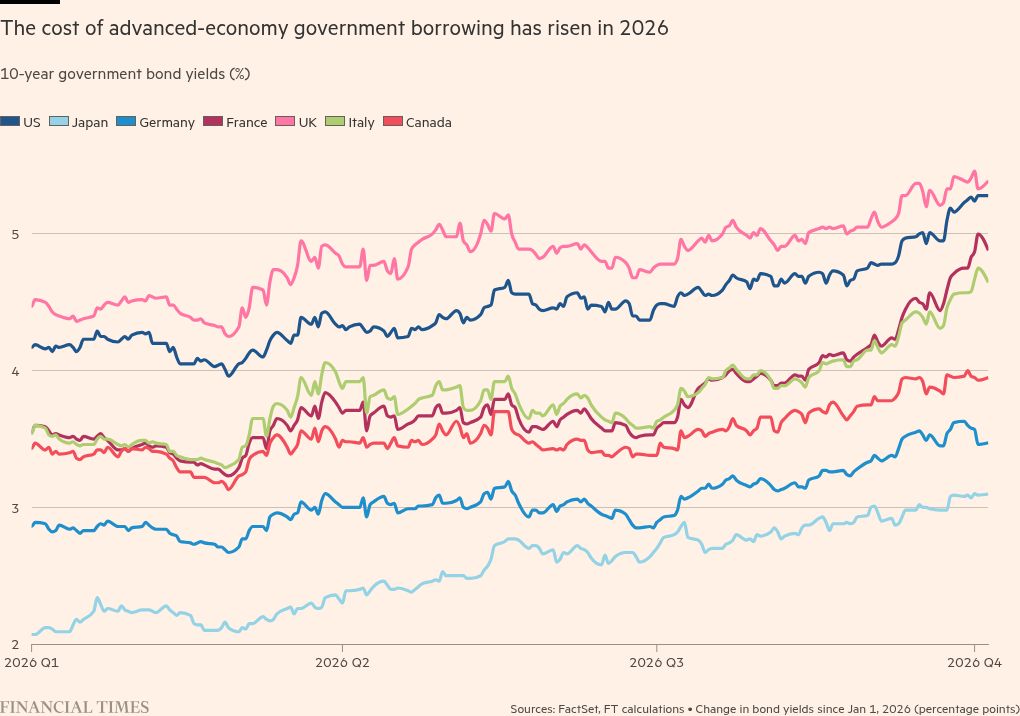
The more important thing he said, however, was that explanations for changes in bond yields “tend to be overdetermined”. In other words, there are many competing but unprovable theories. And he is right.
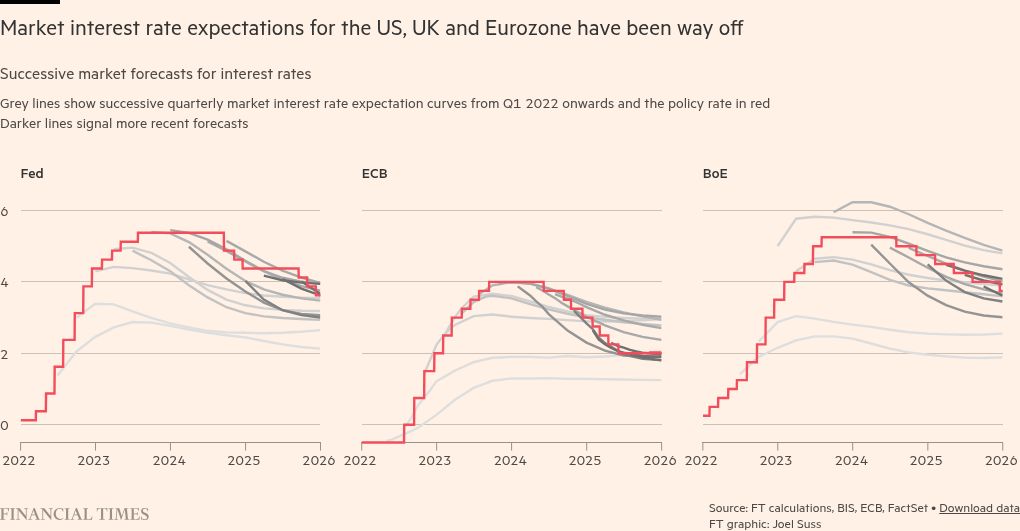
For example, you might argue that expectations of short-term interest rates have changed. But these measures are horribly volatile and often wrong, as the chart below shows.
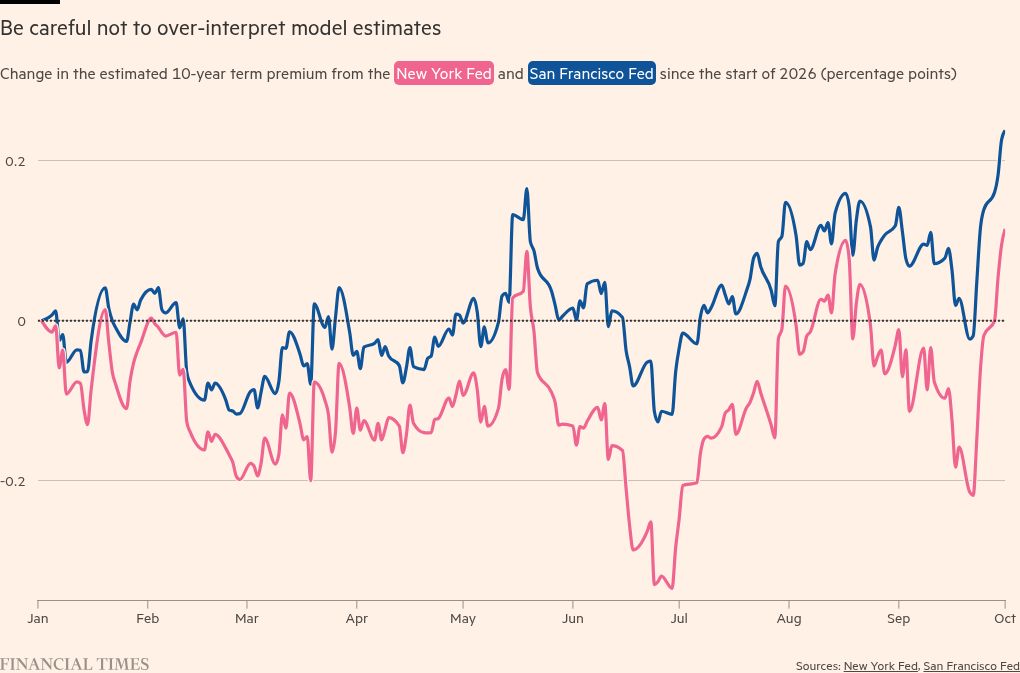
Or perhaps investors need more compensation for holding long-term debt (a rising term premium). But again, term premiums cannot be measured with any precision. The New York and San Francisco Feds both estimate the term premium on a daily basis using different methods to wildly different results. The New York Fed tends to report that the US 10-year term premium has decreased this year, while the San Francisco Fed says it has increased, as the chart below shows.
Warsh is right to talk only in broad terms about what bond markets are telling us. So what can we confidently say?
Central banks have broadly maintained inflation-fighting credibility
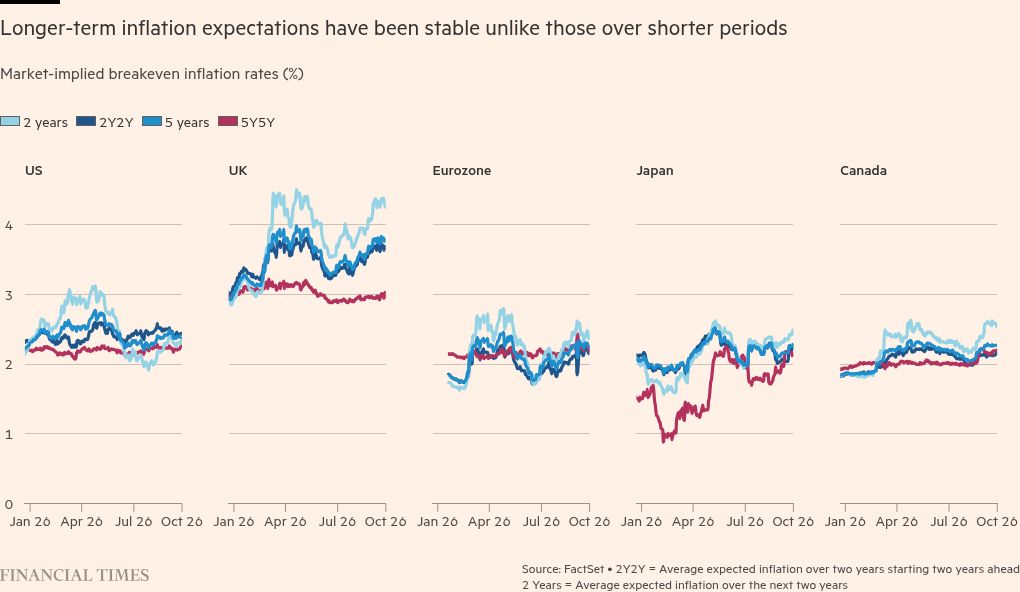
The difference between the yield on nominal and inflation-linked bonds provides an estimate of market inflation expectations. Ignoring the fact that inflation-linked bond markets are thin in some countries, break-even inflation expectations derived from this decomposition give an encouraging result for central banks: their inflation-fighting credibility remains intact.
The red line in the chart below shows longer-term market inflation expectations for the five-year period from five years ahead (that is, from 2031 to 2036). These have broadly been stable and close to target in most countries. The UK stands out here mainly because of a difference between the inflation measure used to uprate gilts and the inflation measure the Bank of England targets.
Rich-world five-year five-year forward market inflation expectations have been volatile this year thanks to the war in Iran. But higher UK rates suggest the BoE should probably be concerned that it appears to have less credibility than other central banks.
To keep inflation controlled, central banks are expected to set higher interest rates
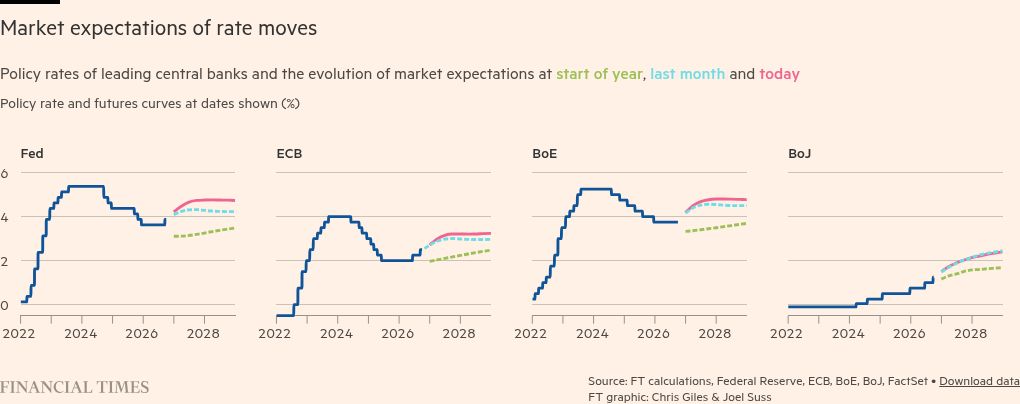
There is no doubt that short-term interest rate expectations have risen across advanced economies. At the start of the year, the Fed was expected to cut rates to almost 3 per cent and now is expected to raise them to 4.75 per cent. That is a huge shift. There have been similar shifts in other countries’ expected policy rates, too. This is clearly an important underlying factor explaining the rise in bond yields.
Nasty geopolitics and higher oil prices are part of the story
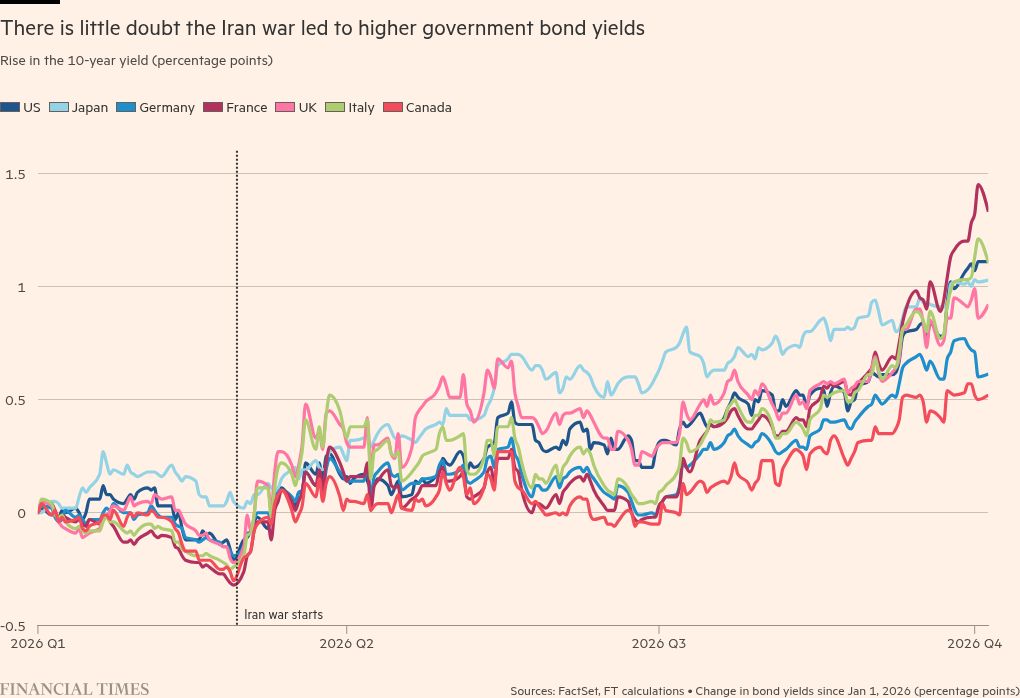
The single clearest cause of the rise in bond yields, as the chart below shows, was President Donald Trump’s decision to initiate war with Iran, before which yields were generally falling. They moderated as tensions subsided in June and have risen since, along with the intensity of the conflict.
These movements suggest investors expect central banks to set higher interest rates to keep inflation under control in a world of fraught geopolitics and higher volatile energy prices.
Are markets parroting back signals sent by central banks?
This is a possibility. Recent research by Paul Beaudry, Paolo Cavallino and Tim Willems found a link between movements in long-term yields since 2020, US non-farm payroll data releases and central banker speeches. There is no doubt that central banks became more hawkish this year, but it is quite a leap to say higher yields are caused by loose talk from officials alone. Moreover, the Fed and European Central Bank have recently attempted to talk down interest rate expectations without huge success.
Are high yields an expression of economic strength?
Warsh thinks so, even though signs of immediate economic strength are much clearer in the US than elsewhere. In reality, signs of US strength are exaggerated occasionally by very strong quarterly figures, which are then annualised per convention. For example, the Atlanta Fed’s GDPNow model estimates 3.7 per cent real annualised growth in the third quarter, despite real growth rates in the first and second quarters being nothing to write home about.
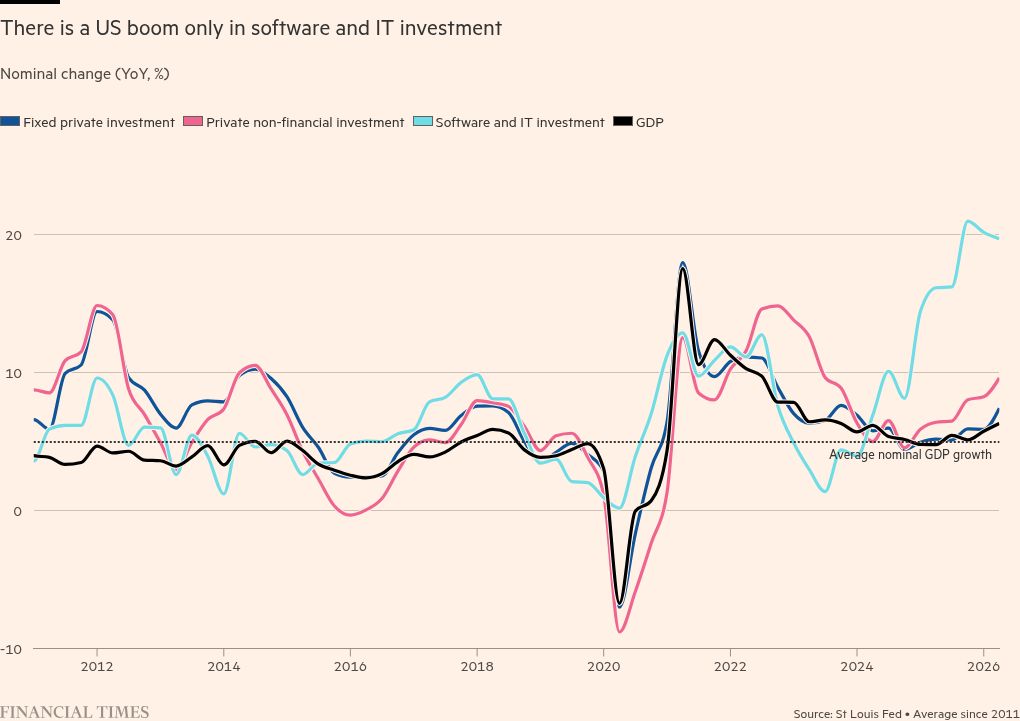
Since we are looking at nominal yields, it is perhaps more informative to examine the performance of the nominal US economy. For sure, software and IT investment grew about 20 per cent in the year to the second quarter of 2026, and overall private non-financial investment grew almost 10 per cent. But GDP growth was just a little more than the average since 2011. And anyone who remembers 2022, when the US Inflation Reduction Act led to excitement about green growth that did not materialise, should be wary of predicting a massive increase in US growth rates.
That said, I have added the chart below not to say Warsh is wrong, but to show that if economic strength is the cause of higher yields, it must be an expectation of strength. And expectations are not always correct.
A war for capital
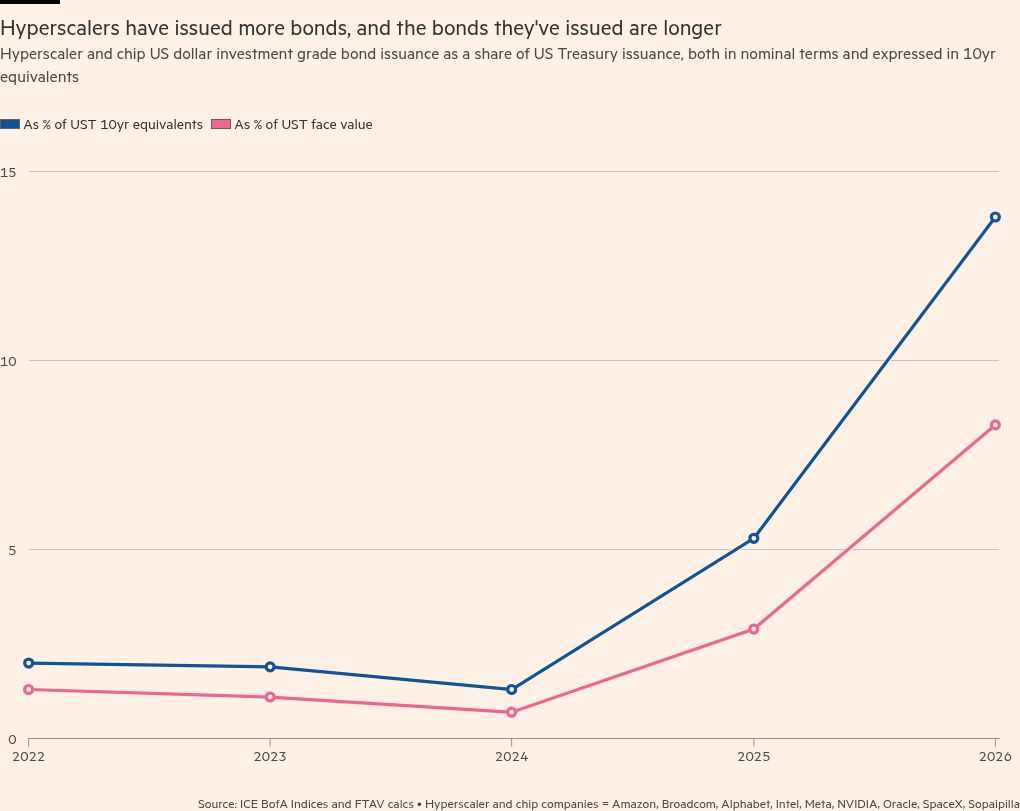
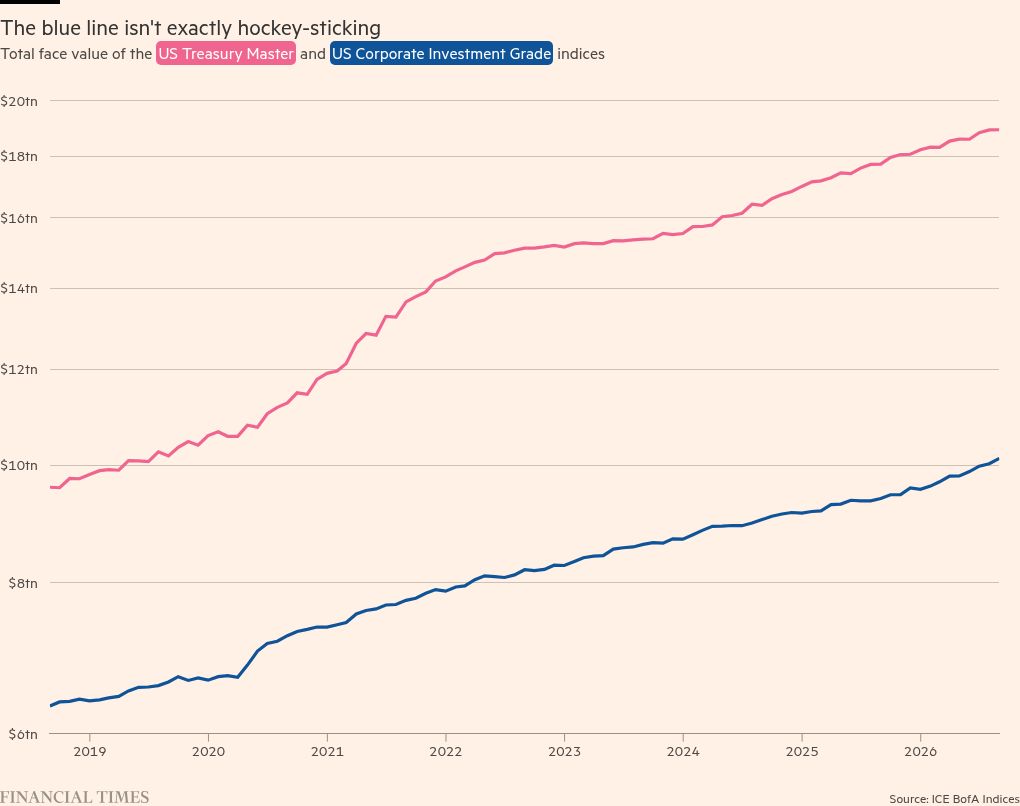
Higher yields could simply reflect a massive increase in demand for investible funds that is not met by increased supply. The chart below, which I have borrowed from Toby Nangle’s excellent piece, shows that debt issued by AI hyperscalers accounts for 13.8 per cent of US Treasury issuance, up from only 1.3 per cent in 2024. In other words, there has been a big increase in demand for debt from the AI sector.
A very important qualification, however, is that overall US corporate debt has not increased as a proportion of US Treasury debt, as the chart below shows. It is therefore hard to argue that AI or US corporate investment is the cause of higher global bond yields.
That said, there could still be a general change in the balance between overall debt issuance and debt demand among investors. To the extent that the war for capital is a valid explanation of higher long-term yields, it is more a story of excess debt overall than one to be pinned on the tech bros. Recent Fed research suggests that a $100bn increase in US Treasury supply raises five-year yields by 0.03 percentage points.
What about fiscal incontinence?
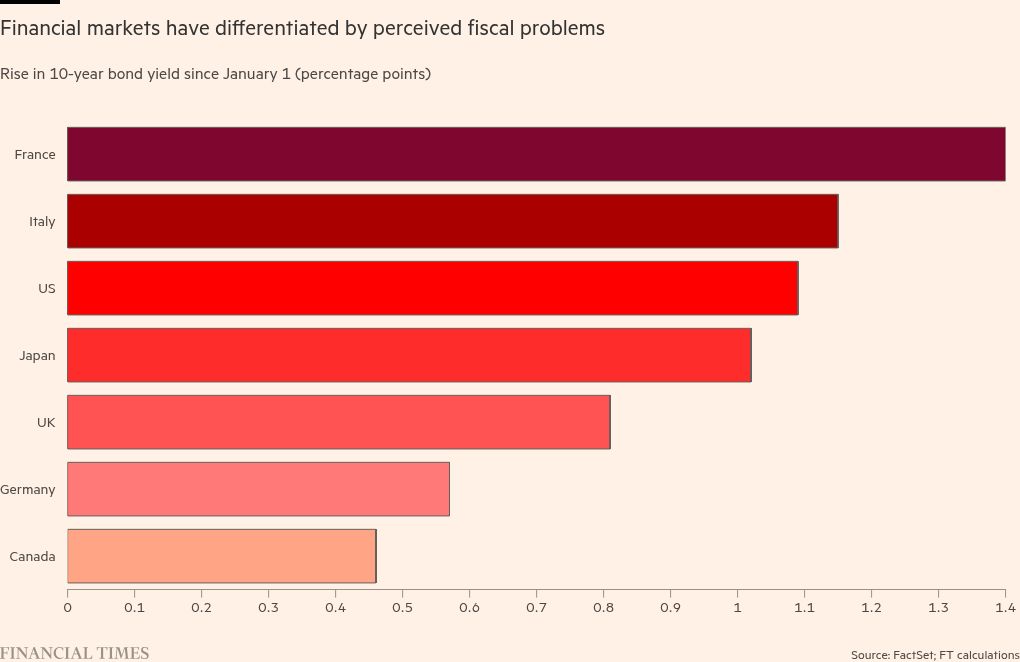
No one I have spoken to thinks government debt markets in advanced economies are currently disorderly or signalling impending default. But countries that have very high levels of debt, difficult politics or no coherent plans to reduce their deficits have seen a bigger rise in bond yields than elsewhere, with France, Italy, the US and Japan performing worst. So some explanation behind the yields story must be investors wanting more compensation for fiscal risks.
Could it all be financial market fashion?
As you can see, the real causes of rising yields are rather hard to pin down with any precision. This problem is exacerbated by a huge increase in hedge fund activity in government bond markets, with these potentially flightier investors replacing stickier pension funds, insurance companies and foreign governments. As the FT reported last week, some hedge funds have made a lot of money by betting against government bonds and ensuring the negative narrative sticks. This may well be an example of government bond markets failing to be as efficient at pricing as we might like, especially if hedge funds are using momentum strategies to position themselves.
So what?
Remember that we cannot know for sure what is causing bond yields to rise. The one thing we know quite clearly is that central banks still have broad inflation-fighting credibility. On top of this, there is strong evidence that nasty geopolitics are playing a role, and that financial markets are reflecting central bankers’ increased hawkishness which, in turn, is justified by the fundamentals. Moreover, there are signs that high government debt issuance is applying upward pressure to yields and that markets prefer lending to countries doing something about their deficits. There is weaker evidence that high yields are caused by current economic strength, borrowing by AI companies or the risk of sovereign default.
Of course, none of these explanations are mutually exclusive.
What I’ve been reading and watching
Fed officials have been damping speculation about a back-to-back US interest rate rise later this month.
Philip Lane, ECB chief economist, reminded people yesterday that energy prices were not the sole determinant of Eurozone interest rates. Other forces warranted more caution, he said.
Sanae Takaichi, Japan’s prime minister, has felt the need to reassure markets that her government will not engage in rapid public spending growth, which is the opposite story she told in July.
The US jobs market is still fine.
One last chart
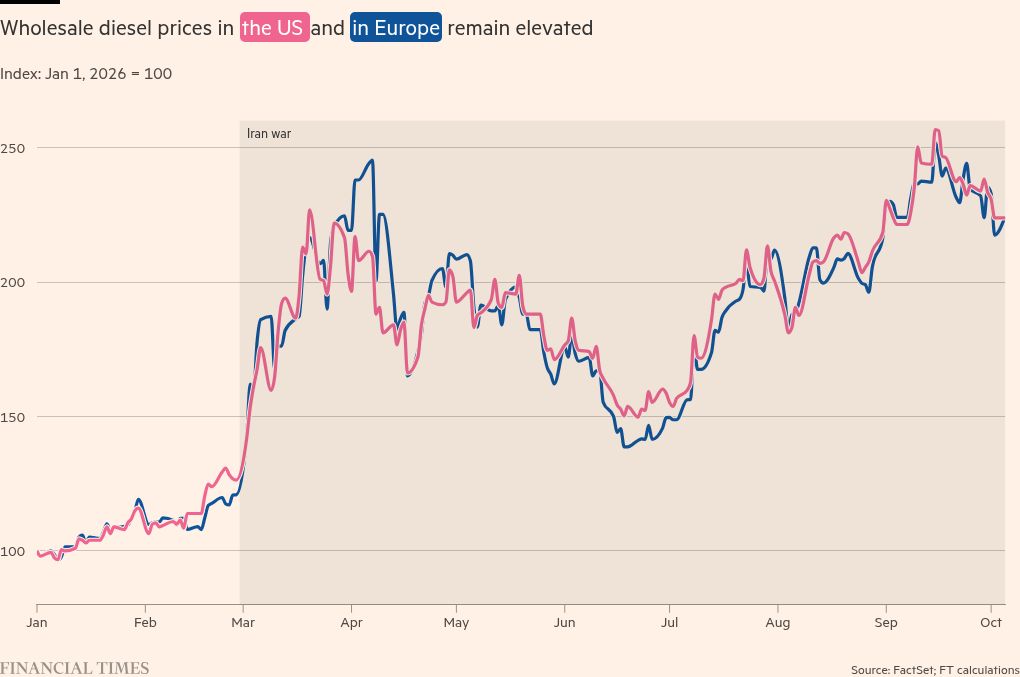
The G7 agreed on Friday to release 100mn barrels of crude oil and diesel over the next four months, including a “substantial” release of diesel reserves within the first 20 days. Diesel prices dropped on the news but were rising again yesterday. Wholesale diesel prices remain about twice as high as what they were before the Iran war, as the chart below shows.
The price drop seen at the end of last week will not substantially relieve pressure on US Republicans as the midterm elections approach.
Central Banks is edited by Harvey Nriapia