There is one big takeaway from recent merger discussions between Sainsbury’s and its rival Morrisons: UK supermarkets no longer believe that mergers are completely unthinkable. If they are right, and the competition watchdog has softened its hawkish stance on consolidation among the country’s grocers, it ought to be good for Sainsbury’s itself — and bad for market leader Tesco.
Why supermarkets would like to merge is no mystery. There are too many of them, chasing a market where demand is not growing. Discount chains Aldi and Lidl have taken about 10 percentage points of market share over the past decade, taking sales from private-equity-owned Morrisons and Asda, and profitability from everyone. Tesco generates an operating margin of only 4 per cent. Sainsbury’s manages about 3 per cent. Bigger supermarkets are better at fighting price wars.
Until recently, tie-ups weren’t on the cards: the Competition and Markets Authority blocked a proposed union of Sainsbury’s and Asda in 2019. Since then, however, it has changed its definition of discount retailers to include them on the same terms as supermarkets. Factoring them in fully would change the calculus on national market share and competition within specific regions, two of the most important considerations.
In any future consolidation, Sainsbury’s is best placed to play kingmaker. With 15 per cent of the market, it could combine with either Morrisons or Asda and still be smaller than Tesco in national market share terms. Its skew to the south of England also means it could buy either Morrisons or Asda, both of which have larger footprints in the north, without having to dispose of too many stores.
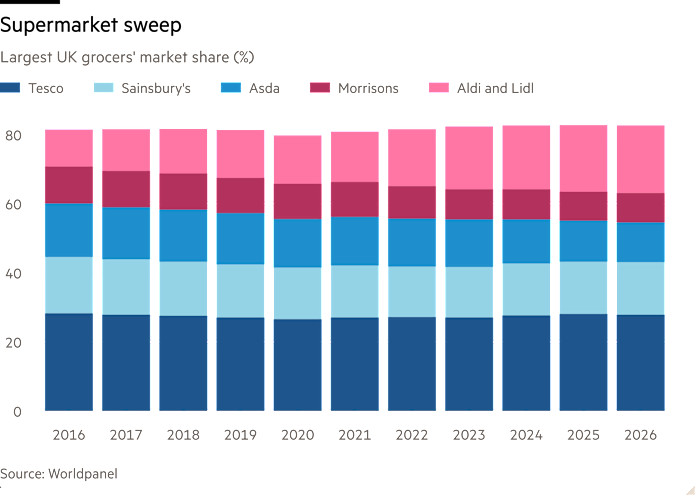
Having broken off talks with Morrisons already, Sainsbury’s risks seeing its struggling rival combine with Asda instead. The two would have roughly 20 per cent of the national market, overtaking Sainsbury’s as the number two. But both businesses have large positions in the north of England, meaning they would probably have to dispose of a big chunk of their store base. Sainsbury’s would be an obvious potential buyer, and — as a larger operator — would likely be able to outbid smaller groups such as Waitrose and Marks and Spencer.
Besides, it would be rash to conclude that Sainsbury’s and Morrisons can’t still find terms that appeal to both sides. The sticking point may well be price: CD&R bought Morrisons for £9.8bn, equivalent to 9 times ebitda; Sainsbury’s trades at nearer 5. But there is much to be gained if that obstacle can be surmounted. In 2018, the retailer estimated that buying Asda would enable it to lower prices on essentials by 10 per cent. Achieving that would roughly halve the gap with the discount chains.
What, then, becomes of the market leader? While Tesco might be able to pick up assets here and there, with a near 28 per cent market share and widespread local presence it is too big to take part in any meaningful consolidation. It has had a good run of late: since 2020, it has grown its market share by 1.3 percentage points. There’s no potential combination that would be bigger than Tesco, at least — but an outbreak of M&A would give it a run for its money.