Europe has a Nimby problem when it comes to banks. Politicians, regulators and executives agree the continent needs cross-border consolidation, just as long as it’s not their banks being consolidated. An agreement between France’s BPCE and Spain’s Sabadell offers an imperfect way to tiptoe around the issue.
BPCE has bought a “friendly” 7 per cent stake in Sabadell, worth around €1.2bn at Monday’s closing price. It will take a seat on Sabadell’s board and the two groups will consider ways to work together. That could mean, for example, BPCE-owned Natixis providing investment banking services to Sabadell’s business customers. BPCE says it won’t lift its holding above 9.9 per cent.
BPCE will be hoping the capital buys it some of the upside of an acquisition — in the form of indirect exposure to the fast-growing Spanish economy — without the political wrangling. European cross-border deals tend not to include many cost savings, owing to the continent’s patchwork of different regulations, so it isn’t missing out on much there.
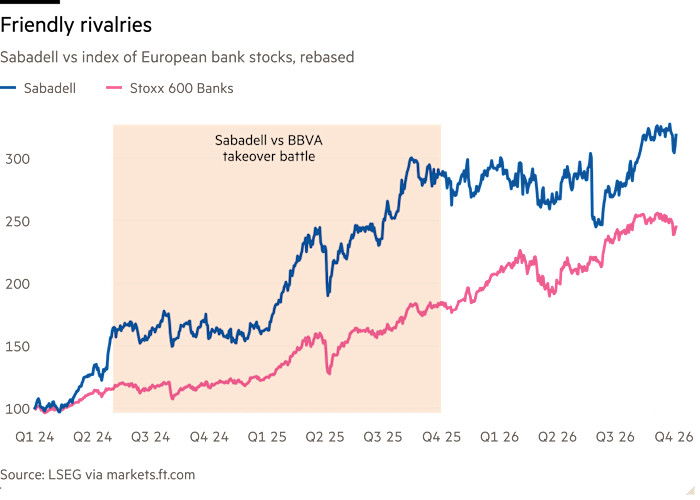
If BPCE did eventually decide it wanted full control, spending a few years getting to know Sabadell’s board and local politicians could smooth the way. In the meantime, it is busy with the integration of Novo Banco, which it bought for €6.4bn last year. Taking a stake in Sabadell makes it harder for other bidders to swoop in while it is distracted. Sabadell, meanwhile, can focus on its standalone strategy without worrying about another hostile bid, after it spent 18 months fending off local rival BBVA.
UniCredit’s Andrea Orcel has had success with a more aggressive version of this strategy. The Italian bank earned healthy returns from investments in Germany’s Commerzbank and Greece’s Alpha Bank even before it launched a bid to take control of Commerz earlier this year. And, once it became clear that UniCredit was likely to win, previously recalcitrant German politicians became more willing to negotiate.
There are downsides, however. Minority investments tie up capital that could be used elsewhere, and give financial exposure without much control — Sabadell and BPCE are on the same page for now, but a crisis or simply a change of strategy could leave the French bank lumbered with a stake to offload at a loss. And if the mooted strategic partnership were truly attractive, it should be possible without BPCE taking a stake. Any investment, then, needs to be attractive on its own terms — banks shouldn’t buy in solely as a means to an end.
Step back, and there’s a bigger issue. Europe needs larger banks to support investments in defence, energy and infrastructure. That is why former central banker Mario Draghi and others have been pushing for banking consolidation. But that requires things that don’t yet exist, such as harmonised regulation and acquiescent local politicians.
Those projects are needed now, not in 10 years. So while slow-motion takeovers might be the best available way for bank investors to edge towards a more efficient industry, for Europe more broadly they are very much a consolation prize.