“To get rich,” according to a saying often attributed to Deng Xiaoping, “is glorious.” The great Chinese reformer’s slogan became synonymous with his campaign to open the country up to the outside world and its capitalist forces.
And over decades of astronomical growth, many in China did get rich. Today, the country boasts the world’s second-biggest economy, with more than 1,000 billionaires and 5mn millionaires.
Now the pendulum is swinging back again. Strongman Xi Jinping wants those who benefited the most from China’s economic ascent to increase their contributions back to the state, embarking on what could be the most ambitious global tax hunt in history.
From October 22, authorities will begin collecting a 20 per cent tax on dividends and interest earned from offshore trusts, explicitly targeting wealthy Chinese who shelter their assets overseas.
Analysts at Barclays view the measures as “potentially the first steps” in a broader campaign to “[expand] scrutiny to areas such as exporter earnings held offshore, overseas investment income, overseas employment income and, over the longer term, estate or inheritance taxation”.
The sudden move announced this summer came as a shock to many of China’s wealthiest people, arriving at a pivotal moment when the country faces a generational handover of wealth. Many Chinese entrepreneurs who built fortunes during the early decades of reform are nearing retirement, raising pressing questions about how their assets will be passed on, who will take control of the family empires — and who will pay the taxes.
The shockwaves have been felt in financial, legal and property industries across Asia. Hong Kong, Singapore and Tokyo are in flux as their status as havens for money channelled offshore from China faces an existential test. Others, including New York bankers, spy an opportunity to shield Chinese customers from their country’s taxman.
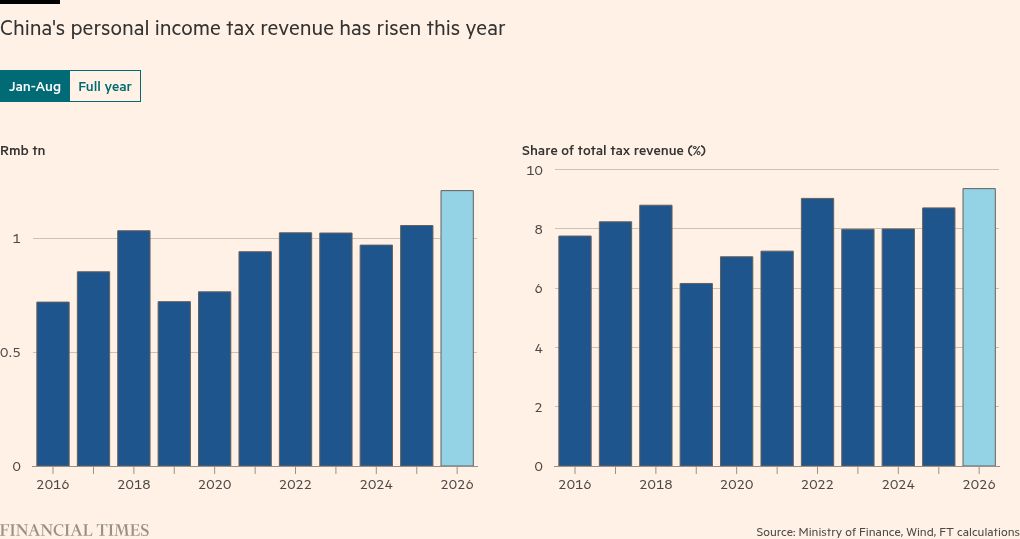
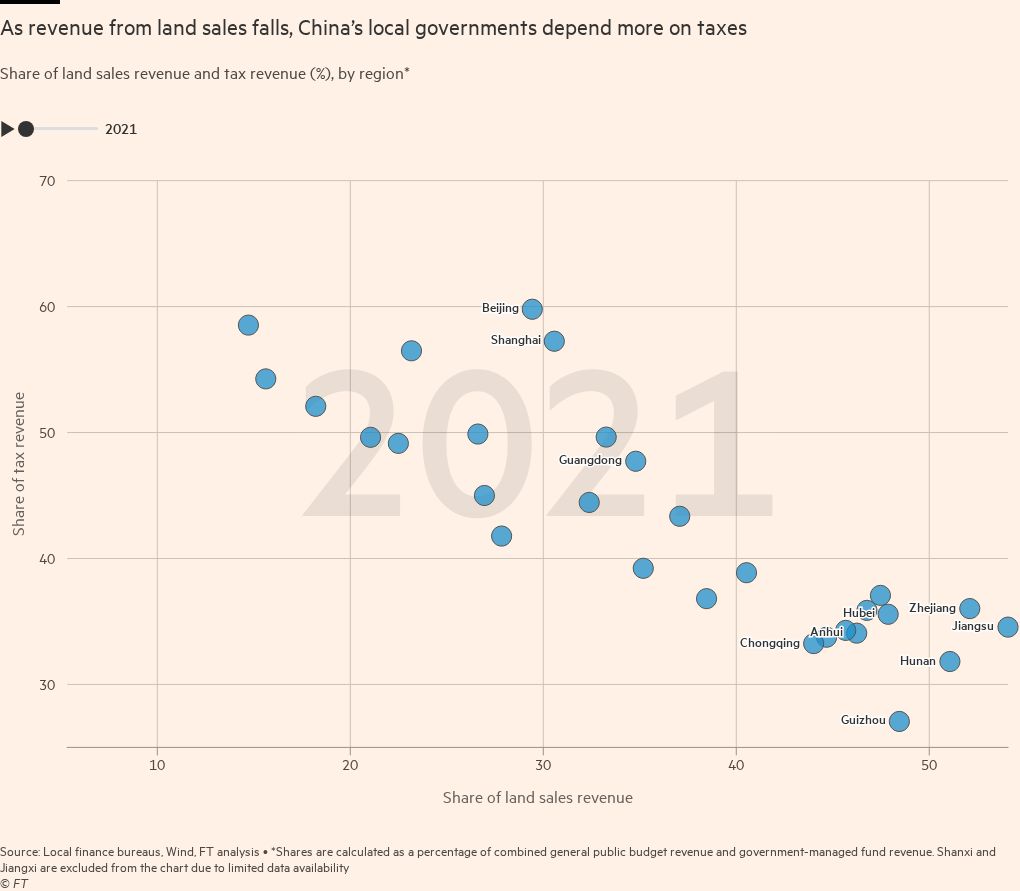
If successful, the campaign has the potential to help Beijing fill a deepening fiscal hole in central government coffers. Revenue collected by local authorities from land sales has plateaued or fallen, and the central government has been siphoning more funds to provinces in recent years to cover basic services such as education and health and to pay civil servants. The situation is “becoming untenable on [its] current trajectory”, says Victor Shih, professor of Chinese political economy at the University of California, San Diego. Technocrats “have to find another source of revenue”.

It could also bring China’s tax system in line with the US and Europe. “For China, wealth became international much faster than the tax system did,” says Lizzi Lee, a fellow at the Asia Society Policy Institute’s Center for China Analysis. “Now the tax system is just closing that gap.”
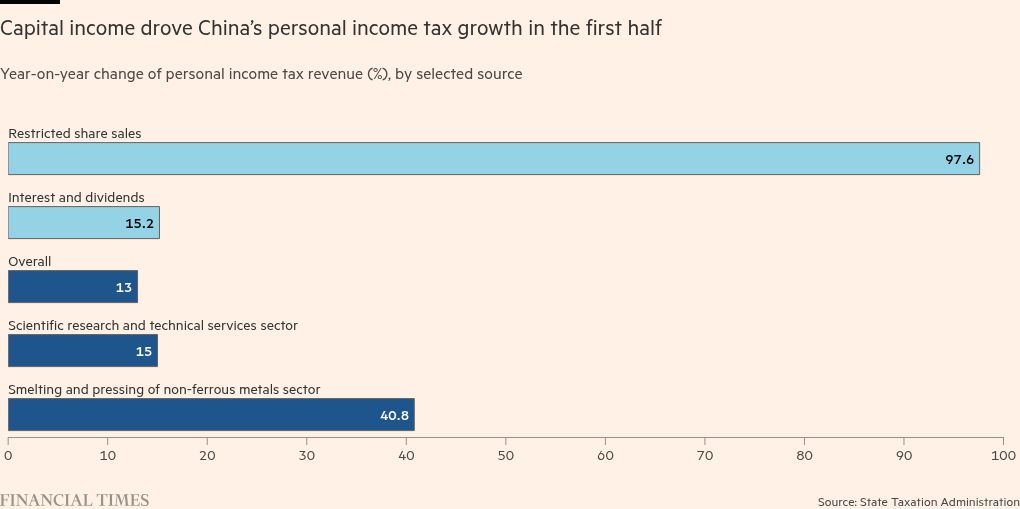
But the campaign also serves Xi’s long-term desire to redistribute wealth in China, tackle inequality and create a more egalitarian society. Redistribution and taxation are a means of achieving “common prosperity”, he wrote in the fourth of his five-volume collection of speeches and essays, which is “an essential requirement of socialism with Chinese characteristics”.
It marks a further step along his journey of redrawing the social contract between the business elite who helped propel China’s rise and the ruling Communist Party.
“The shift in focus is away from the ‘to get rich is glorious’ mantra of Deng Xiaoping,” says Willy Wo-Lap Lam, a China expert and fellow at the Jamestown Foundation, a US think-tank. “Xi frowns on wealth accumulated by the filthy rich.”
The brass tacks of Chinese tax
The news came via a typically bland notice issued by the national tax office.
On July 24, Beijing announced it would begin taxing income generated by offshore trusts. Not only would this be retroactive, but it would also be levied at numerous points, from when the trust is established, as the underlying assets appreciate, and including when income is realised and distributed to beneficiaries.
A further one-off 20 per cent tax would apply when trust assets are inherited or when a Chinese individual ceases to be a mainland tax resident, including by acquiring foreign citizenship.
The statement said the rules would apply to gains on offshore assets from 2023 to 2025. Individuals and their advisers were allowed a 90-day grace period — until October 22 — to get their affairs in order. After that, the payments would be collected annually.
A few days later, in early August, the FT revealed that tax officials are, in fact, probing beyond the 2023-2025 period, beyond trusts, and well beyond China’s borders.
According to multiple officials, bankers and advisers, Chinese banks and other financial institutions have been instructed to review overseas investments by wealthy Chinese people to check if income has been declared to authorities. In some cases the authorities’ scrutiny of overseas capital gains and investments went as far back as 2000.
China’s business establishment was caught off guard, as well as the vast industry helping to manage their money inside and outside the country.
One Chinese tech investor, who spoke on the condition of anonymity, says he and friends of similar high net worth were shocked by the precision with which the tax reforms target key offshore holdings and historic income, and the tight deadline set to pay.
“They have the system, they know your investments overseas . . . they can actually break open those trusts,” he says. “I think they’ve been thinking about this for a long time.”
Harry Yu, a senior partner at Hong Kong-based Fung Yu Trust Services, who advises China-connected families on cross-border wealth structuring and succession, says that although Beijing’s “direction was foreseeable”, the detailed trust rules arrived sooner than he expected.
“After the announcement, my [messaging app] filled up with worried questions. I spent that weekend responding to messages,” he adds. “Families are having to address past transactions, present cash needs and future succession arrangements together.”
Over recent weeks government officials have been co-ordinating efforts to put pressure on certain entrepreneurs, nudging them to meet the 90-day deadline.
In one example, an executive at a Beijing-based internet company was contacted by the local branch of the powerful National Development and Reform Commission as well as other local government officials over tax payments since the new taxing rule took effect, according to a person familiar with the executive’s tax issues.
The Chinese tech investor says that the implementation of the tax seems to be “discretionary”, with a spectrum of severity across different provincial tax authorities.
With Beijing’s deadline looming, Yu is urgently working with clients to reconstruct their historical offshore records to establish a reliable factual basis before they move towards an official Chinese tax assessment and discussions with the relevant local tax authorities.
In many cases, this is no easy task.
“Sometimes it is closer to archaeology than planning: you have to put the pieces back together before deciding what to do next,” Yu says. “The information isn’t always sitting in one complete trust file. Some records may be missing or incomplete. Others exist, but are scattered across institutions and weren’t organised to answer the questions now being asked.”
The global fallout
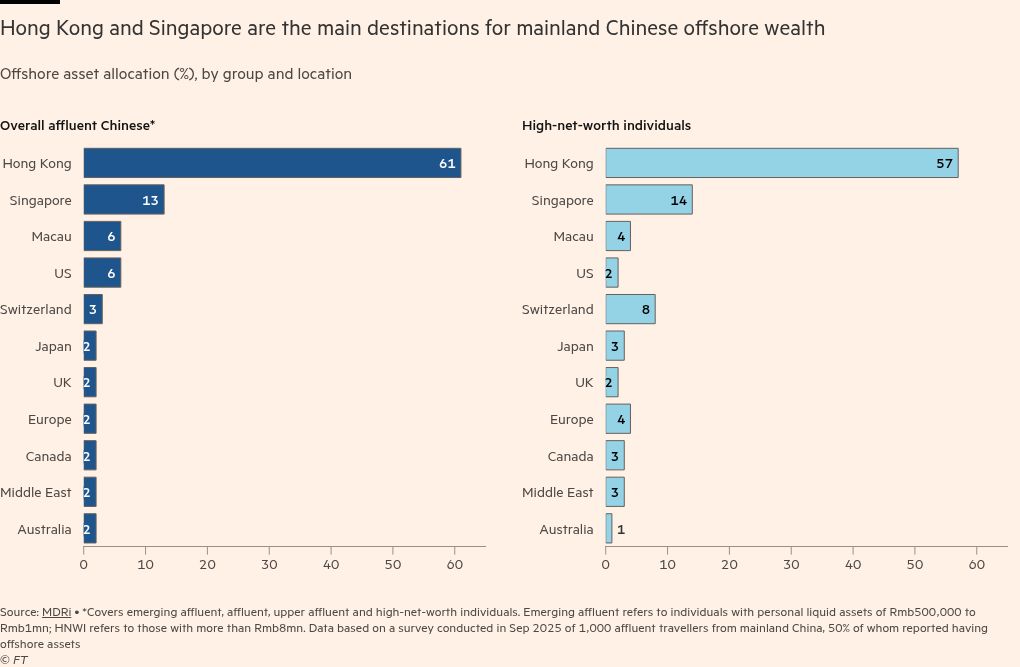
The repercussions have rattled Hong Kong and Singapore, where Chinese offshore wealth is highly concentrated.
Cross-border wealth booked in Hong Kong reached $2.9tn last year, with the financial centre overtaking Switzerland as the world’s largest offshore wealth centre, according to Boston Consulting Group.
But as Beijing’s authority over Hong Kong has tightened, the city has struggled to maintain its identity as a financial hub independent of China. Singapore, meanwhile, has become a magnet for wealthy Chinese nationals, who set up family offices in the low-tax jurisdiction to manage their fortunes while buying luxury properties and high-end cars.
Financial and legal advisers in the city-state say their Chinese clients flew into a panic upon hearing the news. “There was a sense of disbelief,” recalls Sim Bock Eng, head of private wealth at Wong Partnership, a Singapore law firm. “Many had set up trusts when they relocated to Singapore and thought that would protect them from paying tax in China.”
Among the highest-profile Chinese expats in Singapore are Zhang Yong and Shu Ping, the married co-founders of Chinese hotpot restaurant chain Haidilao. Forbes estimates that their combined fortune is more than $7bn. The pair have taken up Singaporean citizenship, set up a family office and spent tens of millions of dollars on properties in the city-state in recent years.
In September, Shu abruptly sold more than $350mn of stock in the Hong Kong-listed company, sending its shares down 12 per cent. While the company did not disclose the reasons for the sale, equity analysts speculated that Shu was trying to generate cash to pay her tax bill.
The prospect of other Chinese émigrés living in Singapore having to undergo a fire sale of assets — such as company shares and properties — in order to pay Chinese taxes has caused anxiety. Singapore’s 55 billionaires include several Chinese-born entrepreneurs with extensive business ties to their homeland.
These include Li Xiting, the co-founder of China’s largest medical equipment manufacturer, Mindray, who is worth $10.6bn, according to Forbes; Jason Jiang, founder of Shanghai-based Focus Media, who has a net worth of $3.9bn; and Ji Qi, executive chair of Chinese hotel operator H World, who has a $3.4bn fortune.
One option for wealthy individuals such as these would be to borrow money from banks, using collateral such as company shares and property, to pay their tax bills.
“Most clients prefer to look at financing options because that gives them a quick remedy without having to make longer-term moves,” says Kevin Teng, chief executive of wealth manager Wrise. “There will be more of these than outright sales of trophy assets.”
He said assets such as property in Singapore would be among the last to be sold because they provided the most security.
Mike Tan, global head of wealth planning and family advisory at Standard Chartered, says there were plenty of lower-profile examples than Shu of company executives selling shares apparently to raise funds, but this tactic was fraught with problems. “This can cause drops in the share price, which damages the rest of your holdings,” he says.
He adds that the value of shares in one of his client’s companies is now a fraction of what they were worth when he set up his trust. As a result, his 20 per cent tax bill could be larger than the value of shares he owns.
“He tried to explain this to the tax officer, but understands that the new tax rules still apply and he would have to take advice and decide what he wishes to do,” Tan says.
The fallout has also been felt in Japan. Even though it is not among the largest repositories for offshore assets, it has for many years been quietly attracting a huge flow of Chinese, many of them wealthy and with businesses still in China.
Until recently, Chinese people could set up businesses in Japan cheaply and without huge technical barriers, and those businesses could then sponsor visas that allowed them and their families to live in Japan. Some managed to circumvent capital controls to move large amounts of money into Japan via underground banks, which are managed by a combination of mostly Chinese and some Japanese operatives, according to Japanese bankers and wealthy executives.
These people have been extremely aggressive buyers of higher-end property, either in central Tokyo, Osaka or other major cities, or in some of the favourite ski resorts, notably Niseko in the northern island of Hokkaido. In some parts of the market, say multiple brokers, the Chinese money has been a major factor in inflating property prices. Some have also been diversifying their assets in Japan, buying small unlisted businesses in areas that interest them, sake brewing among them.
Now, all the expatriate Chinese are urgently seeking out advice on how to keep on the right side of the tax man in China, while also not raising too many questions about how they got so much money out — and how much the businesses they are supposedly running in Japan are worth.
“Until about a year ago, all the conversations we had at dinner among [Chinese] friends in Tokyo were about where to buy good properties, how many more family members could be brought over from China, where the best schools were, that kind of thing. Now, a lot of the conversation is about tax, tax, tax,” says a Chinese businesswoman who runs a tech investment firm in Tokyo.
“How hard is it going to hit? Is it still viable to stay in Japan? . . . There are some answers but I’d say there are still more questions at this point.”
The search for safety
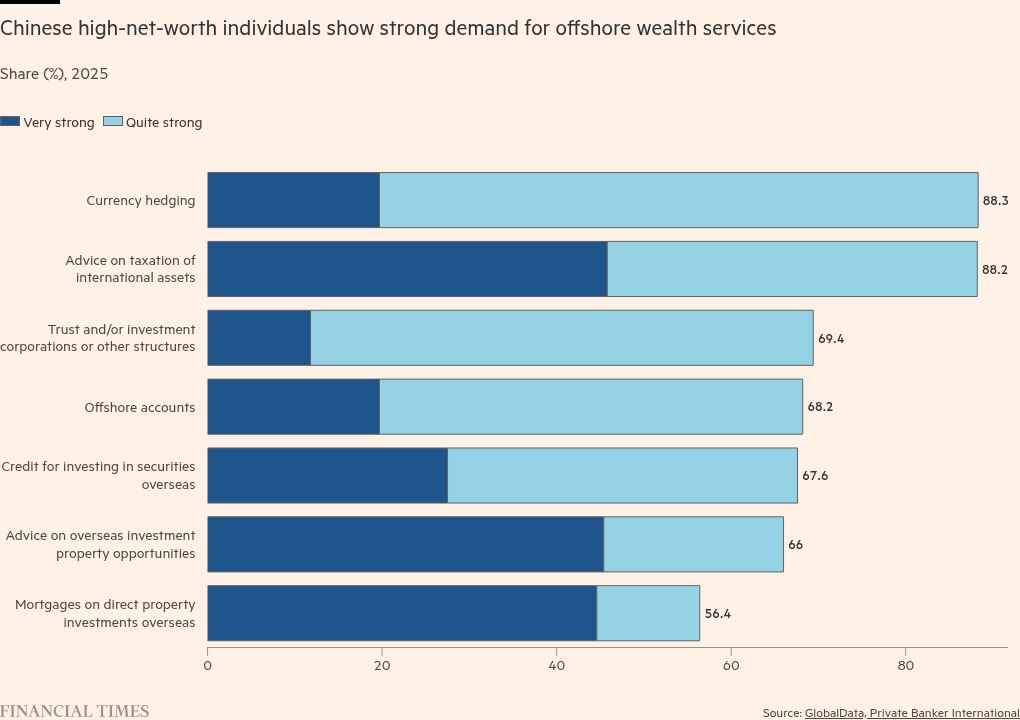
For those hoping to shield their assets from the Chinese authorities, there are options available.
Some Singaporean advisers report clients who are weighing moving their assets to Taiwan or the US — two countries that are not formally signed up to the OECD’s Common Reporting Standard (CRS) framework, which facilitates the automatic exchange of financial account information between jurisdictions.
Morgan Stanley’s private wealth business in New York, for example, has seen a sharp increase in enquiries, account openings and asset transfers from Chinese clients in Hong Kong and Singapore, according to two bankers with knowledge of the matter.
The team has received transfers from the two Asian financial centres very frequently in recent weeks, they say, reflecting growing demand among wealthy Chinese for broader investment access, lower fees, favourable US tax treatment and greater protection from Chinese government scrutiny. “This is a trend that all financial firms are seeing,” they add.
Many of the Morgan Stanley clients moving assets to New York already hold money or securities in Hong Kong or Singapore. Moving capital out of mainland China remains the most difficult step and is not something Morgan Stanley can facilitate, the people say.
Once the assets are offshore, however, transferring them to the US is straightforward. Cash sent from Hong Kong or Singapore can generally reach a Morgan Stanley US account on the same day or within one business day.
Clients can transfer US dollars, Hong Kong dollars and offshore renminbi. Eligible stocks, bonds and mutual funds can also be moved directly from a Hong Kong institution without first being sold. Morgan Stanley declined to comment.
In the US, non-resident foreigners are generally not required to pay capital gains tax on investments there. The bankers say that many Chinese clients using the New York platform also do not report or pay Chinese tax on their US investment gains.
The opportunity to avoid paying capital gains tax in the US and in China is a major reason for moving assets from Hong Kong and Singapore to New York. And the absence of US participation in CRS reduces the likelihood that the accounts will be disclosed automatically to Chinese authorities through that system.
The perceived security of the US financial system appears to be a further attraction. Political agreements between Washington and Beijing, or executive proposals targeting particular countries or groups, are not seen automatically to translate into action by banks, regulators and courts.
This institutional fragmentation is regarded as an additional layer of protection. Chinese clients tend to view assets held with a large private US financial institution as better insulated from abrupt government intervention.
A more extreme move would be for wealthy Chinese nationals to apply for passports in countries such as Turkey and New Zealand — which can be processed relatively quickly for wealthy individuals — and renounce their Chinese citizenship.
But that tactic would only work to shelter assets already outside China. And giving up citizenship is also not a feasible option for many executives whose businesses fall under the watch of Beijing’s regulators.
“Clients who are already in the C-level position of A-share listed firms have no choice: they cannot have overseas status,” says one China-based wealth manager who serves a group of founders.
And for people who want to take their companies public, personal tax clearance is also, in practice, a condition for listing in the mainland market, according to several IPO bankers familiar with current listing standards.
Some warn that there is little China’s elite can do to escape Beijing’s long reach, as authorities tighten controls on overseas travel for its citizens, including expanding the use of exit bans. “The government feels like it has access and a right to pursue people back to ‘the motherland’,” says Minxin Pei, an expert in Chinese governance at Claremont McKenna College in California. “This is this mindset, you can never be un-Chinese.”
Beijing’s rigid tax authority is clearly a high priority to Xi, who views the campaign as part of a broader “egalitarian push”, says Jamestown’s Lam. He notes that it builds on earlier episodes during his 14-year rule when Beijing has cracked down on private tech giants, property developers and high earners as it seeks to align business with socialist values.
Faced with this level of determination, many of China’s high-net-worth class are bowing to the inevitable. A senior executive with a Chinese tech group says he considered closing his offshore trust immediately but decided against it because that would trigger the 20 per cent closure tax. Emigrating from China was not immediately possible because he still has family in the mainland.
“Financial advisers told me to learn more about obtaining foreign citizenship or setting up a ‘foundation’, which can be done in Europe without paying tax. I am still thinking about it [for the future]. But for now, I’ll just pay.”
Yet one of the wealthy Chinese investors who spoke to the FT for this story noted that China’s leaders, who are urgently trying to address a worsening employment crisis, must balance not pushing the business leaders too far, given that the private sector is responsible for about 80 per cent of the nation’s jobs.
“Running a business means taking on a lot of risk already. You become like, ‘this is too much’,” he says, adding: “It is a pendulum swing: right now, the direction is this. It could swing back.”