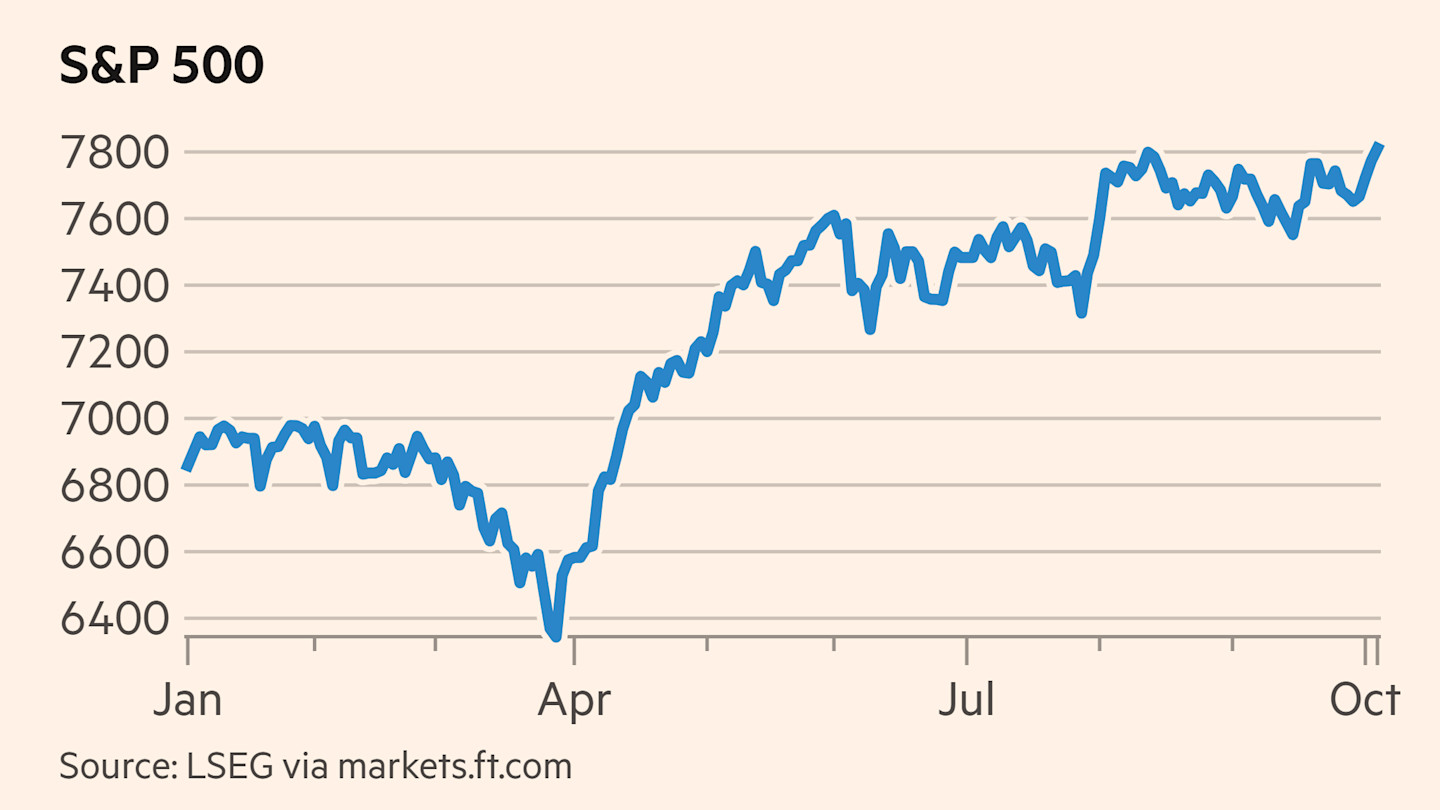
The S&P 500 closed at a record high on Tuesday as expectations of bumper earnings among AI-related companies helped stocks shrug off a brutal sell-off in government bonds.
The S&P 500 closed up 0.6 per cent, pushing Wall Street’s blue-chip index to a new peak after a downturn in September, when elevated oil prices and US Treasury yields at multi-decade highs were threatening to weigh on other assets.
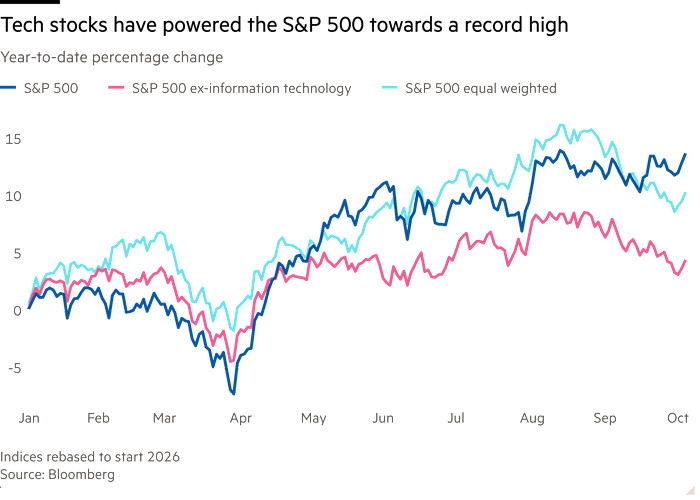
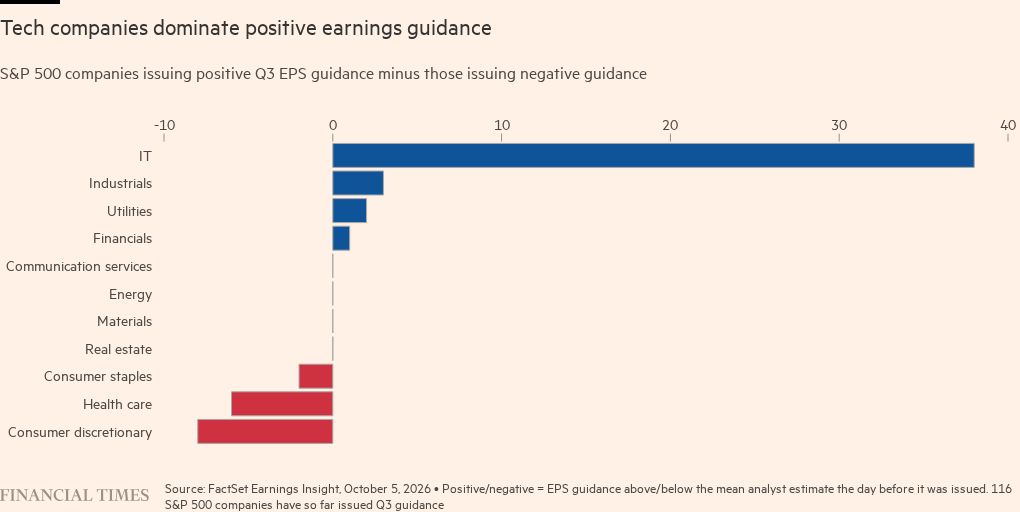
Investors and analysts said the rally was being powered by expectations of a stellar third-quarter earnings season for corporate America, driven by the trillions of dollars pouring into AI infrastructure. However, many sectors have been left behind, leaving the market increasingly reliant on a small group of tech stocks.
“We are in an earnings upswing,” said Arun Sai, senior multi-asset strategist at Pictet Asset Management. “In the short term, I just don’t see any evidence of that cracking.”
Sai said that while “there is no dearth of excuses to be bearish” — including high oil prices, rising bond yields and fears about circular spending among AI companies — “I can still see a lot of macro, micro and technical factors in favour of owning equities.”
Technology stocks have rallied sharply since the S&P 500’s September low, hit nearly three weeks ago. Since then, chipmakers Advanced Micro Devices and Super Micro Computer have all gained 20 per cent or more, while Nvidia, the world’s biggest listed company, is up about 12 per cent, taking its market value to about $5.8tn.
The Philadelphia Semiconductor index of US chip stocks is up 17 per cent since the start of September.
With earnings season starting in earnest next week, analysts are expecting annual earnings growth for the S&P 500 over the three months to September of 29.5 per cent, according to FactSet, the third consecutive quarter of growth of more than 25 per cent.
Goldman Sachs forecasts AI infrastructure stocks will contribute more than half of the earnings per share growth of the entire S&P 500 in the third quarter, according to US equities strategist Ben Snider, who expects chip groups Micron and Nvidia to account for more than a third of the entire earnings growth of the index.

“Earnings estimates are still going up,” said Max Kettner, chief multi-asset strategist at HSBC, adding that while the S&P 500 has gained only a few percentage points since late May, earnings estimates have been upgraded by “a whopping” 21 per cent.
“That’s very different from all the other episodes in the last few years when yields have gone up,” he said.
However, in a sign of how reliant the US stock market has become on its biggest technology names, the equal-weighted version of the index — in which moves in all stocks are weighted the same, rather than being heavily swung by the bigger names — remains more than 5 per cent below its record high.
Since the S&P 500’s low point in mid-September, only a third of its constituents have rallied, while the other two-thirds have fallen further, amid fears of further US interest rate rises. Since the start of August, the utilities sub-index of the S&P 500 is down 7.5 per cent, and the consumer discretionary sub-index has fallen about 3 per cent.
“Rate-sensitive stocks . . . have really suffered,” said Kettner. “There’s damage under the hood.”
Marija Veitmane, global head of equity strategy at State Street, said she expects “companies with weaker fundamentals to crack under higher interest rates”. The sell-off in bonds has started feeding through to American companies, sending borrowing costs soaring for lower-quality companies in particular.
However, she expects the tech sector to “continue to weather higher interest rates” because “their cost of borrowing and overall leverage is much lower.”
Higher oil prices and strong US economic data have forced a sharp repricing of interest rate expectations this year, prompting investors to demand higher yields on government bonds. The bond sell-off gained momentum in September and pushed US 10-year borrowing costs to the highest level since 2002.

Higher bond yields tend to weigh on stocks by raising the cost of capital for companies as well as reducing the present value of companies’ future earnings.
“If the bond market is hell-bent on driving rates even higher from here, stocks are going to have to break,” said Michael Zigmont, co-head of trading at Visdom Investment Management.
Analysts from Citi this week said they are expecting global stocks to rally about 6 per cent further by the end of 2026, “despite a growing list of headwinds”.
However, they added the “broadening” of stock market returns beyond the tech sector “may remain on pause until a resolution is found in the US-Iran conflict” and oil prices come down.
Some analysts see the market’s growing reliance on the tech sector as a cause for concern.
“Low breadth is a classic feature of bubbles building and typically doesn’t stop until they pop,” wrote Bank of America analysts in a note to clients.
Data visualisation by Ray Douglas