A global bond sell-off resumed on Wednesday, pushing long-term borrowing costs in the US, Europe and UK back to their highest levels in decades, as fears over inflation and high public debt burdens rattled investors.
The yield on 30-year US Treasuries climbed as much as 0.09 percentage points to 5.73 per cent, its highest since 2002. It later dipped to 5.66 per cent after a strong auction for 10-year Treasuries.
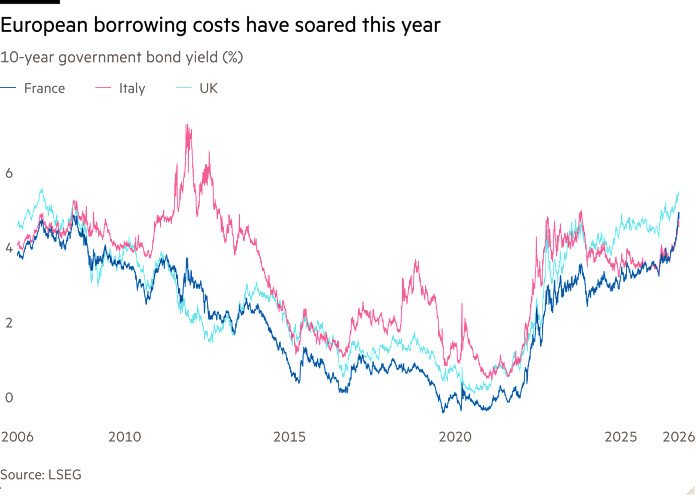
European government bonds were also under pressure, with French and Italian yields rising more than 0.1 percentage points, extending a series of wild swings. Bond yields move inversely to prices.
Investors said that a combination of debt concerns, high oil prices and the lack of visibility over an end to the Iran war was powering yields higher. Strong US economic data has added to the upward pressure on Treasury yields.
But there were also signs that investors are looking to take advantage of the high yields on offer.
The US government sold $39bn worth of 10-year notes to investors on Wednesday at a high yield of 5.3 per cent to strong demand. Primary dealers, big banks that are responsible for buying any bonds not absorbed by investors, had the lowest participation rate since the 2008 financial crisis, according to Vail Hartman at BMO Capital Markets.
France’s 10-year borrowing costs rose to 4.87 per cent, heading back towards the post-2002 high reached earlier this month, amid persistent worries that the Eurozone’s second-biggest economy is heading for a debt reckoning.
“France might be the first but it won’t be the last,” said Akshay Singal, global head of short-term interest rate trading at Citi.
The UK government debt market was also swept up in the volatile trading, with the yield on the 30-year gilt rising as much as 0.13 percentage points to a 28-year high of 6.04 per cent in afternoon trading in London. It later drifted back to just below 6 per cent.
“We hear a lot about the bond vigilantes, especially in the UK, but I think it is really a question of having credible budgetary policies and that’s unfortunately a bit scarce right now globally, and that is what is driving the bond market,” Singal added.
The renewed bond sell-off hit stock markets, with the Stoxx Europe 600 down 1 per cent. The S&P 500 was down 0.2 per cent and the Nasdaq 100 was 0.4 per cent lower in early afternoon trading on Wall Street, having closed at record highs on Tuesday.
Evelyne Gomez-Liechti, multi-asset strategist at Mizuho, said that Wednesday’s selling was triggered by “risk sentiment souring” as oil prices moved higher again.
“Investors are very hesitant to buy [long-term bonds] because of all the volatility ”, she said, adding that investors such as pension funds were reluctant to step in despite the more attractive yields.
Brent crude, the international oil benchmark, was slightly higher at around $100.80 a barrel.
In a sign of the threat to the US economy from rising yields, the average rate on 30-year fixed-rate mortgages rate hit 7.49 per cent on Wednesday, its highest level in almost three years, according to the US Mortgage Bankers Association.
The US on Wednesday is scheduled to sell $39bn worth of 10-year notes, which will offer insight into investor demand for bonds at these levels. An auction of $22bn worth of 30-year bonds is scheduled for Thursday.
The euro, which has been hit by concerns over France, was down 0.5 per cent against the dollar. It also touched its lowest level against the pound since mid-2025 in intraday trading.
“French risk is causing fresh idiosyncratic euro underperformance,” said Francesco Pesole, forex strategist at ING.
Some investors said that bonds were starting to look attractive after the sharp sell-off this year.
John Stopford, head of multi-asset income at Ninety One, said that “if the sell-off carries on much further”, bonds would start to look “meaningfully cheap” and described 30-year Treasuries approaching 6 per cent as a “steal”.
“I don’t think there is a hard ceiling here [on yields],” said John Thornton, head of fixed income at Keyridge Asset Management. “The only thing that fixes this in the short term is a significant shift in the oil price.”