
A sell-off in French government bonds that spread into broader Eurozone markets this month has lured big investors to “bottom fish” among beaten-down assets including Italian bonds and corporate debt, on a bet that contagion fears are overdone.
The wave of selling in French debt pushed the country’s benchmark 10-year bond yield to its highest in almost a quarter of a century this month, at almost 5 per cent, as worries grow over the sustainability of the government’s €3.5tn debt pile.
France’s borrowing cost premium — or spread — over 10-year German Bunds, a key barometer of investor worry, has jumped to 1.4 percentage points, up roughly two-thirds from the start of the month.
Other Eurozone spreads have also widened, as concern deepened over the potential fallout from a French debt crunch, with Italy’s climbing to more than 1.1 percentage points.
Several big asset managers said they had pounced on broader debt that had been caught up in the sell-off, on a view that the region was unlikely to be heading for an economic blow-up similar to the Eurozone debt crisis more than a decade ago.
“This isn’t a repeat of the early 2010s,” said Aberdeen Investments fund manager Alex Everett. “Despite recent volatility, the European government bond market today benefits from materially stronger institutional backing and market confidence.”
The manager has made fresh bets on Italian bonds outperforming German Bunds, he said.
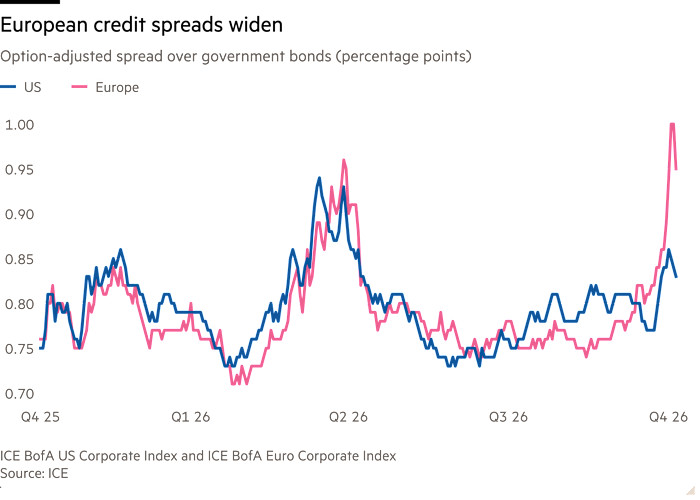
Corporate credit spreads have also widened in the tumult. Option-adjusted spreads on European investment-grade credit over government debt rose from 0.8 percentage points in early September to 1 percentage point on Friday, according to an ICE BofA index, before edging back to 0.95 points on Tuesday.
“We saw the moves over recent days as overdone and have been bottom-fishing in a few French corporates,” said James Carter, co-head of fixed income at investment house W1M, saying it bought bonds including those issued by insurer Axa and banking group BNP Paribas.
While some managers have bought back into French government bonds, others say they are reluctant to push against a long trend of underperformance.
Yields fell on Tuesday as investors responded positively to far-right presidential frontrunner Marine Le Pen’s promises of fiscal rectitude, but jumped again on Wednesday as oil prices rose and investors said huge uncertainty remained about the direction of France’s public finances in the run-up to April’s presidential election.
In a sign of the volatility across European government bonds, the yield on France’s 10-year bond was up 0.05 percentage points at 4.92 per cent, on the back of a rise in the oil prices.
Investors say their confidence that this will not be a repeat of the Eurozone debt crisis is based in part on the array of tools that the European Central Bank now has to calm markets, as well as its strong messaging over the years that the euro would be protected.
France’s central bank chief said on Wednesday that an intervention by the ECB was not needed, adding that it was “not here to deal with countries’ budget problems”.
“The market has got a little bit overexcited” about the necessity of ECB intervention, said one trader.
Fund manager Ninety One has also added European credit exposure through a high-yield debt index.
“Whilst there could be some catalysts for containing French spreads . . . we do not have conviction in adding directly to [French sovereign bonds] ahead of the 2027 elections,” said portfolio manager Jason Borbora-Sheen.
“Instead, we have been adding to other assets which have started to be impacted by recent moves in French sovereign bonds, and where ultimate French sovereign risk exposure is very low.”
James Ringer, global fixed income fund manager at Schroders, said the firm had been running an underweight, or smaller than benchmark, position in Italy and Spain.
It has reduced these underweights as the bonds have cheapened, he added, as well as taking more exposure to European investment-grade credit.
“The French situation is by no means resolved,” Ringer added. “Hence the focus on other sovereigns and asset classes with stronger fundamentals.”