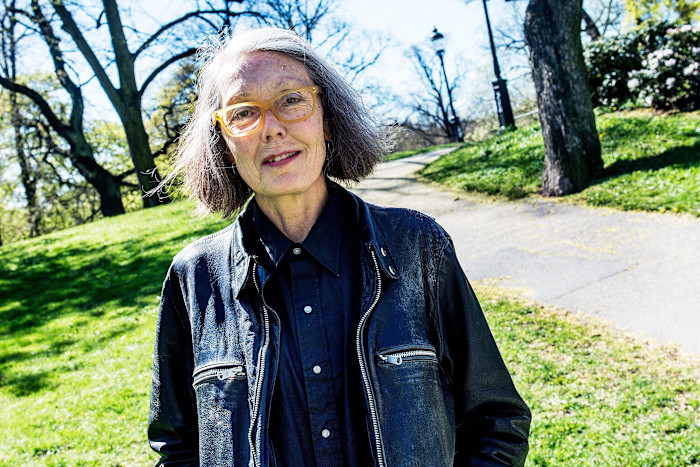
The Canadian author Anne Carson, known for her formally inventive and genre-crossing approach to poetry, prose and translation, has won the 2026 Nobel Prize in literature.
Carson, 76, was given the award “for her bold and inventive oeuvre that, in playful dialogue with the classical tradition, has created new forms for contemporary literature”, the Nobel committee said on Thursday.
Born in Toronto in 1950, Carson has published dozens of works of poetry, translation and literary non-fiction since 1986 while teaching at universities across Canada and the US. Her translations from classical Greek include works by Sappho, Sophocles and Euripides. But it is her intertwining of the classical and the starkly contemporary that has won her international critical acclaim.
Anders Olsson, chair of the Nobel Committee for Literature, praised Carson’s “playful and ironic works that move not only between classical and modern poetry but also between different genres and art forms”. Her collaborations with visual artists, choreographers, opera and theatre directors — including an adaptation of Sophocles’ Antigone directed by Ivo van Hove — have lent her writing a “strongly performative aspect”, Olsson added.
Highlighting Autobiography of Red (1998), Carson’s widely translated novel-in-verse that bridges the myth of Herakles with a modern-day teenager’s experience of unrequited infatuation, Olsson said the author possessed an “extraordinary ability to give the classical literary tradition an intensely contemporary feel” thanks to her “keen sensitivity for modern-day idioms and experiences”.
The form and juxtapositions in Carson’s work speak to her humour and curiosity about literary styles and figures alike. In Float (2016), her verse was printed on more than 20 chapbooks in a modular book structure that readers could open and reorder as they wish; the FT’s reviewer said the poems in the collection “confront the artifice of order and question the linearity of memory”. In The Beauty of the Husband (2001), which won the TS Eliot Prize, the betrayals and bitterness of a doomed marriage are ironically punctuated by the romantic poetry of John Keats. In Men in the Off Hours (2000), winner of the Griffin Poetry Prize, she places Virginia Woolf and Thucydides in dialogue with each other.
“It is through such often unexpected literary constellations that Carson has broken away from lyrical poetry bound to the narrative self and inspired new forms of contemporary literature,” said Olsson.
The Nobel Prize in Literature is awarded to Canadian poet Anne Carson
Last year’s winner of the prize was the Hungarian writer László Krasznahorkai, known for his postmodern, dystopian oeuvre in the central European tradition of Franz Kafka.
The literature prize, which comes with prize money of SKr12mn (£900,000), is the fourth of the six annual Nobels that are being announced on successive weekdays. The winners of the peace and economics prizes follow on Friday and Monday.
Ingrid Carlberg, permanent secretary of the Swedish Academy, made Thursday’s announcement a few minutes after reaching Carson by telephone. Carson was “very taken by surprise”, Carlberg said, and was “in Iceland, listening to the wind”.
Poet Robin Robertson, who was Carson’s long-term editor at publisher Jonathan Cape in the UK, responded to the news, saying: “Resolutely sui generis, Carson is the most unclassifiable of writers: a philosopher of love and loss, restlessly jumping genres, always ambitious, radical and alert, always interrogating the world with her clean economy of language and her ranging, idiosyncratic intelligence.”
“She is really an author for our time,” said committee member Steve Sem-Sandberg. “Nobody writes like her, and nobody would dare to do this in this way.”
Join our online book group on Facebook at FT Books Café and follow FT Weekend on Instagram, Bluesky and X