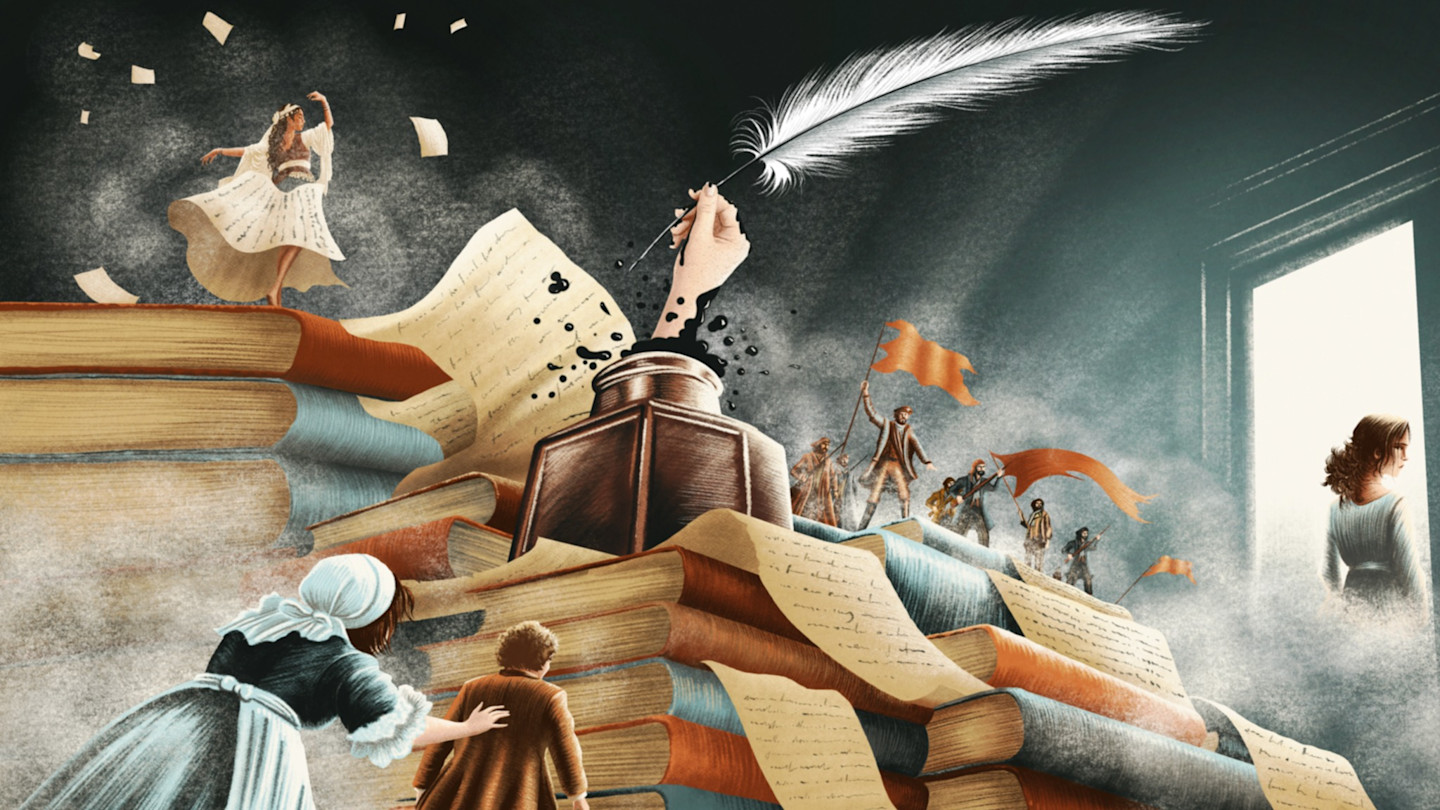
What is the function of literature in turbulent times? Elif Shafak asked herself this question as she brainstormed a subject for her latest novel. It drew her to the life of Gustave Flaubert, who wrote in the wake of the French Revolution of 1848, which ushered in the shortlived Second Republic before a return to imperial rule in 1852.
In One Brief Moment All Eternity alternates between a close third-person narration of Flaubert’s life and the first-person perspectives of 30 female characters. Some of the women were real, including family members, his nanny, and the author George Sand, with whom he enjoyed a late-life correspondence. There’s also Eleanor Marx, the first to translate Madame Bovary into English, who copied its heroine’s tragic fate by swallowing poison. Others, such as an acrobat and a belly dancer, came from “a dream world”.
Along the way, we hear the more unusual voices of a camel, the city of Istanbul, opium and syphilis, which Flaubert contracted during his travels and led, in the words of his mistress, Louise Colet, to his “premature decrepitude”.
Flaubert is credited as a pioneer of realism thanks to his depiction of Emma Bovary — “an everyday heroine who, however feckless and lacking in foresight, is ultimately a mixture of good and bad, hopeful and sad, lowly and sublime, just like everyone else in this world,” writes Shafak. Her idea was to turn the premise of the author as a “connoisseur of the female mind” upside down by letting women tell his story, she explains in a note to the reader. “Not just Emma, but . . . women whose voices were not heard in history books.” Madame Bovary, c’est nous toutes.
The book is organised in five life stages, each assigned colours. Though Flaubert did not have synaesthesia, he associated mood colours with his works (shades of blue and yellow feature prominently in Madame Bovary, for example).
It begins in his childhood in Rouen, where his father was a physician who ran a hospital where the family also lived. An affecting early scene features a young Gustave running to ask his father to treat a yellow butterfly with a broken wing. Stumbling upon a dissection, he mistakes the cadaver for his nanny. Unlike his older brother, who followed in their father’s footsteps to become a doctor, he was dubbed the “family idiot”.
“Why does the writing make us chase the writer?” Julian Barnes wondered in Flaubert’s Parrot, his 1984 riff on Flaubert. “ . . . Why aren’t the books enough?” It’s unsurprising that Shafak feels an affinity with Flaubert. Both faced obscenity charges for their fiction — Flaubert was prosecuted for “outraging public morals” when Madame Bovary first serialised. Shafak self-exiled from Turkey in 2008 after being put on trial for “offending Turkishness” by addressing the Armenian genocide in her 2006 novel The Bastard of Istanbul. In 2019, she was investigated for obscenity by Turkish prosecutors for depictions of sexual violence in her novels. (Unlike Shafak, Flaubert benefited from the notoriety and admitted in a letter to Colet that he sought to “heat the loins of even the most cold-blooded reader”.)
Well-versed in the literature about and around Flaubert, Shafak is unapologetic about the artistic licence she takes with certain facts. She has Delphine Delamare, the inspiration for Emma Bovary, executed by guillotine for the attempted poisoning of her husband, rather than taking her own life as Emma does. She moves Flaubert’s first epileptic fit forward, and has him declare his love to his muse Élisa Schlésinger as a teenager; in reality, he waited until she was widowed, 35 years later. More troublingly, perhaps, she suggests that Schlesinger’s daughter was the product of rape.
“History’s written from what can be found; what isn’t saved is lost, sunken and rotted, eaten by earth”, the historian Jill Lepore reflected about the difficulties of researching her biography of Benjamin Franklin’s sister, Book of Ages (2013). In voicing the women surrounding male authors, Shafak joins novelists such as Paula McLain, whose The Paris Wife (2011) was told through the eyes of Ernest Hemingway’s first wife Hadley Richardson, and Anna Funder, who fictionalised the life of Eileen O’Shaughnessy, George Orwell’s first wife, in Wifedom (2023). It is in the gaps of what is known that such novelists can imagine the missing pieces. Liberties with history can niggle, however: Hilary Mantel, the doyenne of historical fiction, maintained a strict rule that she never went against known facts.
The author of 22 books, of which 14 are novels, Shafak is a skilful weaver of fiction, with a penchant for inventive framing devices. There Are Rivers in the Sky (2024) braids three narrative threads, linked by a single drop of water. The Booker-shortlisted 10 Minutes 38 Seconds in This Strange World (2019) imagined the last minutes of consciousness of a murdered sex worker and her outcast friends.
The voices of the polyphonic chorus narrating In One Brief Moment All Eternity, however, tend to blend. Due perhaps to their sheer number, except for Flaubert, the characters are less defined than in Shafak’s previous work.
Shafak calls this book her “love letter to literature”, and it is in this realm that the book does best. She shows Flaubert bullied at boarding school, finding respite in books. He remained committed throughout his life to finding le mot juste above all else (to the despair of his lovers). Nearly two centuries later we still strive to “render in words those things for which there is no language, those impressions of the heart, those mysteries of the soul unknown to the soul itself.”
In One Brief Moment All Eternity by Elif Shafak, Viking £20, 608 pages (to be published by Knopf in the US in January)
Join our online book group on Facebook at FT Books Café and follow FT Weekend on Instagram, Bluesky and X