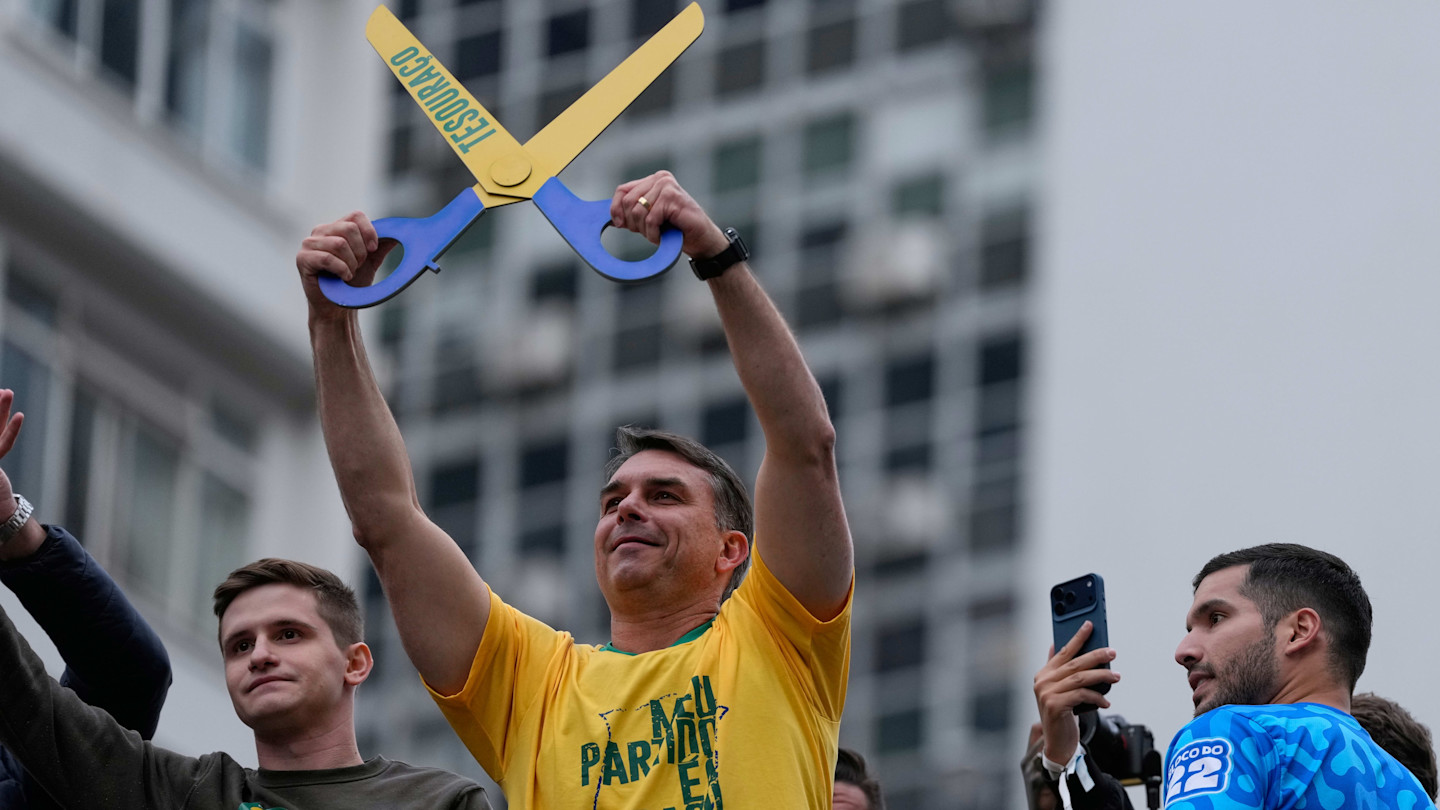
Where Javier Milei famously vowed to chainsaw Argentina’s bloated state, his hard-right ally in neighbouring Brazil, Flávio Bolsonaro, has been waving a giant pair of scissors at campaign rallies.
In prime position to win the presidency later this month after taking a surprise two-point lead in the first election round, the son of jailed former leader Jair Bolsonaro has made balancing the public accounts the centrepiece of his pro-business platform.
Before a run-off vote against leftwing President Luiz Inácio Lula da Silva, the 45-year-old senator’s team has pledged to tackle elevated debts and borrowing costs through spending reductions equal to 1.5 per cent of GDP (around $40bn).
“I’m going to wield the big scissors from January next year. There will be cuts to taxes, cuts to bureaucracy, cuts to corruption,” he said at a rally in August.
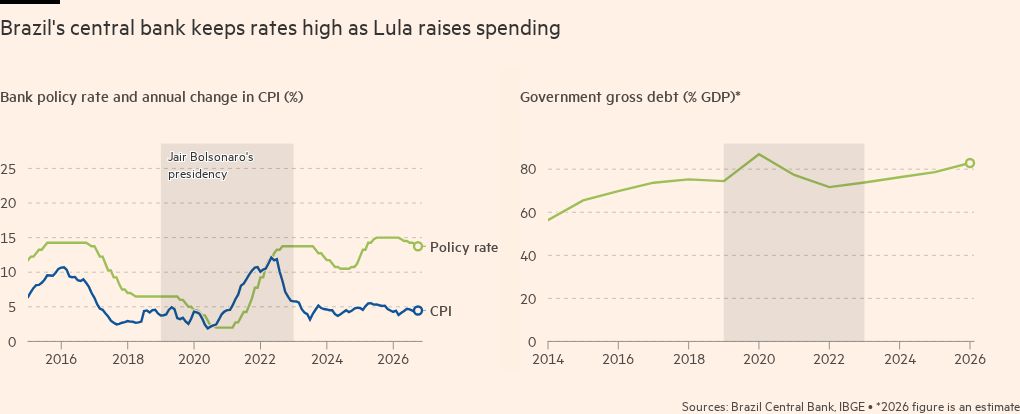
Public debt in Latin America’s largest economy has climbed to 83 per cent of GDP under Lula — a relatively high level for a developing country that some economists warn risks becoming unsustainable. Brazil’s budget deficit is among the widest in the G20.
“It’s very pressing,” said Alberto Ramos, chief Latin America economist at Goldman Sachs. “It’s a ticking time bomb if you don’t address it.”
Lula’s critics say rising spending and budget shortfalls have forced the central bank to maintain tight monetary policy to contain inflation. Despite cuts this year, the benchmark interest rate is 13.75 per cent, saddling the government, consumers and companies with onerous financing costs.
Bolsonaro has promised to reduce the number of government ministries and crack down on public-sector perks and social security fraud. But he has otherwise yet to fully spell out how he would achieve the ambitious fiscal retrenchment, which analysts say could be politically challenging to deliver as the economy decelerates.
Though Bolsonaro’s proposed cuts are more modest in percentage terms than Milei’s shock therapy in Argentina, his promises of fiscal rectitude have been welcomed by investors. Local stocks and the Brazilian real surged after Sunday’s first-round result.
“We believe the positive confidence shock of a Flávio Bolsonaro win could result in a reduction in interest rates over the medium term and thus help to improve fiscal dynamics in Brazil,” said Jared Lou, a portfolio manager at William Blair.
Bolsonaro’s plans include an unspecified debt-to-GDP target, which if not respected, could trigger budgetary restraints. His team has also promised to roll back Lula’s tax increases.
Yet for all the market enthusiasm, there are questions about the feasibility of pushing through unpopular austerity as a period of solid growth under Lula loses momentum. Mandatory items like social security and wages consume about nine-tenths of Brazil’s budget, leaving the government little room for manoeuvre without legislative changes.
The country’s sizeable interest bill is another burden on the public coffers. Its primary budget deficit — meaning before interest payments — is forecast to be 0.4 per cent of GDP in 2026. But after factoring in debt costs, the gap balloons to 8.9 per cent, outstripping most of the world’s major economies.
To prevent debt rising further, some economists reckon that a primary surplus of around 2.5 per cent is required.
Still, strong rightwing gains in legislative elections on Sunday bolstered investor faith in Bolsonaro’s economic agenda. His Liberal Party expanded its presence as the single largest force in Congress and should be able to build majorities in both houses with the support of other conservatives and centrist parties, according to analysts.
Cost savings could potentially be found by targeting areas such as so-called public sector ‘supersalaries’ that exceed a constitutional cap and ending a rule that pegs certain benefits and pensions to minimum wage increases.
However, they would face resistance from affected groups and lobbying, with parliamentary approval needed for certain measures such as privatisations or the removal of corporate tax breaks.
“We don’t think Flávio will be able to deliver everything he is putting on the table, especially the full 1.5 per cent GDP spending cut,” said Leonardo Meira Reis, political analyst at Eurasia Group consultancy. “But more broadly he will be able to pass a new fiscal framework . . . Congress will strongly back his economic agenda from the get-go.”
He warned, however, that even a more conservative legislature would not automatically be fiscally disciplined. Lawmakers have gained a growing share of discretionary spending in recent years for pork-barrel projects, which may prove difficult to rein in.

Lula’s Workers’ Party this week warned that social policies and public services could be hit by his rightwing rival, saying that funding for things like school meals and free medicines was squeezed or frozen under the candidate’s father. Bolsonaro’s father was criticised internationally for gutting environmental enforcement agencies.
Marcelo Kayath, a banker who has acted as an intermediary between Bolsonaro and the financial sector, said the candidate was committed to maintaining welfare schemes in the deeply unequal country, calling it a “compassionate rightwing” approach.
“[Bolsonaro] has no desire to cut social programmes or place the burden of fiscal adjustment on the poorest classes,” said Kayath, former head of Credit Suisse in Brazil.
But he warned that serious cuts elsewhere were unavoidable: “We have no alternative. Either this, or we could face a crisis a few months down the line.”
“If we don’t make the adjustment in a co-ordinated, constructive manner, the market will do it . . . in an uncontrolled way. [That] would trigger a recession far more acute and severe than necessary.”
Additional reporting by Beatriz Langella and data visualisation by Janina Conboye