
The UK’s pension “triple lock” was costed at just £50mn when politicians first settled on a measure that has gone on to cost 300 times as much, according to the top adviser on economic strategy at the time.
The guarantee on the value of the state pension — ensuring it would rise each year with the highest of inflation, earnings or 2.5 per cent — was a key demand of the Liberal Democrats in negotiations to form a coalition with the Conservatives following the 2010 election.
Rupert Harrison, then chief of staff to the incoming chancellor George Osborne, said the Conservative team sent a point person to ask Treasury officials for a costing of the policy in the final stages of fraught talks to craft an economic strategy out of the two parties’ manifestos.
“After half an hour he returned with a number: it would cost £50mn. That’s not a typo,” Harrison said in a note circulated on Thursday by the bond group Pimco, where he is now a senior adviser.
The Treasury’s actual calculation “was probably zero”, he added, noting that forecasts at the time showed no year when earnings growth would fall short of inflation or 2.5 per cent. That meant the triple lock would cost no more than the previous policy of earnings indexation.
“The Treasury officials may have felt they couldn’t come back with zero, so they picked £50mn as a suitably small number,” Harrison wrote in the note, which did not say over what timeframe HMT expected the £50mn cost to emerge.
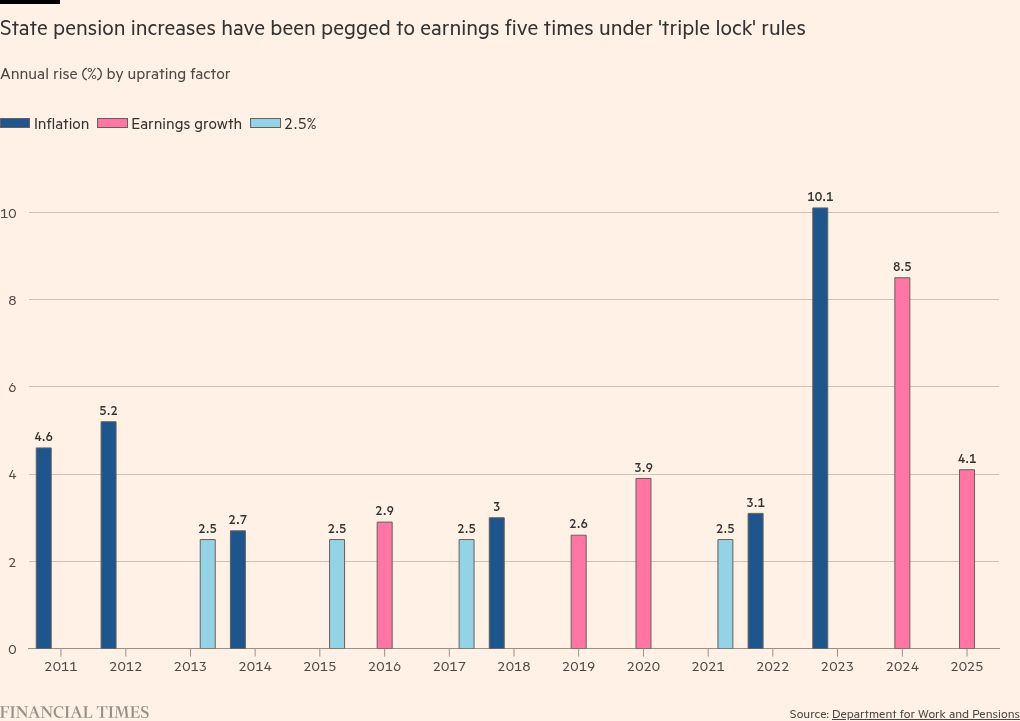
Once in place, the triple lock proved politically impossible to ditch for successive governments, even as the UK entered a long period of slow or stagnant wage growth punctuated by bursts of high inflation.
By last month, when Prime Minister Andy Burnham formally scrapped Labour’s commitment to keep the triple lock at the next general election, the “ratchet” effect of the policy had added £16bn to annual spending on the state pension, according to estimates by the Institute for Fiscal Studies.
The government said its planned reform — replacing the triple lock with a new commitment to raise the state pension in line with inflation or 2.5 per cent each year and with earnings growth over time — would save £11bn in 2039-2040.
But Harrison said the same logic that made it hard to predict the policy’s cost applied to estimates of savings from its abolition. The IFS estimates the annual gain to the exchequer by 2039-2040 at anywhere between £4bn and £20bn.
Given the government was also pledging to create a new “national care service”, this meant that “any fiscal credibility [it] could have earned with gilt investors has therefore been undone,” Harrison argued.
The Treasury did not immediately respond to a request for comment.