
Institutional investors are increasingly investing directly in companies alongside private equity firms, rather than committing capital to funds that leave investment decisions up to asset managers.
The shift towards so-called co-investments, which come with lower fees and greater flexibility, has accelerated as investors seek more control over their private-market portfolios amid a prolonged dearth of realised returns from portfolio company sales.
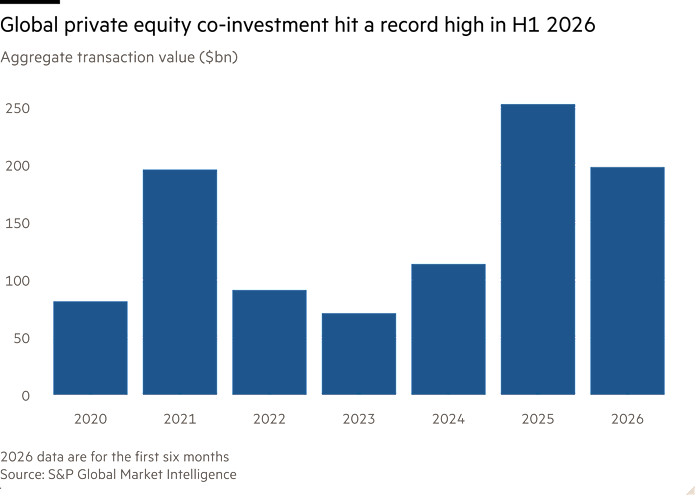
The value of private equity co-investments more than doubled year on year to a record $198bn in the first half of 2026, according to S&P Global Market Intelligence. Overall private equity fundraising rose 5 per cent over the same period to $312bn but remained below its 2021 peak.
“This is increasingly a part of the institutional playbook,” said Roger Vincent, founder of Summation Capital, a New York-based private equity fund that has made about a dozen co-investments.
Some investors have generated outsized returns from co-investments that gave them additional exposure to fast-growing start-ups. The North Carolina Investment Authority invested $200mn in Anthropic alongside Baillie Gifford earlier this year, a deal that could return five times if the AI start-up goes public at a $2tn valuation.
The fund has also twice co-invested in continuation vehicles involving Ascent Resources, a US natural gas producer. The latest investment in March had been marked up by about 20 per cent in six months.
“Our share of co-investments is going up dramatically,” said Brad Briner, North Carolina state treasurer and chair of the North Carolina Investment Authority, which manages the state’s $150bn retirement system, adding that about half of its planned private equity deployment would in the future go towards co-investments.
Unlike traditional private equity funds, where investors typically pay a 2 per cent management fee and 20 per cent of investment profits as carried interest, co-investments come with little or no management fee and carry.
The lower fee burden could translate into higher returns. The $86bn Pennsylvania Public School Employees’ Retirement System estimates its co-investments have outperformed its overall private equity portfolio by about five to six percentage points, thanks largely to savings on management fees and carried interest.
“The advantage goes right to the bottom line,” said Benjamin Cotton, chief investment officer at PSERS.
Co-investments also give investors greater control over when and where to deploy their capital than traditional private equity funds, where managers make investment and capital call decisions.
Allen Waldrop, deputy chief investment officer at the $89bn Alaska Permanent Fund Corporation, said co-investments accounted for up to a third of its annual private equity deployment and were used “opportunistically” to increase exposure to specific sectors, such as energy and financial services, or geographies, as well as to control the pace of investment.
“If we think there are a lot of interesting opportunities, it’s an easier way to get capital invested than waiting for the right fund to commit money to,” said Waldrop.
The private equity fundraising slump has also boosted co-investment, as managers, particularly at smaller firms, offer investors more opportunities to strengthen relationships or raise capital for deals that exceed their funds’ capacity.
“There are more co-investments coming out of a lower number of deals in the market,” said Jennifer Fox Bensimon, head of co-investments at Partners Capital.

Still, co-investments do not guarantee outperformance over traditional private equity funds. Anton Orlich, deputy chief investment officer at the California Public Employees’ Retirement System, told a board meeting in January that its co-investments had underperformed private equity portfolios “in most periods” over the three decades to 2022 before the trend had reversed in the past three years.
A main concern over the strategy is that private equity managers may offer institutional investors lower-quality deals for co-investment. Nat Fraser, a partner at Cerity Partners, an investment firm that manages capital for endowments and family offices, said the risk of adverse selection was “paramount”. When presented with a co-investment opportunity, one of the first questions he asks is: “why are we so fortunate to be seeing this deal?”
Monte Tarbox, chief investment officer at the New York City Retirement System, said many public pension plans lacked the dealmaking expertise to participate in co-investments on an equal footing with private equity managers.
“By the time a co-investment comes to an organisation like mine, the details are already baked,” said Tarbox. “The manager dresses it up in a nice wrapper, puts a pretty bow on top of it, and says, ‘Here you go, take it or leave it’.”
Timing is another challenge facing co-investments, which often require investors to make decisions within weeks or even days, rather than the several months they may spend selecting a private equity manager.
Fraser said Cerity Partners had recently taken 92.5 hours from learning of a co-investment opportunity in an artificial intelligence company to holding a final investment committee vote.
“If we hadn’t moved that quickly on this particular deal,” he said, “we probably wouldn’t have been able to participate.”
Capacity constraints have set a limit on how much co-investments can grow. Investors said private equity managers would continue to play a central role in sourcing and managing deals, with co-investors taking up additional capacity beyond what their funds invest.
“The market will probably find an equilibrium in terms of fund dollars versus co-investment dollars that are made available,” said Fraser.