No one in their right mind tries to call the top for Games Workshop. Selling the UK-listed wargaming leviathan rarely works as an investment strategy and, even when it has, it has rarely worked for long:
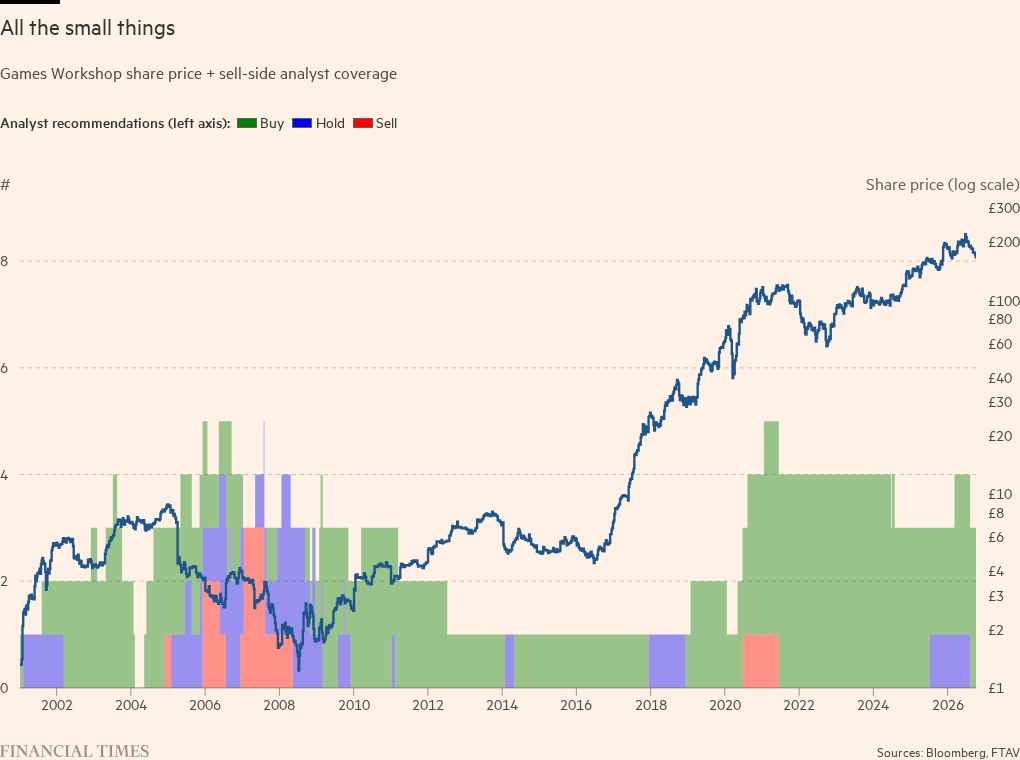
A lack of stock Cassandras isn’t just cowardice. Games Workshop is weird. This makes its investment case a bit difficult to analyse.
Louis did a detailed examination of its weirdnesses in 2024, the theme of which was that the company doesn’t care if you don’t understand. Its market communication on results days is perfunctory and, in-between times, doesn’t happen. There are no conference calls and not much guidance, with management only ever commenting on whether the outlook matches the board’s expectations. Investor relations and media functions are guided more by ambivalence than secrecy. Success is allowed to speak for itself.
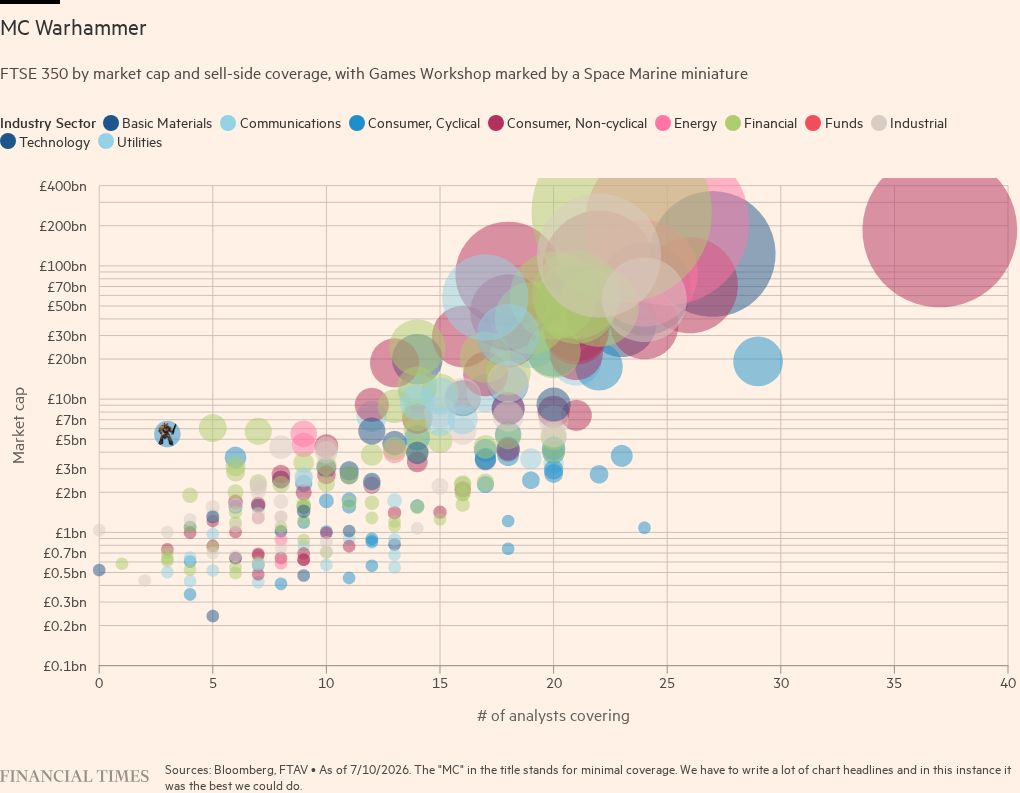
Games Workshop’s products — miniature figurines, paints, game rule books and connected media — are often portrayed as too esoteric to explain to anyone who’s not ready to be entrenched in the lore. The stock has a similar appeal. Just three sell-side firms publish on the company: house broker Peel Hunt; Jefferies; and issuer-paid Edison Investment Research. Relative to size, no other FTSE 350 constituent goes so unexamined:
That’s not to say the Games Workshop bear case hasn’t been discussed. Following the appointment of Kevin Rountree as CEO in 2014, people like us have been talking about the possibility that over-commercialisation would exhaust the fanbase.
On Warhammer’s myriad online forums, talk of over-saturation follows every IP licensing agreement. Each new edition of figures leads to grumbles that the company is boiling the frog — not just through unit price inflation, but by increasing the number of miniatures hobbyists need to play the various games. Every attempt to make gaming more accessible has raised concerns that new players won’t have the same franchise loyalty.
In recent years, these worries have rarely caused a share price wobble. What happened instead was a pandemic, which grew the community and helped move a greater proportion of group sales online. As a result, Games Workshop stopped being valued like a retailer and turned into a luxury goods maker:
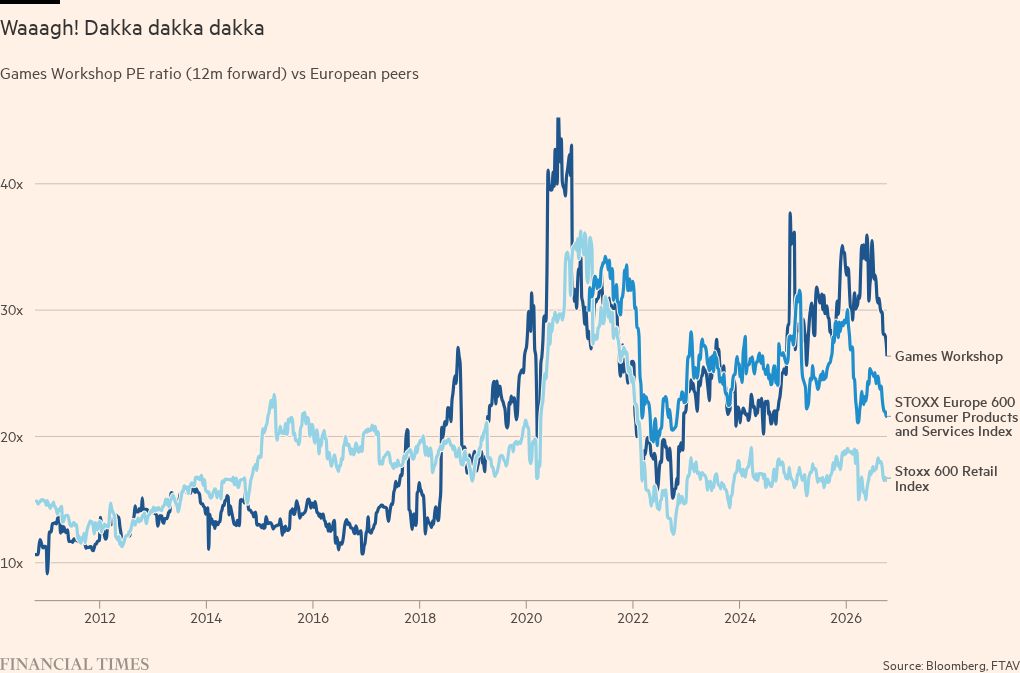
By now you may be shouting, “You’re a financial blog! The shares are down nearly 25 per cent since June! The PE has compressed by 10 turns! Aren’t you going to talk about that?” And yes, we are. We just needed to explain why we’re not calling the top. Nothing here is ever investment advice. The share price discussion continues after the chart:
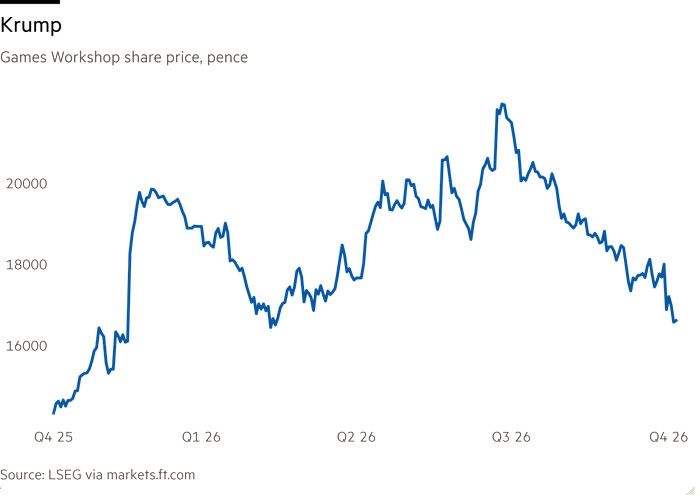
Conventional reasons for the pullback include: profit-taking in a sideways market; some tweaking lower of future-year expectations to reflect US tariffs; and the mixed signal that is Nick Train, who revealed last October that he’d been buying the stock, then in January posted a fifth straight year of market underperformance. Train also top-ticked the stock’s record high perfectly with an announcement in June that his Finsbury Income and Growth fund planned to buy more.
Games Workshop’s full-year results, posted in late July, contain some more fundamental explanations. Headlines were good, with pre-tax profit up nearly 5 per cent to £275.7mn, but buried in the detail were a few signs that growth might be slowing.
The first focus for the share bears has been own-store sales.
By the end of its June financial year, Games Workshop operated 596 “hobby centres”. The estate has grown by almost 50 per cent in the past decade. Core revenue is up more than sixfold in the same period, though much of the growth has been via independent retailers.
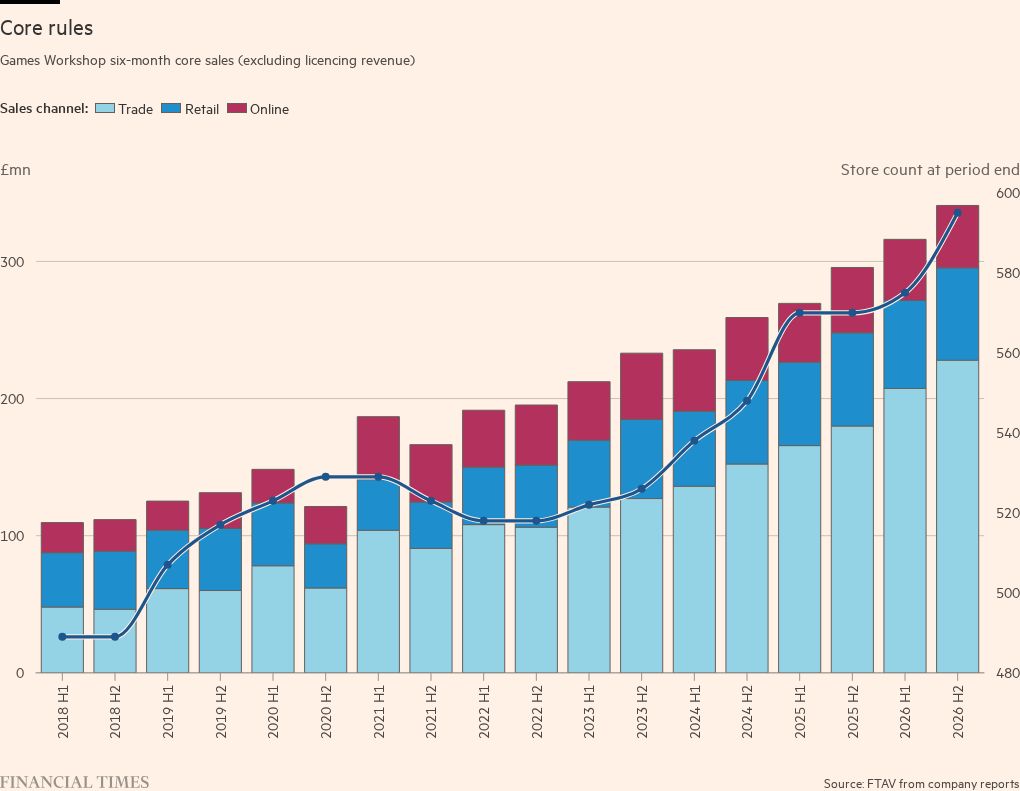
Narrowing the view to direct sales only, the trends are less positive. Retail growth per store turned negative for the first time since the pandemic in the second half of its 2026 financial year, with online direct sales no longer picking up the slack:
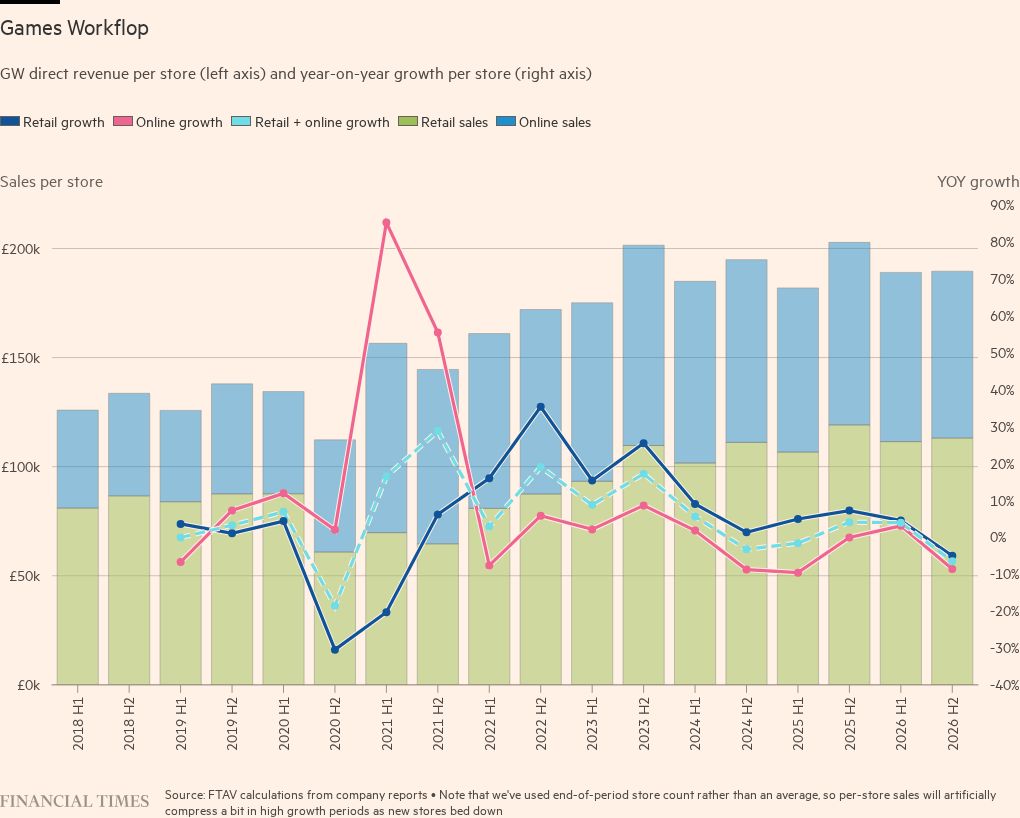
As we said above, the trade channel is increasingly important to Games Workshop. It accounts for 65 per cent of Games Workshop sales, from 35 per cent a decade ago, and its number of trade accounts has been growing steadily at a pace of approximately 10 per cent a year.
Per account, however, trade revenue shows the same pattern as direct sales, appearing to turn negative year-on-year in the most recent period:
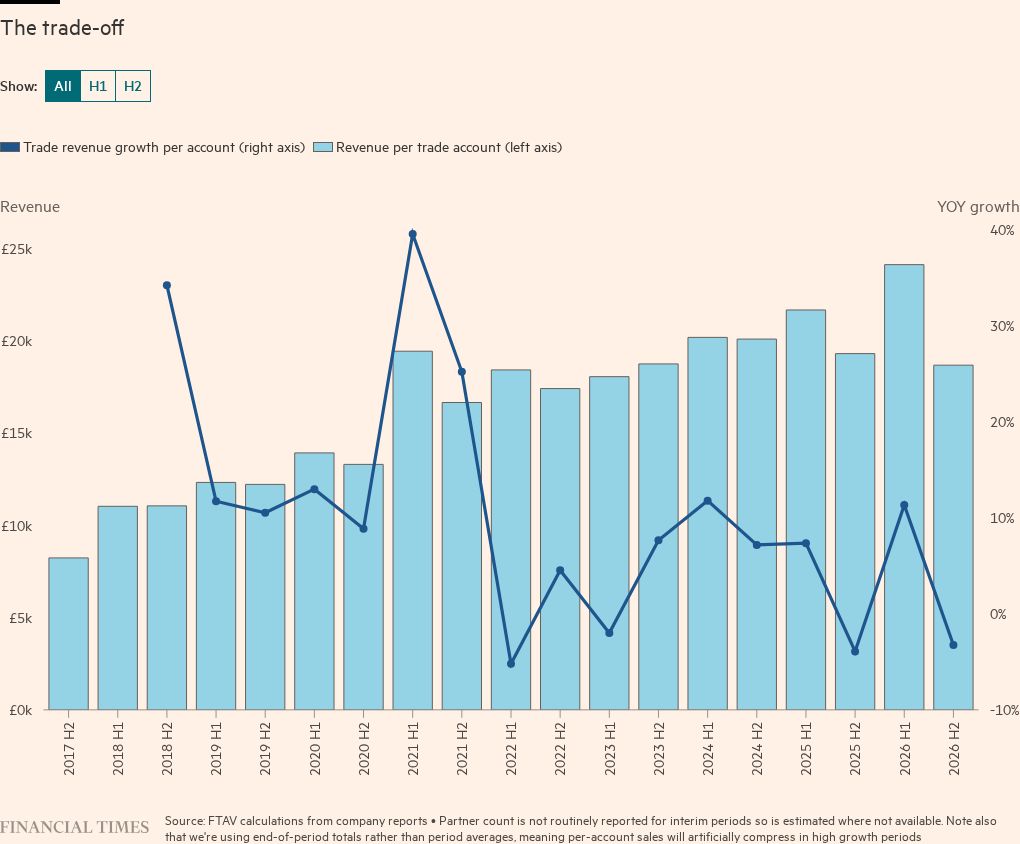
Let’s not go overboard. Six tricky months might not mean much when weighed against decades of success. But if both the retail and wholesale sides of the business are stalling simultaneously, it would give credence to all those long-standing fears that Warhammer’s losing its mojo.
Finding evidence for why is really no challenge, beginning with the community. They’ve always liked to complain. As some jerk said recently in another context, being a Warhammer player is like supporting a football team into middle age: “it’s an allegiance once guided by excitement, then replaced over time by extremely specific enmities”:
Embedded YouTube video
To show this video, YouTube may use cookies and collect data. You can read YouTube's cookie and privacy policies before continuing.
Manage CookiesSome of the apathy might be explained by demographics. The ninth and 10th editions of Warhammer 40,000 — the company’s flagship game — were launched in mid-2020 and mid-2023, respectively. A lot about a life can change in three to six years. The people who took up or returned to the habit in the pandemic years then may now be more focused on exam revision, sexual intercourse, parenting, career progression, or AI taking their jobs.
Moreover, the launch this year of Warhammer 40,000’s 11th edition revived all the old worries about inflation, brand saturation and quality dilution. Games Workshop’s announcement last month, that trading to end-August had been in line with the board’s expectations, doesn’t seem to have settled nerves.
On price inflation, Games Workshop told its trade network last month it was raising UK recommended retail prices by 3.9 per cent on average. Averages don’t tell the whole story, however, as the company’s pricing architecture is so intricately constructed it could make a pharmaceutical sales rep jealous.
The revised price list wasn’t available on its trade network site last we checked, but screen grabs are available elsewhere. These show that some of the biggest price increases were for so-called HQ miniatures that players view as mandatory purchases when building an army for the most popular Warhammer games. The RRPs for its Space Marines Captains, for example, were raised by 7.4 per cent to £29 each.
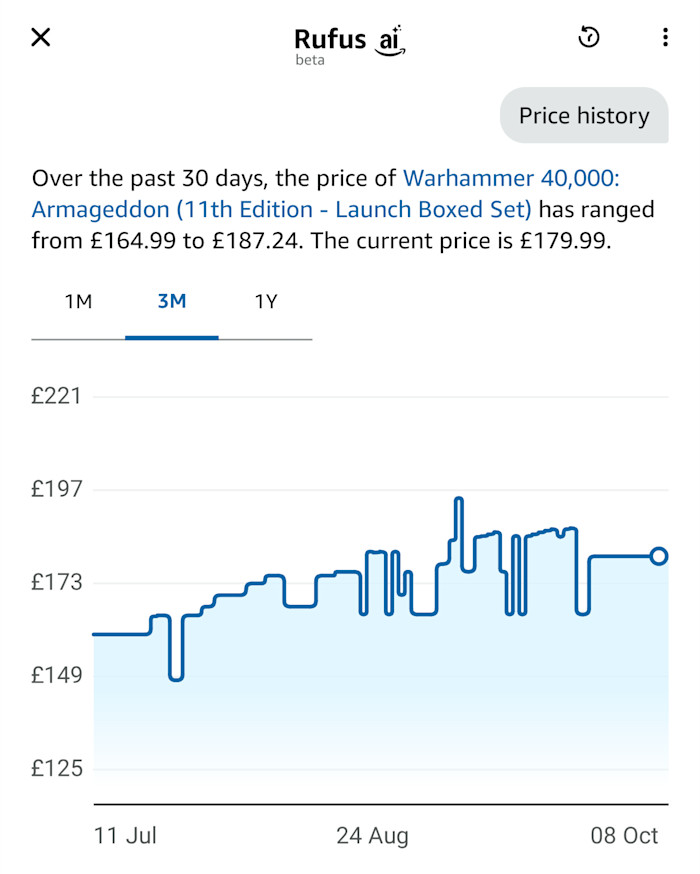
The best value Warhammer sets have always been the launch boxes. These are priced to recruit new players using the “give away the razor, sell the blades” principle. But Warhammer’s 11th edition launch box, Armageddon, is 23 per cent more expensive than the 10th edition box at £185 in spite of containing fewer figures.
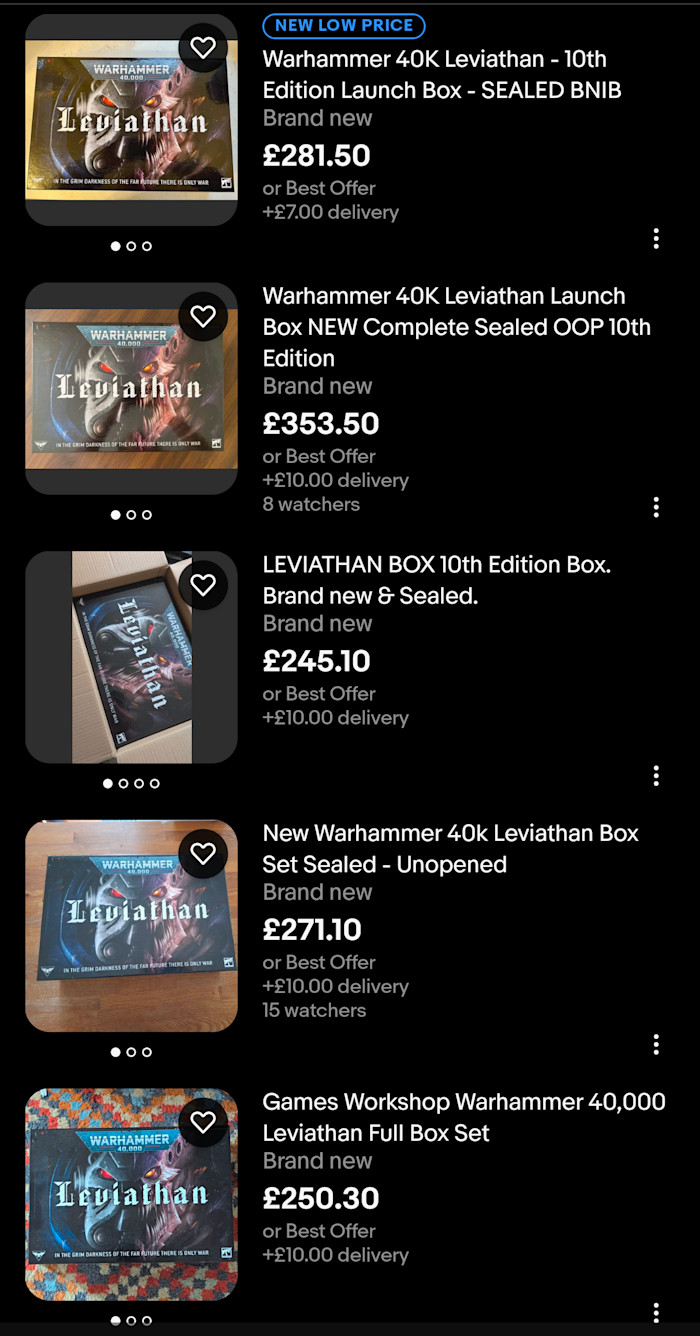
Perhaps more significantly, demand for Armageddon looks mid at best. While the 10th edition launch box continues to be advertised at huge premiums to RRP . . .
... the 11th edition box is widely available online at a discount:
Independent trade outlets aren’t locked to the RRP. They typically buy stock wholesale at a 43 per cent discount to the recommended price and are free to sell it however they wish, including online. Per the Games Workshop trade network website, the minimum initial order value is £1,250 and must include the Best Seller Foundation Range. Trade outlets can claim even bigger discounts to the RRP after 12 months if they allow Games Workshop to monitor their stock levels and auto-order, among other conditions.
Thanks to Warhammer’s booming popularity in the past few years, the initiative helped expand the market from specialist gaming and hobby stores to post offices, tattoo parlours, leisure sites, bookshops and newsagents. It has also helped grow a cottage industry of online retailers that sell discounted Warhammer miniatures and paint sets. Games Workshop’s online store locator lists all 9,100 partner stores worldwide and is well worth a browse.
Games Workshop bears argue that the trade channel has added too many retailers who view Warhammer as a side hustle, and that online stores are using their additional RRP discount to drive volumes at low margins. Both trends have been built on rising demand. But as soon as sales plateau, independent retailers are left with excess inventory and the growth flywheel goes into reverse. Falling revenue per trade account could be the first sign of that happening.
There’s lots more to discuss. We’ve not touched on licensing for video games and TV, including the upcoming Amazon drama series that could introduce war-gaming to a new audience. We’ve not mentioned competition, which can’t easily replicate the layers of lore or match the installed base, though a look at the r/Wargaming subreddit suggests there’s a growing number of alternative sets that promise shorter games with less rulebook rigmarole. We’ve not mentioned whether IP is a defensible moat when AI-generated wireframes and 3D printers exist. You probably have a view on all these topics, having read this far, and you have no reason to be subjected to ours.
We care more about the numbers. Even after the stock’s recent pullback, a PE of 27x or thereabouts is still pretty rich. The valuation can be justified by expected growth — but do bear in mind there’s not much of a consensus when only three analysts publish forecasts, one of whom is Edison.
For illustrative purposes, we’ve picked Jefferies’ model:
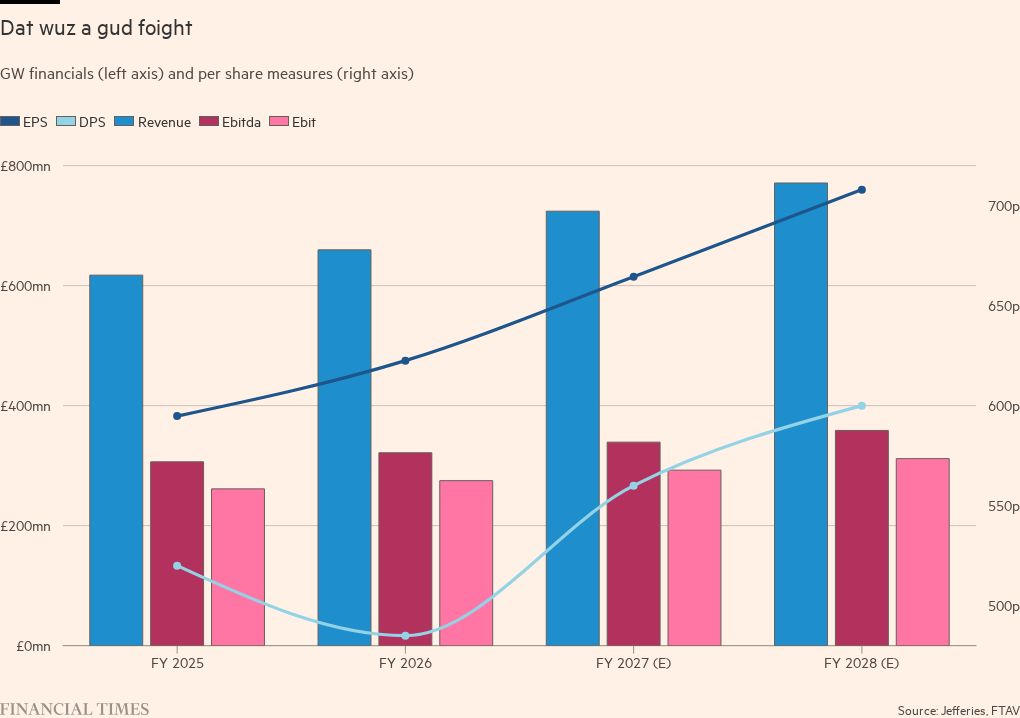
If Games Workshop’s valuation were to fall back in line with the retail sector then, on unchanged earnings expectations, it’d suggest about 40 per cent more downside. Should sales growth significantly undershoot current forecasts, even that sort of level might look optimistic.
On the other hand, who knows. As we said at the start, no one in their right mind tries to call the top for Games Workshop. Not when the next catalyst for player recruitment might already be heading this way from Siberia.
Further reading:
— Warhammer is weird. That’s why it works (FTAV)
— How Warhammer won (FT)
— Triumph of the orcs: why Britain needs more Games Workshops (FT)