Georg Baselitz, who died in April aged 88, was tall and lean, with a big head, a serious, dignified manner and boundless vitality. The alter ego that won him fame was similarly colossal, but chunky, ungainly, with a small head, a bedraggled, battered appearance and lethargic pose. In 1965-66, in rough slathered impasto, sombre hues — browns, greens, muted pinks — and broken lines, Baselitz painted and drew scores of these solitary defeated characters, mostly in ragged military uniforms, wandering through devastated landscapes.
The anti-heroic Heroes, bursting into life at the dawn of pop art, were initially widely disliked — too pessimistic, too painterly, regressive — then later understood as one of Baselitz’s greatest series. Seldom seen together, around 35 works including major museum loans are reunited for the historic, rare show Georg Baselitz: The Heroes 1965-66 at Thaddaeus Ropac in London.
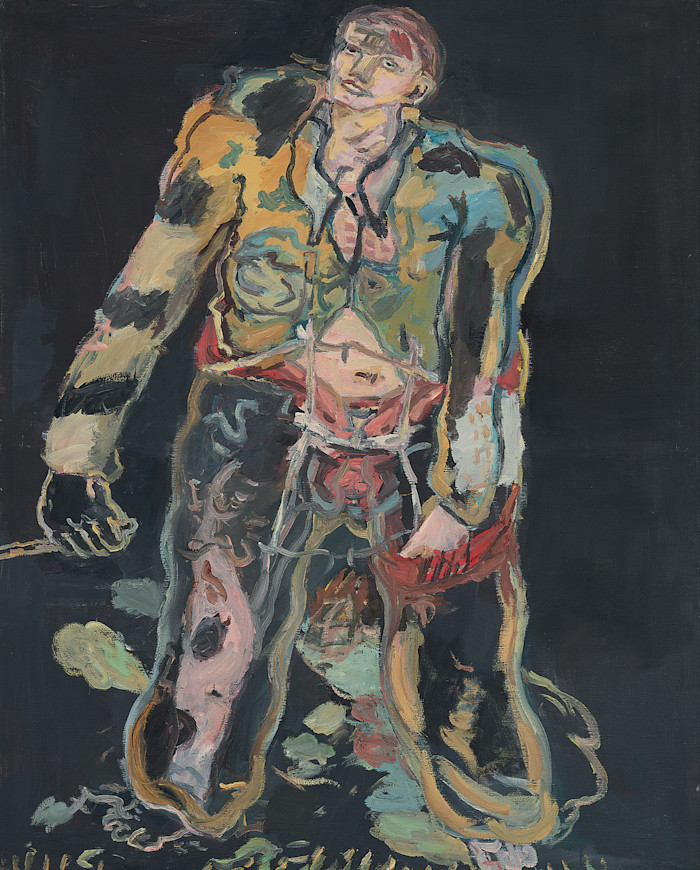
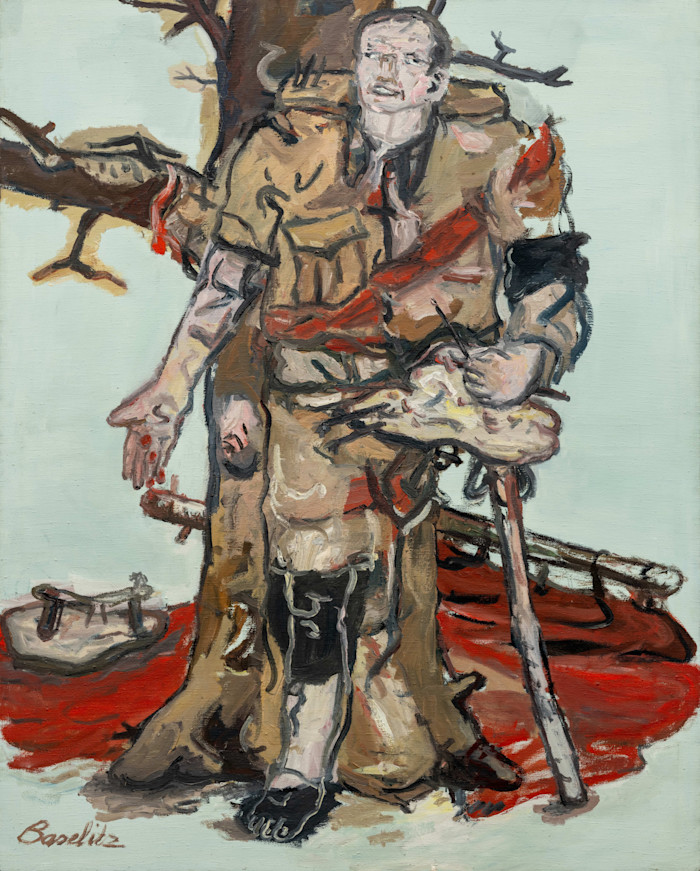
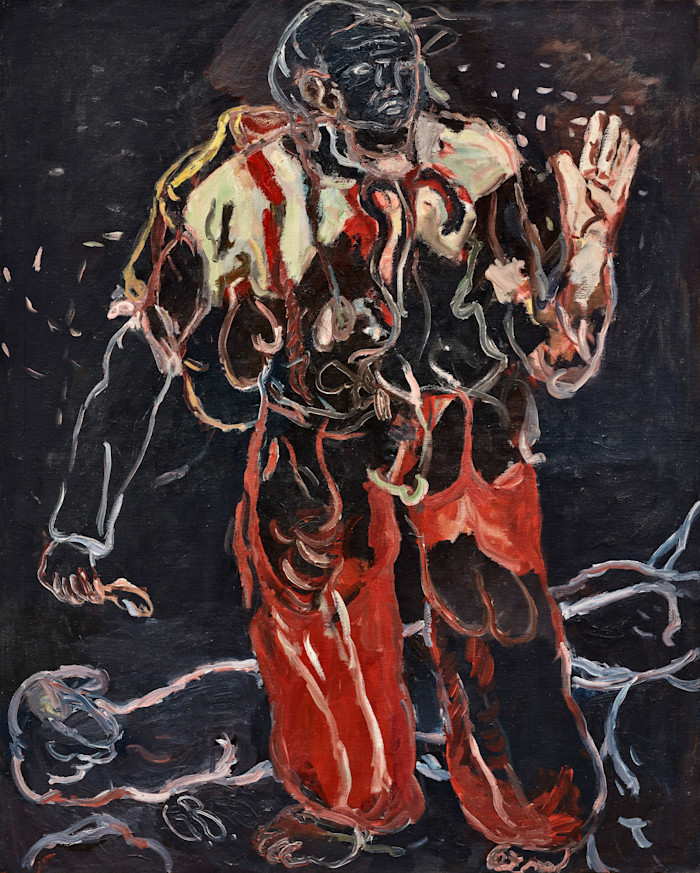
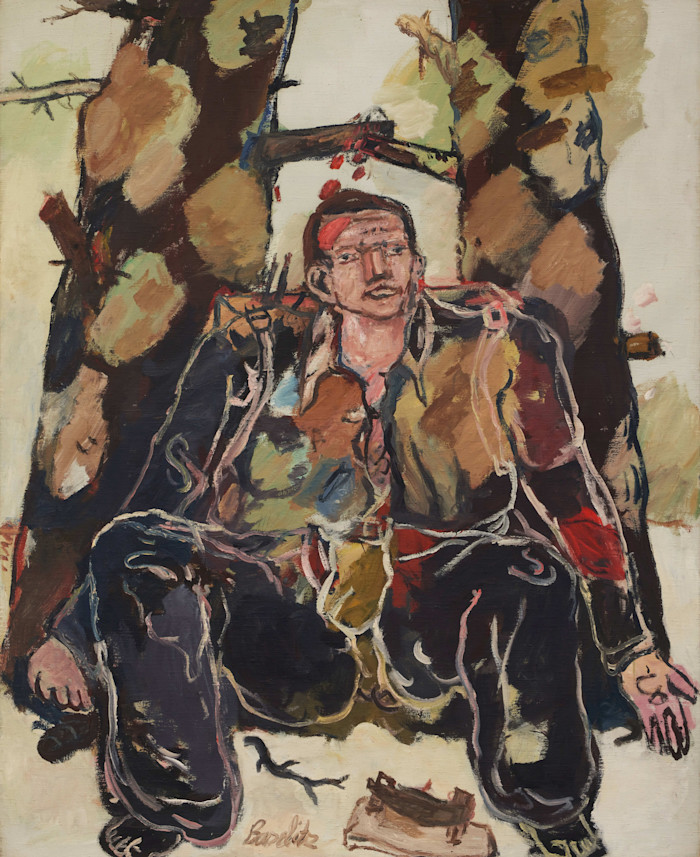
In the large, light main gallery, the monumental single figures, many on dark grounds and seeming to push forward out of the canvas, surround you on all sides. They stare each other down, and together amplify the paradox of each one: Baselitz’s painterly aggression in depicting failure and collapse. In “Black Grounded”, a blood-drenched, multicoloured soldier emerges through a void splattered with sinister forms in grey-white-red outlines, hinting at traps, wild animals, the uncertain terrain of a forest floor. “Rebel”, smiling wanly, is so weak that he has become semi-transparent; a house burns between his legs. “Blocked Painter”, an amputee with a bewildered gaze, leans against a leafless spiky tree, his palette supported by a crutch; “A Modern Painter” crouches forlornly, flies undone to expose a limp, impotent spiral of paint instead of a phallus.
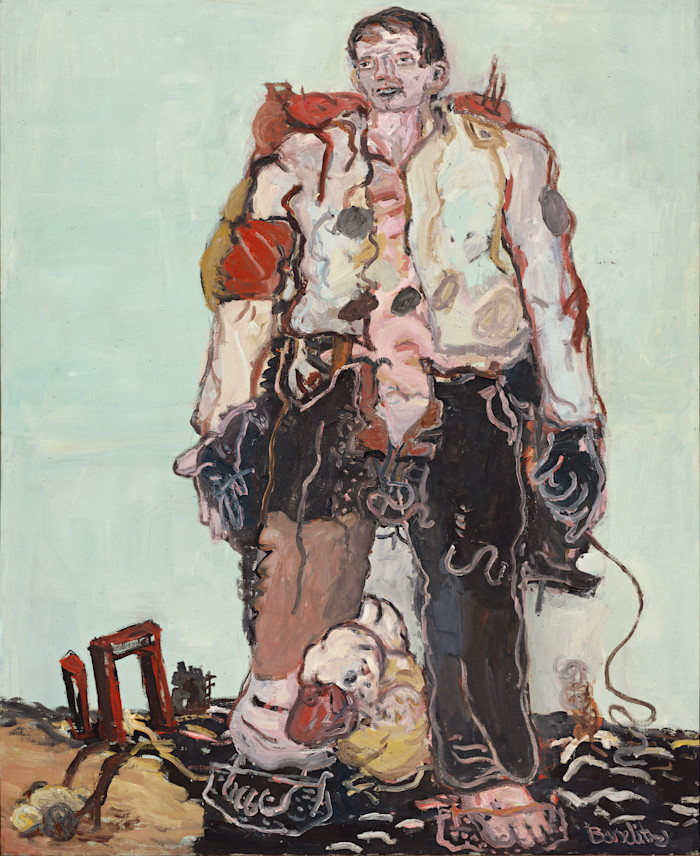
With their unwieldy knapsacks, the artist-heroes in the series can barely support their own weight — by implication, the weight of history — and speak of the young Baselitz’s concerns about the “blocked” future of postwar painting. Other works allude to ruined pastoral idylls, rootlessness, disharmony with nature. “The Shepherd”, unable to protect his flock, has his feet caught in a snare, with only a cartoonish fluffy duck for company. A scarred figure, perhaps a forester, slumps between two trees in “Trap”. In a densely hatched charcoal drawing, “The Hunter” holds an elongated, eerily human-sized hare.
Born in Saxony in 1938, Baselitz grew up under totalitarian rule, first Hitler then the GDR. Expelled from art school in East Berlin for “sociopolitical immaturity”, in 1957 he moved to West Germany. There the economic miracle was under way; beneath lay what poet Rudolf Brinkman called “the musty atmosphere of collective guilt”, though recent history was hardly mentioned. Baselitz could paint as he wished but found “a very alien, chilly environment. When the traditional ties are gone, when there are no more teachers, no more fathers, that’s what I mean by rupture.”
He was 27 when he began The Heroes, evoking memories of the end of the second world war, “a destroyed landscape, a destroyed people, a destroyed society”, the wretched German soldiers returning to it, the Soviet soldiers stationed close to his home.
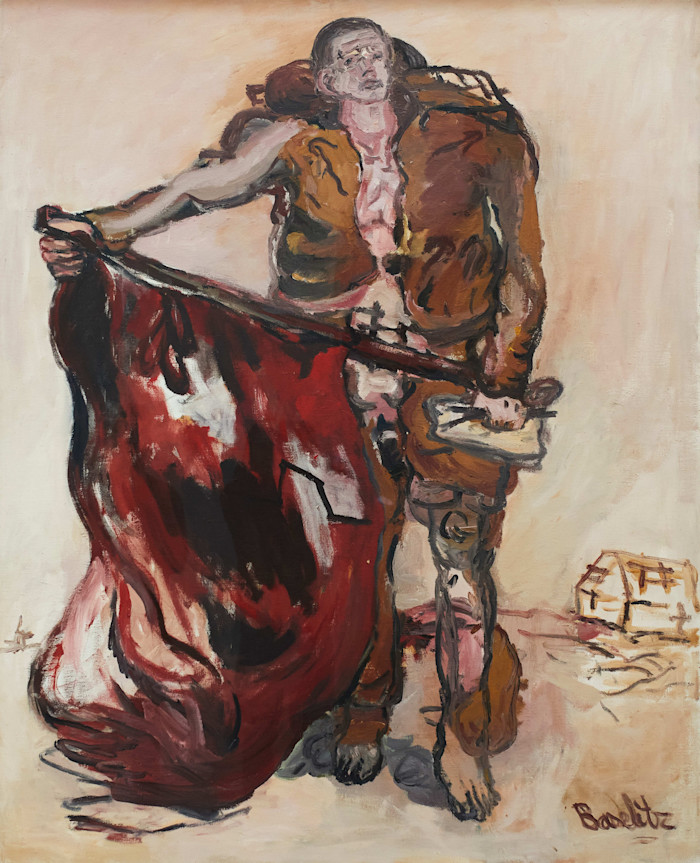
In “With Red Flag”, the archetype of the series — and the most expensive Baselitz painting ever sold (£7.5mn in 2017) — a bloody track trails from a gutted house across barren ochre land, all colour drained away, to the giant with characteristic diminutive head, gashed leg and tattered uniform standing in the foreground. Defensively, he lowers a scarlet flag with black markings: a smashed Swastika, the Soviet Red Banner, or a fusion of the twin emblems of terror.
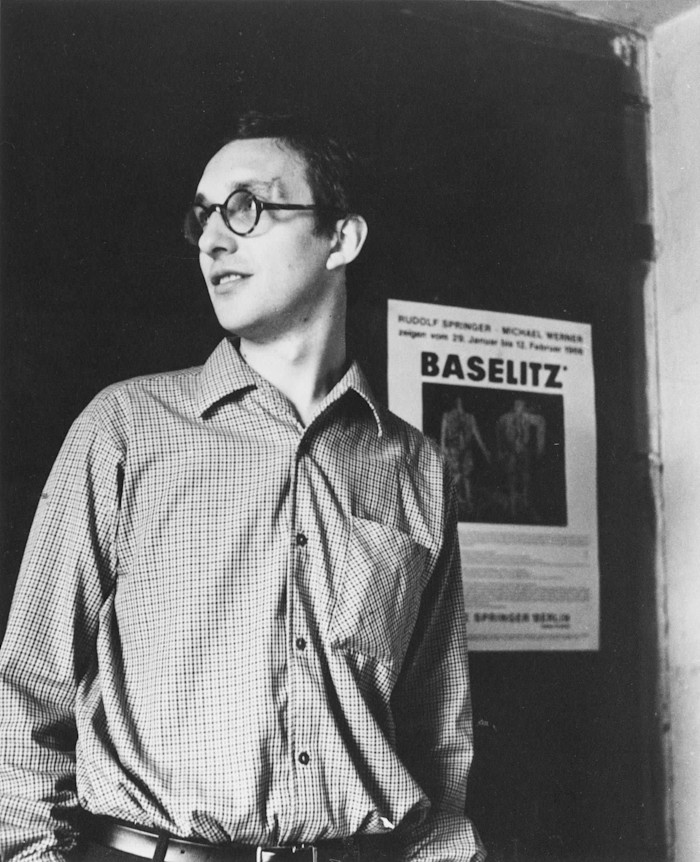
These fallen heroes parody the brutal aesthetic of Soviet realism, and also assert the power of figuration at a time when western art, led by American expressionism, was tending towards abstraction. The impact of German Gothic and grotesque — from Grünewald to Dix and Grosz’s savage 1920s portraits — is strong; “I am a German artist and what I do is rooted in the German tradition. It’s ugly and expressive,” Baselitz said.
But he blends other influences: the immediate inspirations for The Heroes were the distortions, tiny heads, unstable compositions, serpentine lines and often feminised attributes — tumbling curly hair, soft features — of the 16th-century mannerists Pontormo, Parmigianino, Fiorentino and Beccafumi, whom Baselitz encountered on a residency in Florence in 1965.
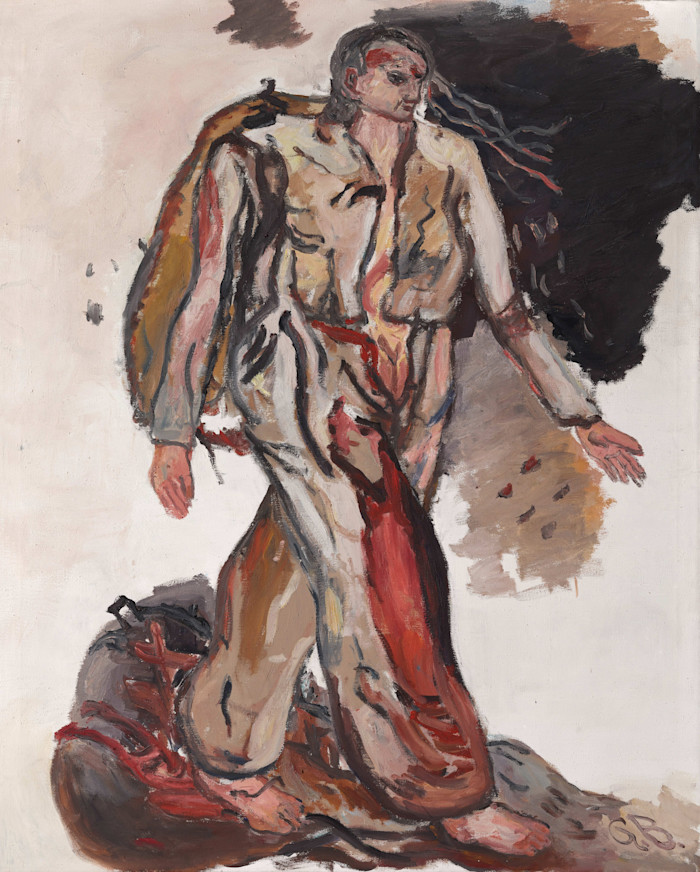
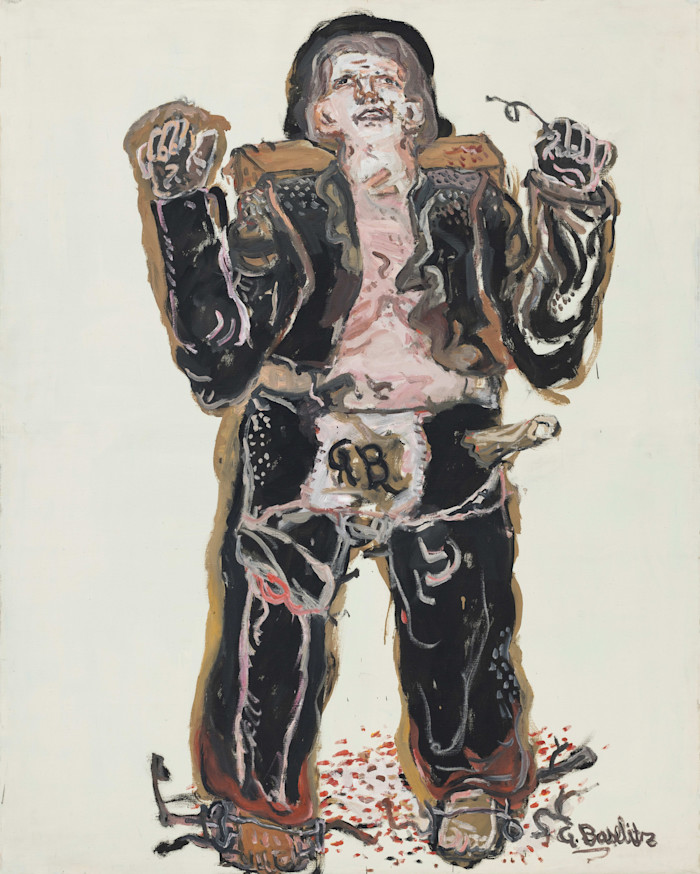
The extravagantly disproportioned “Bonjour Monsieur Courbet”, an early work in the series — the title refers to Courbet’s own self-portrait — was painted there. “Spekulatius”, a figure whose black costume opens to reveal raw flesh in impasto pink streaks, raises his arms and tilts his head upwards in an Italian mannerist pose of religious ecstasy — though he is named for a German gingerbread biscuit: an absurd character.
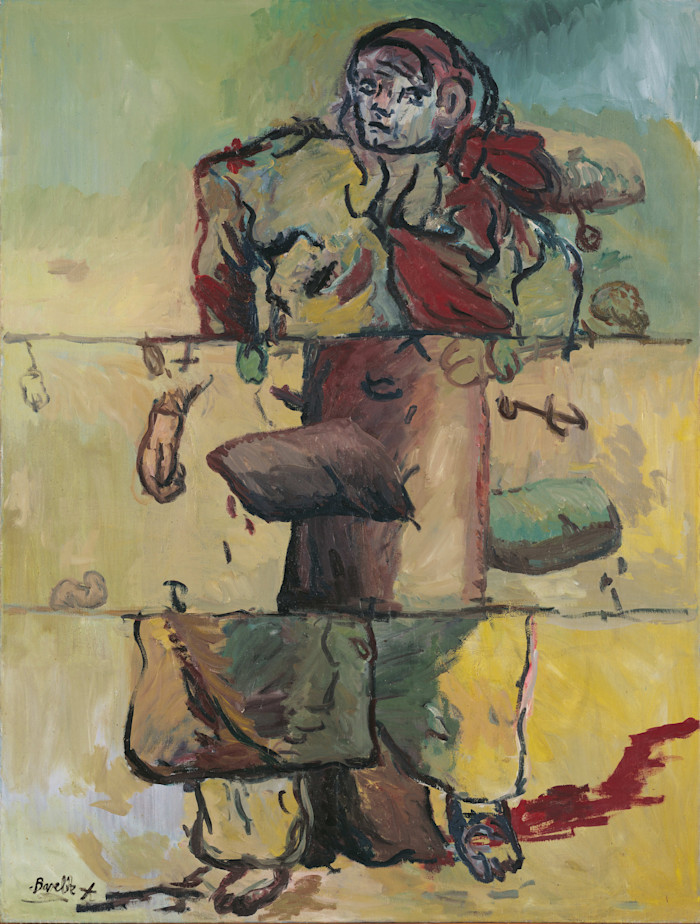
There’s an exhilarating sense here of a young painter grabbing at whatever helps from the past to create a new sort of realism: expressive, sensational, not directly representational. Cubism, inevitably, came into play: the show ends with a couple of “Fracture Paintings” (1966), “Divided Hero” and “Three Stripes — the Painter in a Coat (Second Fracture Painting)”, where Baselitz splits the canvas into horizontal sections and in each depicts fragments of the body, the parts connected but failing properly to join up. He is testing how far to push an image before it dissolves — the next stage, in 1969, would be his upside-down figures — and offering a symbol for divided, scarred Germany.
Although Baselitz believed “what I could never escape was Germany, and being German”, his Heroes, dramatising dilemmas of a postwar European generation seeking identity and meaning after trauma, share a sensibility with the existentialists Giacometti and Francis Bacon. Baselitz titled some of his heroes “A New Type”, for example the gouache, ink and oil pastel drawing here, washed across with yellow-gold, of a figure resembling an astronaut stumbling forward, half-falling, half-floating; with them he asks, as the existentialists did, what is modern postwar man, how can he survive alienation, isolation, failure?
In Eroi d’Oro (Golden Heroes, 2026), his show just closed at Fondazione Giorgio Cini, Venice, Baselitz was still addressing the question in larger-than-life-size portraits of exhausted, vulnerable, declining bodies splashed here and there in high colour. Ropac’s and the Cini’s rhymed shows were the final exhibitions of his works which he himself planned: marvellous memorials both, and a reminder that for this humanist, single-minded painter, “in my beginning is my end”.
From October 13 to December 18, ropac.net
Find out about our latest stories first — follow FT Weekend on Instagram, Bluesky and X, and sign up to receive the FT Weekend newsletter every Saturday morning