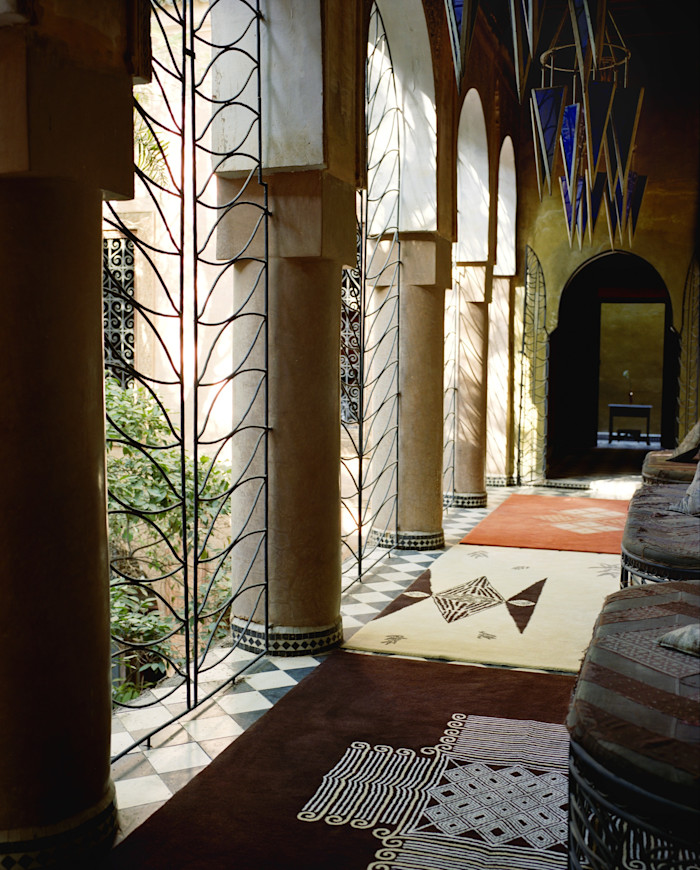
Mosaic designs, garden layouts and ironwork gates are some of the inspirations behind Colin King’s fifth collection for Beni Rugs. The eight new pieces are at once ornate and graphic, featuring fern-like motifs and floral patterns in a palette of browns, greens and blacks – and wrought with exacting intricacy. An 8ft by 10ft rug takes four to five months to weave and contains 1.3mn knots, handcrafted using a technique reserved for Moroccan nobility since the 18th century.
“Think of a knot as a pixel,” says the brand’s co-founder Tiberio Lobo-Navia. “This is the highest resolution we can produce.” It is a fitting analogy for a brand that has set out to connect ancient Moroccan craftsmanship with contemporary design, in partnership with New York-based artistic director King, but also through collaborations with creative powerhouses including architecture practice Studio KO and American interior designer Michael Bargo.
Brands such as The Rug Company and CC-Tapis have explored the intersection between traditional skills and modern aesthetics for decades. But while the old and the new were often dramatically juxtaposed, now they feel more aligned. There’s a newfound reverence for the original patterns, but the results are still contemporary.
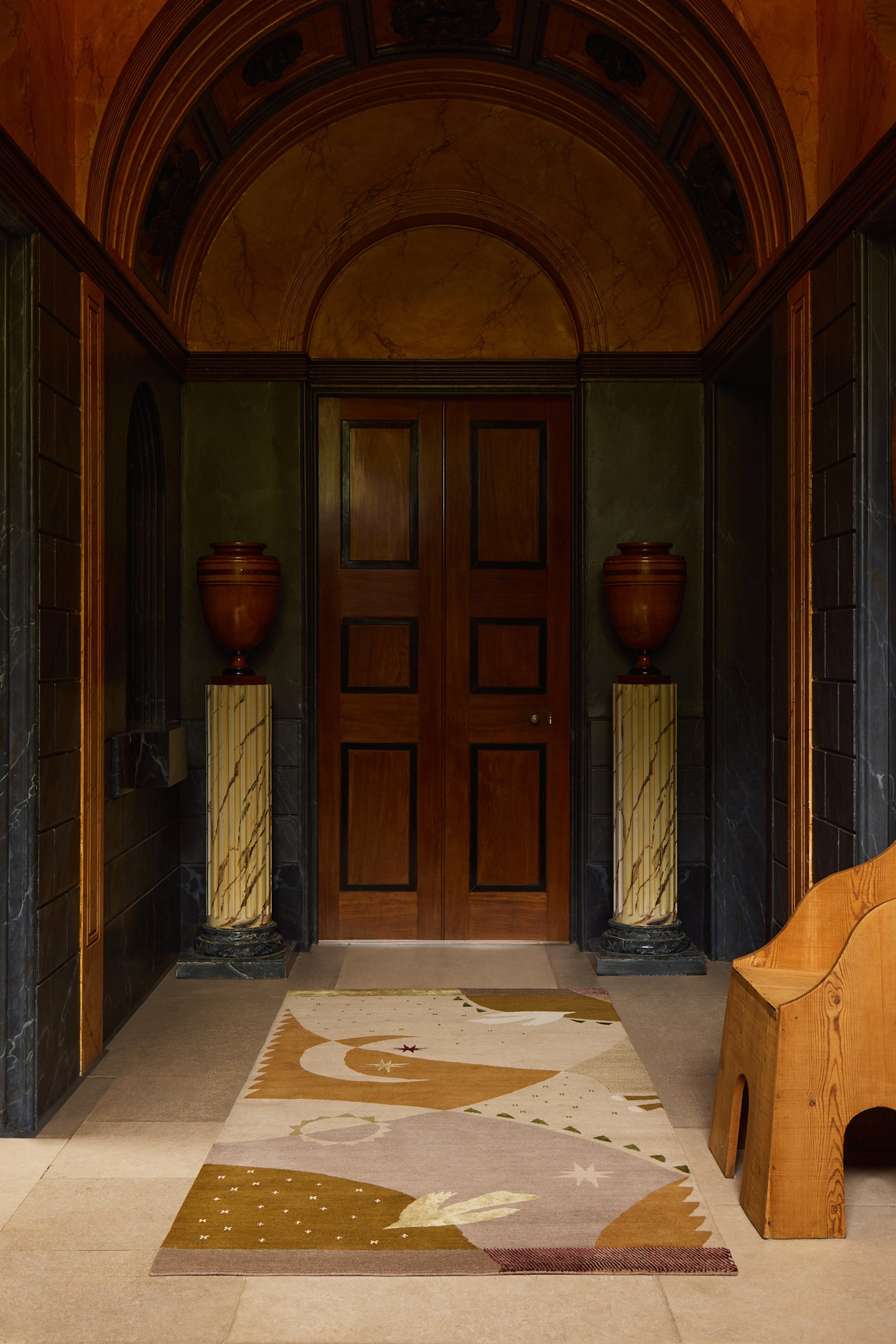
“We appreciate the heritage but we’re not preservationists,” says Dylan O’Shea, who founded Somerset-based textile and rug studio A Rum Fellow with his partner Caroline Lindsell in 2013. While their signature graphic patterns experiment with complex colour palettes, pile heights and loop-knot structures, inspired by the artisan communities they work with around the globe, the new Elsewhere collection ventures into pictorial territory, featuring moons, leaves, ladders and waves.
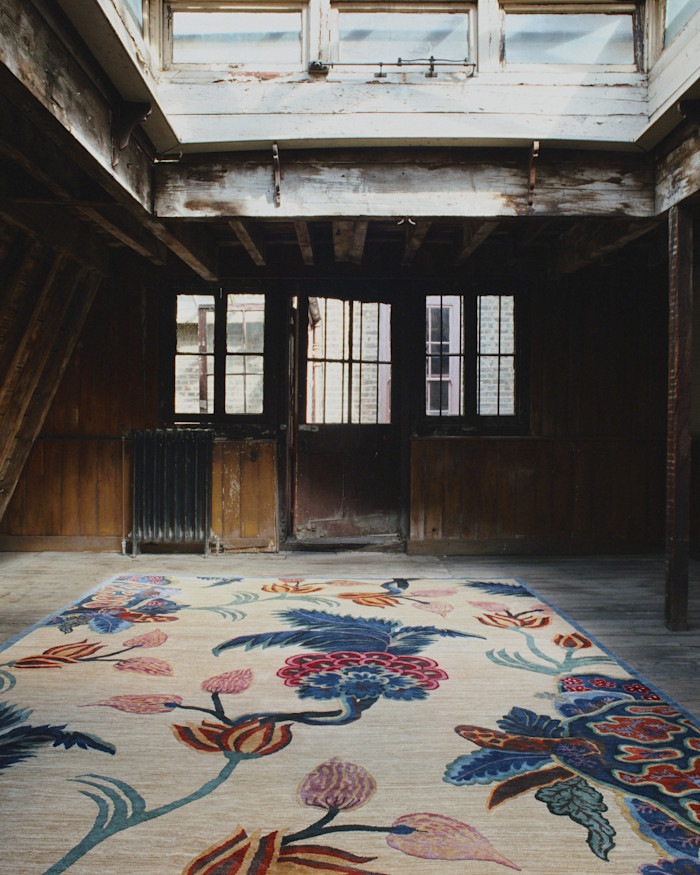
In London, Christopher Farr works with weavers in Turkey, India and Afghanistan, alongside artists and designers ranging from Rifat Ozbek to Ai Weiwei. Its latest collaboration with architect Chris Dyson is based on an 18th-century silk fragment. “It’s a floral design in these wonderful naturally dyed colours, which would likely have been made as metreage for a dress,” says Dyson, a Spitalfields resident known for his sensitive approach to historic buildings. The 15cm by 70cm panel dates back to the 1720s, crafted by one of the Huguenot weavers whose east London homes were built to accommodate looms in the light-filled lofts. For Christopher Farr co-founder Matthew Bourne, the piece of fabric by an unknown maker “pressed a button”. The original pattern of tulips and fruit has been scaled up – to “resonate with the modern eye and not feel too busy”, says Dyson – and woven in Afghanistan through a partnership with Turquoise Mountain, a charity set up by King Charles to protect the country’s cultural heritage.
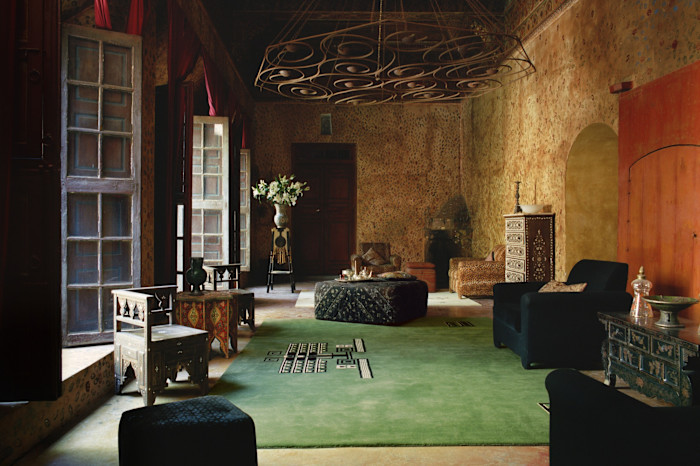
Beni Rugs has worked exclusively with Moroccan weavers since its launch in 2018. Its output has become progressively more technical. “These are the most detailed and labour-intensive rugs we’ve ever made,” says co-founder Robert Wright, noting the “plushness of pile” as well as the “intricacy of design” created in the once-dwindling Royale style of weaving. The new Chelsea collection “was a chance to show the technique’s capability”, says King, who conceived the designs with his New York apartment in mind, while reinterpreting traditional tropes such as the central floating medallion.
Shining a light on heritage craftsmanship is simultaneously revolutionising working practices. Beni Rugs, A Rum Fellow and Christopher Farr are all partners with Swiss-based nonprofit Label Step, which ensures high social and environmental standards across the industry. A Rum Fellow, a Certified B Corporation, recently started working with Nepal’s first universally accessible weaving workshop. The Karuna Facility in Kathmandu was set up by Sangita Pant and Urgyen Wangchuk in 2022 to teach weaving to people with disabilities. It represents a shift that “would never have happened if it wasn’t for the modern influence”, says O’Shea. Adds Lindsell: “We’re creating rugs that we feel are significant, while also making huge impacts on people’s lives.”
At the core of Beni Rug’s operation is an 8,000sq ft atelier in the village of Tameslouht, 30 minutes south of Marrakech. “Our weavers are paid at two to four times the national average,” says Wright, adding that their approach is attracting a young, dynamic workforce (a quarter of its employees are under the age of 35) and promoting women to management roles in a traditionally male-dominated industry.
“I hope what we’re doing makes rugmakers think beyond the product,” says Karuna co-founder Pant, who also heads up EPSA Nepal, an organisation dedicated to providing vocational training to people with disabilities. “We can innovate if we go a step further than just making a pretty carpet. Every order we get here kickstarts a new process in an age-old tradition, which helps an entire community survive on the other side of the planet.”