
Good morning. Yesterday, Federal Reserve governor Christopher Waller said: “If the economic data continue to come in as expected, I anticipate additional hikes.” Last month, before he voted for a rate increase, he said he “would be inclined to support holding the target for the federal funds rate at its current setting”. Well, when the facts change, rational people change their views. But shifts like this are a reminder that you can interpret Fedspeak all day long, but the economy is in charge. Email us: [email protected].
Hedge funds
Hedge funds have got very, very big and regulators don’t have the tools to mitigate the risks.
Between 2013 and 2026, gross assets of hedge funds increased from $4tn to $13tn, according to the IMF’s semi-annual Global Financial Stability Report. The number is higher if you include notional exposure through derivatives. The hedgies are still a small part of overall non-bank financial intermediation, but the rate at which they’ve been increasing their footprint in markets is striking and has no parallels among traditional non-banks such as insurers and pension funds. These points, in chart form:
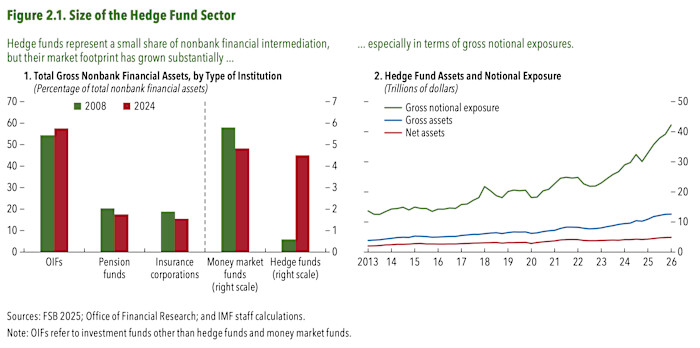
Hedge funds have not only grown their assets but also become much more important players in government bond and equity markets. Their sovereign bond exposures have more than doubled since 2022, and their estimated share of US Treasury holdings rose from 4 per cent in 2022 to 9 per cent last year. As central banks and asset managers have pulled back from government bond markets, hedge funds have stepped into the gap, helping to absorb record levels of sovereign debt supply. Debt management offices, which issue debt on governments’ behalf, appreciate the support.
The big risk lies in how the hedgies have been doing it. These funds may sit outside the banking system; their leverage does not. They obtain financing from their prime brokers, typically the world’s largest dealer banks. The prime brokerage business is highly concentrated, with the “five largest [banks] serving an estimated two-thirds of funds by assets under management”. (See also our news colleagues’ excellent report yesterday on how banks are profiting from this uptick in prime brokerage business.)
As a rule, it is good to have diverse financial system made up of investors with different mandates and risk profiles. When one group wants to sell, another may be willing to buy, supporting liquidity and helping prices incorporate information. But while hedgies’ highly leveraged strategies help to grease market functioning in good times, they can also amplify dysfunction during market stress.
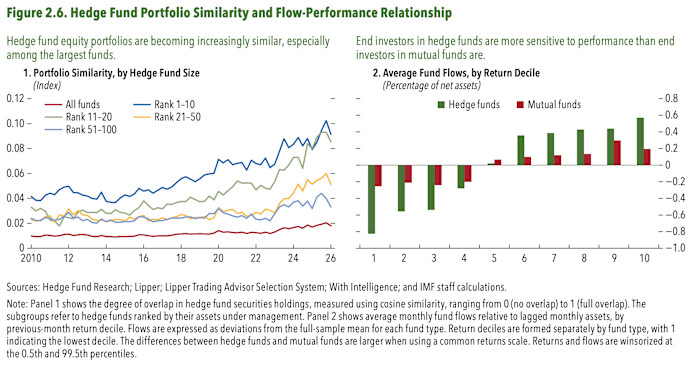
Leverage is only half of the problem; concentration is the other. The IMF finds that “hedge fund portfolios are becoming increasingly similar”, with the overlap in equity holdings rising particularly quickly among the largest funds. Making matters worse, hedge fund investors are often “hot money”, chasing good performance, then pulling their money when losses hit. If lots of funds own the same things and are all forced to unwind their positions simultaneously, that makes a bad moment worse. The effect is measurable: during periods of market stress, the most crowded stocks experience about 10 percentage points more volatility and drawdowns 4 percentage points larger than the least crowded stocks. Hedge funds may not be the cause of the next crisis, but they’re unlikely to help it.
In the past, regulators often treated hedge funds as a small and idiosyncratic part of the financial system. Because their clients were primarily sophisticated investors such as wealthy individuals and large institutions, regulators weren’t overly worried about the occasional blow-up. Proper catastrophes such as the 1998 meltdown of Long Term Capital Management were seen as one-offs. But hedge funds are now such a big part of the financial system that regulators need to have the risks they present under constant surveillance.
In most jurisdictions, regulators have little influence over hedge funds’ investment strategies and risk management. In fact, many hedge funds aren’t domiciled in the main financial centres such as London and New York; their natural habitat is low-tax, tropical islands. About 70 per cent of these funds’ investor capital is raised through offshore structures, further complicating regulators’ ability to see where risks are building.
Hedge funds may not cause the next crisis, but they are large enough, levered enough and similar enough to make any shock much worse.
(MacFadden)
Another comment on inflation-linked bonds
Our two pieces yesterday, on inflation-linked bonds in the US and in the UK, were met with some strong objections from readers. The core complaint was that we talked about Tips and ‘linkers’ as if they were a trade, whereas they are an investment designed to lock in a real return when held to maturity (sample comment, from ‘Welsh Toffee’: “No, no, no! You are confusing a risk-reducing, liability-matching investment with one that is trying to outperform a benchmark.”)
This is a fair point, and we should have acknowledged the utility of these bonds for a specific kind of (mostly retail) investor. At the same time, though, we would emphasise two points. First, as we noted yesterday, every investor has to consider the possibility that they might have a liquidity crisis and need to sell before they plan to, and long-duration inflation-linked bonds can undergo extreme price swings at precisely the moments such crises tend to arise (see: the LDI debacle).
Second, it is important to remember that we all hate losses, and therefore have a tendency to overpay for returns that are nominally certain (this the core tenet of prospect theory). And investments such as linkers and Tips appeal to this form of irrationality. Liability matching can help us avoid the worst, but it is important not to construct a portfolio that underperforms the alternatives under a wide range of scenarios, in return for the sense that the worst can’t happen. Everything is a trade, and the worst can always happen, no matter how many inflation-indexed bonds, gold bars, annuities, or life-insurance policies you own.
(Armstrong)
A correction
In yesterday’s letter, we made the mistake of stating the spread of SpaceX’s five-year credit default swap jumped 194 basis points, rather than saying jumped to 194 basis points. We deeply regret the error — thank you to the eagle-eyed readers who alerted us.
One good read
FT Unhedged podcast
Can’t get enough of Unhedged? Keep following Rob Armstrong and Katie Martin’s incisive and unfiltered analysis on the Unhedged podcast, a twice-weekly, 15-minute lively dive into the latest markets news and financial headlines. New episodes every Tuesday and Thursday.