
Rising interest rates can be either good or bad for banks. More often than not, their effect is positive. A recent fall in bank shares, though, even as bond yields hit multi-decade highs, reflects concerns that some unusual forces are at work.
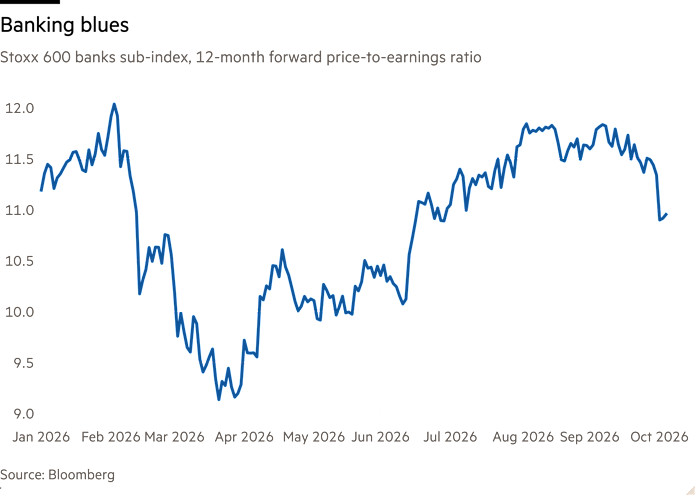
Lenders generally like higher rates because what they charge borrowers tends to rise roughly in tandem with market benchmarks, whereas only a fraction of that increase is passed on to savers as higher deposit rates. Yet despite a recent jump in rates, the Stoxx sub-index of large European lenders has fallen 7 per cent since the start of September, almost twice as far as the broader market.
On the loans side, one risk is that prices get so high that demand starts to wane. In that, bank lending is like any other product. The average interest rate on a 5-year fixed-rate mortgage in the UK recently passed 6 per cent, not great for banks like Lloyds hoping to expand loan growth.
The type of interest rate move matters too. Lately, short-term bonds have moved further than long-term ones. Since a bank’s business model is to borrow short and lend long, this dynamic — a “bear flattener” in market jargon — hurts profitability.
Meanwhile if funding costs rise, the expanding profit margins banks have enjoyed may start to reverse. Competition for deposits is higher than it was in olden times, thanks to ambitious fintechs offering generous yields on savings. The appearance of new AI “assistants” like Meta’s Muse also raises the not-wholly-helpful prospect of consumers handling their finances more proactively.
Fiercer jockeying for savers’ money would be likely to push up banks’ “deposit betas” — the number that reflects how much of a given central bank rate rise they must pass through to their depositors. Expect bank chiefs to be grilled on that ratio when they report third-quarter earnings: US lenders are set to do so next week, Europeans the week after.
Not everyone is concerned. Analysts at Keefe, Bruyette & Woods reckon deposit and loan costs in Europe are rising together, limiting margin pressure. And Deutsche Bank’s chief financial officer Raja Akram told a recent conference that rate moves should lead to higher income.
Nor are all the unusual forces negative. Some demand in Europe is being driven by long-term trends like investment in defence and infrastructure. That sort of demand should be durable even at higher prices. The growth in loans to companies in the Eurozone was above 4 per cent in both July and August, higher than it has been in over three years.
The recent sell-off means expectations are at least set relatively low. The Stoxx banks sub-index trades at a more modest forward price-to-earnings multiple than it did at the start of the year, and if banks prove bullish, it would look cheaper still. Europe’s banks have outperformed the wider market for five years in a row; they still have a good shot of making it six.
[email protected]