Government bonds continue to be in focus with the 10-year US Treasury yield reaching new highs again, with a flare-up in the Middle East, where peace appears to remain a distant prospect, fuelling the ascent.
While the war in Iran and the supply shock it has created is a factor behind the synchronised rise in financing costs across the west, higher energy prices are just one reason for higher bond yields. Chris Giles tackled the topic in his newsletter and assessed the totality of the situation. One consolation for central banks is that inflation-fighting credibility remains relatively intact as longer-term inflation expectations indicate.
Highlights of the week: Federal Reserve
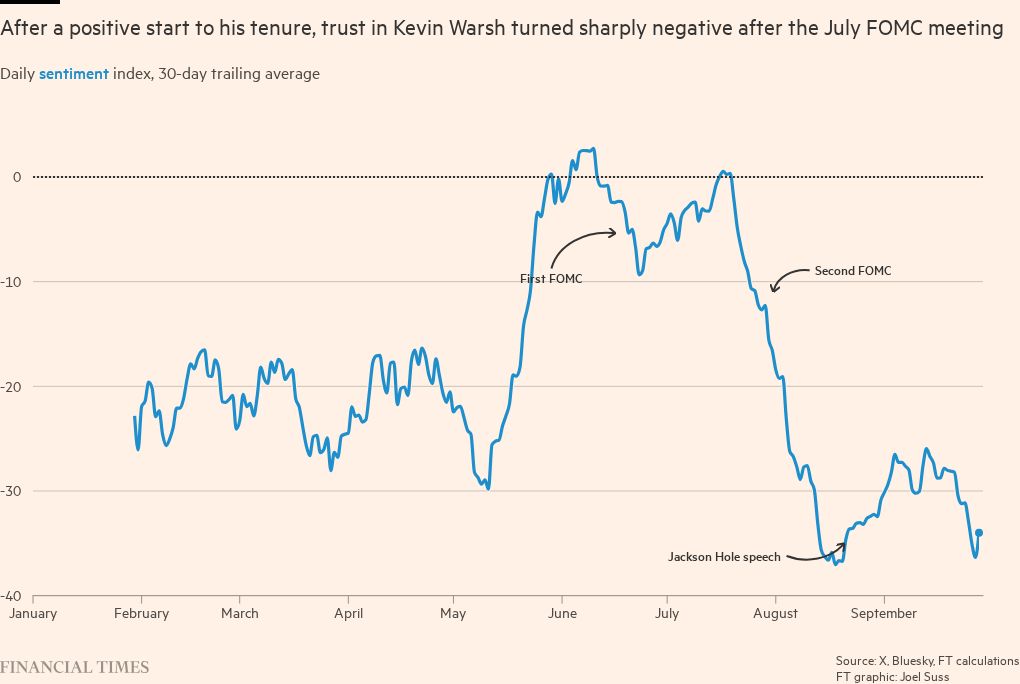
When it comes to the fight against inflation, trust is one of central banks’ biggest resources. The actions of US President Donald Trump have taken their toll at the Fed, writes Joel Suss, who has tracked trust using social media data. But the data also indicates that trust in the Fed has bounced back this year as a result of the renewed determination to get inflation under control.
Minutes from the Fed’s September meeting confirmed broad agreement among policymakers for the new hawkish stance. A higher rate path is the result of higher energy prices and the solid performance of the US economy, which continues to benefit from decent consumption growth and the AI infrastructure build-out. Most policymakers agreed that another rate increase was likely to be needed before the end of 2026.
Even with the latest escalation in the Gulf, the Fed does appear to have more of a handle on market pricing, which indicates another rate rise this year, probably in December. The rate path indicates another two increases on top by the end of 2027.
European Central Bank
Minutes from the ECB’s September meeting suggested the governing council had switched back to a more data-dependent stance following its second rate increase of the year, to 2.5 per cent. Policymakers recognised that the inflation backdrop had worsened in the run-up to the decision as a result of energy prices and stronger than expected growth. But with few signs that price pressures were spreading or second-round effects in wage data, the ECB can afford to watch and wait.
Market pricing acknowledges that narrative when it comes to the October meeting, with less than a 20 per cent chance of an increase to 2.75 per cent. But markets continue to price for the worst, with moves higher priced in for December, April and later in 2027.
Bank of Japan
Wage growth cooled in August to 3.8 per cent from 4.3 per cent in July. Real wages remained in positive territory for the eighth month in a row. With policymakers worried about falling behind the curve, we think the data remains supportive for the BoJ to take rates to 1.5 per cent by the end of the year.
Market pricing agrees with a 70 per cent chance of another move in December and for rates to move to 2 per cent by the end of next year.
Chart of the week
Social media data indicates that trust in Fed chair Kevin Warsh remains low even after the Fed lifted rates in September. Warsh’s enigmatic communication style at his first two rate decisions has taken its toll.
Highlights of the coming week
US inflation data is out on Wednesday, with headline consumer prices expected to have risen by 3.6 per cent in September from 3.4 per cent in August. Core CPI is expected to be 2.5 per cent in September, up from 2.4 per cent. The Fed’s Beige Book qualitative assessment of the economy follows on the same day.
Elsewhere from Monetary Policy Radar
Rate scenarios for our central banks can be found here for the Federal Reserve, European Central Bank, Bank of England and Bank of Japan.
See all the latest central bank commentary here, with our Central Bankers’ Views feature.
See who the hawks and doves are for all central banks, including the Fed, based on their latest comments.
See what professional forecasters think in our Analysts’ Views for the Fed, BoE, ECB and BoJ.