Good morning. It’s going to be an eventful weekend, as the Cockroach Janta Party and various other political and citizen groups unite in their demand for the resignation of the country’s chief election commissioner. New Delhi has been wearing the look of a city preparing for trouble all week, as authorities shut access to several key roads and entry points into the centre of town. In July, police action against young people played a key role in fanning the flames of the student protest, which eventually led to the resignation of the country’s education minister. All bets are off on what tomorrow will bring.
In today’s newsletter, meet the man who holds the key to the tussle in the Tata boardroom. But first, India’s central bank has raised rates after three years. What is the economy signalling?
Schrödinger’s economy
As was widely expected, the Reserve Bank of India raised the repo rate by 0.25 percentage points to 5.5 per cent. More significantly, it decided to shift its stance on rates from neutral to “calibrated tightening”, signalling that there will be more raises in the future. Analysts and economists are divided over how many might come over the next year, with estimates ranging from a single additional increase to as many as four, taking the repo rate to 6.5 per cent. With economic indicators pointing in different directions, making a precise prediction at this stage would be a fool’s errand.
The immediate concern is inflation. As oil prices remain elevated on account of the war in the Middle East, inflation is accelerating. While the official numbers for September are yet to be released, most surveys point to headline inflation of 5.5 per cent, up from 4.8 per cent in August. The RBI itself expects inflation to peak at around 6 per cent in the October-December quarter, which will take it to the upper end of its tolerance band. At the same time, economic growth numbers are promising, with the central bank raising its forecast for this fiscal year to 7.1 per cent, and so there is room to absorb the higher borrowing costs.
For the economy, however, the more interesting question is what is happening to consumption. And here the data is all over the place. For several quarters, India’s rural economy had been showing encouraging signs on consumption. But there are now signs of weakness. Most significantly, tractor sales have fallen 12.6 per cent year-on-year in September, according to industry data. Urban consumption, meanwhile, appears to be improving in certain sectors, especially in low-cost fashion and lifestyle products.
The best bellwether, though, has been the automobile sector, which has had record-breaking numbers month after month. In September, total vehicle sales rose nearly 32 per cent year-on-year. Both urban and rural passenger vehicle sales grew at roughly the same pace.
Will a new interest rate tightening cycle derail this consumption? I am going to stick my neck out and say: probably not; at least not yet. Consumption in India has been displaying contradictory patterns for several quarters, but one trend is becoming increasingly clear: discretionary consumption is holding up remarkably well. India’s wealthier consumers are buying cars, homes and premium services with considerable gusto. They are unlikely to be deterred by a relatively marginal increase in the cost of servicing their debt.
The squeeze is more visible lower down the income ladder, where consumers are cutting back on food and other basic goods. That makes the economy particularly difficult to describe. The pessimist will look at these numbers and see increasingly unequal growth, in which the affluent are consuming while the less affluent are struggling for even the basics. The optimist will describe this as an economy in which one engine is firing strongly even if another is losing momentum.
Both are true.
Recommended stories
India’s first bullet train stumbles over divisions with partner Japan.
AI upends Singapore’s ‘quant Olympics’.
EU envoy lands in China for last-ditch talks over car exports.
Samsung profit surges ninefold to $80bn on AI chip demand.
Why don’t people want to have children any more?
Real men don’t do climate change.
Tata’s kingmaker

Like some of you, I am sometimes hesitant to go into yet another Tata story. But I am glad to have made the exception for this one.
It is an extraordinary turn of events that the battle for control of the $265bn conglomerate hinges on a single vote — and it belongs neither to the founding family nor to its many charitable trusts. That vote belongs to billionaire Venu Srinivasan, the 73-year-old chair emeritus of the TVS Group, who was brought in by former chair Ratan Tata as one of two representatives of Tata Trusts — charitable bodies that own a controlling stake in the vast conglomerate. His support for a proposed listing of Tata Sons and the reappointment of chair N Chandrasekaran has put him at odds with Noel Tata, chair of Tata Trusts.
Srinivasan’s position is crucial because Tata Trusts, which own a controlling stake in Tata Sons, have two of the company’s six board seats — Noel Tata and Srinivasan. A majority of the trusts’ nominees must agree on strategic decisions. This in effect gives Srinivasan the power to block Noel Tata.
The bitterness between the two men seems to be forged under Ratan Tata’s shadow, who appointed Srinivasan, and, according to sources, did not “think much of Noel”. Noel Tata tried to remove Srinivasan from the Tata Sons board in April, but failed. And Srinivasan’s countermove was a masterstroke. He raised complaints with the trust regulator over governance at Sir Ratan Tata Trust, which owns 23.56 per cent of Tata Sons. The regulator subsequently blocked the trust from holding meetings. If the trust cannot hold a meeting, Tata Sons cannot convene a shareholders meeting.
Until that impasse is resolved, neither side can prevail. This leaves Srinivasan, a non-Tata, at the centre of Tata’s power struggles.
Go figure
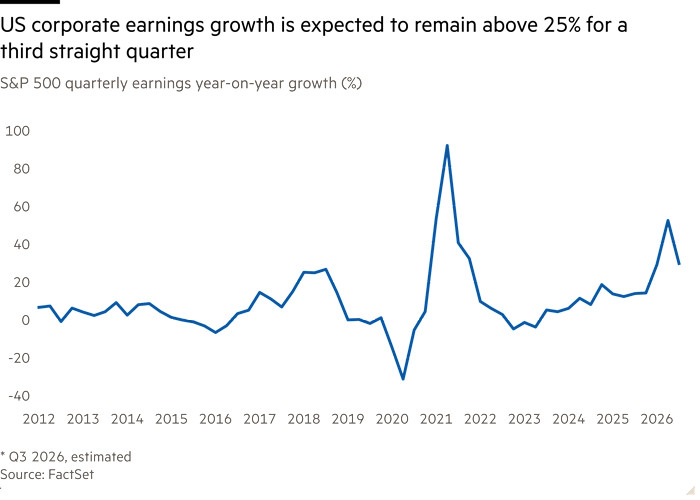
Reserve Bank of India governor Sanjay Malhotra said on Wednesday that the Indian stock markets will probably improve when the AI craze wears off in the rest of the world. That does not seem to be happening in a hurry. The US is gearing up for another quarter of bumper corporate earnings spurred by lavish spending on the AI build-out. The S&P 500 earnings forecast is for 27 per cent annual growth, propelled by AI companies. This will make it the third consecutive quarter in which earnings growth has exceeded 25 per cent — an unprecedented run.
Read, hear, watch
I enjoyed East of Eden (on Netflix). Based on the John Steinbeck novel, the show is a study of two significant biblical stories — that of Cain and Abel and, perhaps to a lesser degree, of Adam and Eve. The period details are rich in this multi-generational saga, and the lead actors, especially Florence Pugh and Christopher Abbott, are sensational. Some of my friends were upset that the show left out significant chunks of the book, but I had none of that trauma, having never read it.
Your View
On Tuesday, I wrote about Essar Group’s $18bn investment in US steel. India Brief reader Neelima Jain had this to say:
I doubt the Iowa plant will be built as announced. My best guess is a smaller plant after 2030, with a partner who brings the capital, and only if Nashwauk, its Minnesota mine, performs. Essar knows the technology. Its weakness has been money.
(Edited for length and clarity)
Buzzer round
Which American tech billionaire co-founded the database giant originally called Software Development Laboratories, served as its CEO for nearly 40 years, and famously purchased 98 per cent of the Hawaiian island of Lanai? His son is now in the news for executing one of the biggest media deals in the world.
Send your answer to [email protected] and check Tuesday’s newsletter to see if you were the first to get it right.
Quick answer
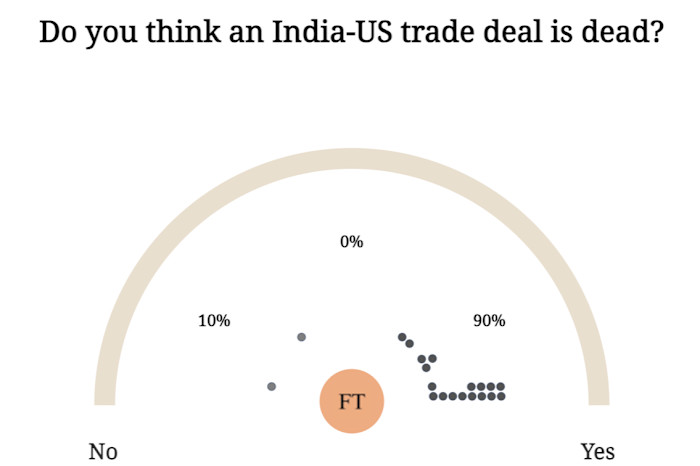
On Tuesday we asked if you think the India-US trade deal is dead. The writing is on the wall.
Thank you for reading. India Business Briefing is edited by Mark Garrison. Please send feedback and suggestions (and gossip) to [email protected].