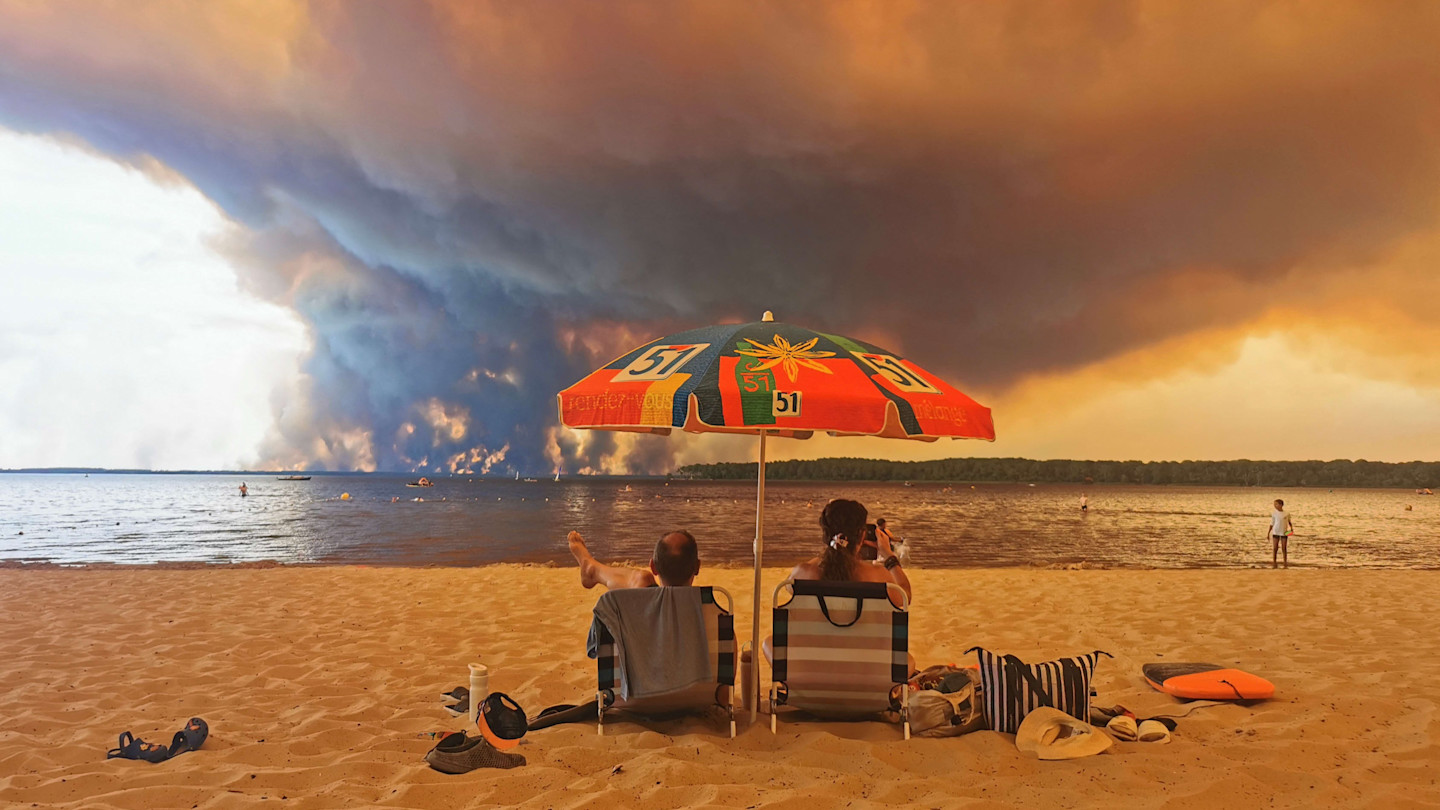
Dinner at Legado. It has been open for more than a year, so should be losing impetus. Instead it is elbow-to-elbow full on a Wednesday evening, with double sittings. As of this week, it is trading on Mondays to meet demand. And so begins the conversation that marks many a night out in 2026: “Who are all these people?” “How are they funding this?” Most of all: “Why does no one look haunted?”
There is a 10 per cent chance that AI will cause human extinction, according to some in the field. Off the record, spies quote similar odds on a pan-European war this decade. And still I, like REM, feel fine. The Homeric struggle to get a restaurant table between 5.30pm and 9.45pm suggests that others do too. What explains the gap between the precariousness of the world right now and the majestic nonchalance out there?
Pessimism fatigue, I fear. In recent times, too many boys have cried “wolf” — or “crime wave” or “loneliness epidemic” or “civilisational erasure” — and the townsfolk are numb to it now. Doom merchants are not just a drag to be around. They are bad citizens, insofar as their round-the-clock bleakness makes it hard for others to distinguish the real threats from the neurotic slop.
A westerner of my age has lived through the following public scares. First, nuclear annihilation. In the 1980s, it was the stuff of Hollywood films and Martin Amis’s weakest writing. Turns out the cold war was ending, not turning hot. Second, al-Qaeda. The threat was not invented but nor was it ever remotely existential. That era’s political speeches have aged mortifyingly. Third, the pandemic, or rather the lockdown, which was going to change human interaction forever. It was an open question whether even the handshake would return, never mind sex. Both have, I hear.
There was no malice behind the raising of these alarms. But the effect, which has been to desensitise people to other warnings, is poisonous. You are likelier to shrug at the mention of Vladimir Putin if you regret not shrugging at the mention of Saddam Hussein. You might feel licensed to belittle climate concern if you remember expert-sounding talk of an eternal pandemic.
At least the panics of yesteryear were founded on large, concrete events: Pershing missile deployments, 9/11, a coronavirus. In vogue now is a psychocultural gloom — the “crisis of masculinity”, “post-literacy” — built on selective data, pop science and a sort of rhetorical overexcitement that starts to bounce off the audience. At some point, people cross-reference the misery of the “discourse” with their experience of three-dimensional life, in which quite a lot is better than it was a generation ago. The resulting loss of trust, the tuning-out of warnings, even valid ones, is fatal.
In the past, this column has argued against pessimism for being quite often wrong. And it is. The quickest route to applause from a dappy audience is to pine for some Edenic past, then give a monocausal explanation — Thatcher, smartphones — for the subsequent decline. The middlebrow-ness, the incuriosity about positive social trends, is infinite. Crime has halved since the 1990s and none of these sourpusses want to talk about it.
But this column is different. Its case against pessimism is utilitarian: that it has bad real-world consequences. Despair is dangerous because, over time, if it is falsified more often than not, it makes us less vigilant, not more. When a president is called fascist and turns out to “just” be wrong, inept and venal, people will have their guard down when an authentic fascist creeps into view.
The culprit in Aesop’s fable is not the lying boy. It is the villagers, who make the inductive error of disbelieving all wolf sightings because the previous ones were false. A classic Humean no-no, that. People shouldn’t do it. But we do. And so the ethical burden is on pessimists to tone things down. Even fairly plausible warnings have to be rationed, to avoid becoming an ignorable white noise. I see the problem most nights. I am the problem most nights, laughing into the gambas al ajillo at what might be the darkest moment since 1945. “Why does no one look haunted?” Perhaps they once did, and feel like fools for it.
Find out about our latest stories first — follow FT Weekend on Instagram, Bluesky and X, and sign up to receive the FT Weekend newsletter every Saturday morning