
Think of it as a bull market with no horns. Earlier this week, the S&P 500 hit an all-time high, a scenario that would normally come with a frenzy of mergers, acquisitions and public offerings. Rising prices usually lead to rising animal spirits, after all. But after what looked like a healthy start to 2026, corporate dealmaking has proven oddly muted.
Several high-profile listings, including those of OpenAI, fitness tracker Oura and SoftBank’s greenfield data centre builder SB Energy, have been postponed. Reasons vary: SB Energy is still waiting for regulators to sign off its paperwork. But outside buoyant equity prices, market conditions aren’t terribly friendly. Interest rates, which impact companies’ cost of capital, are rising. Consumer confidence has been hit by higher prices and mortgage rates, as well as weak job-hiring trends.
And the S&P 500 isn’t necessarily the best indicator of market sentiment. Technology accounts for 40 per cent of the index, which has far outperformed the more broad-based Russell 2000. Yet the titans in its roster are not just a play on the future trajectory of AI. Alphabet and Meta Platforms, for example, have huge advertising businesses that already throw off huge amounts of cash. That sets them apart from a lossmaking pure-play AI company such as SB Energy.
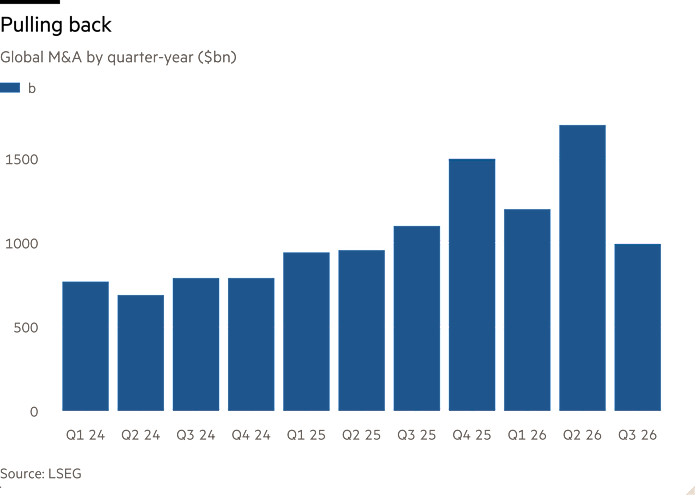
In the third quarter of the year, global M&A fell below the psychologically important $1tn level. The boutique investment banks that rely on deal fees have been feeling the chill. Shares in Evercore, the biggest of the specialist firms, are down nearly a quarter this year. Perella Weinberg is close to selling itself to a diversified rival, according to press reports.
The big banks are in a slightly better position, since market volatility has been good for trading desks. The State of New York recently disclosed that broker-dealers in the first half recorded record profits of $46bn, up 50 per cent relative to 2025. Goldman Sachs is happy enough with its prowess to give another $500mn special bonus to its brass. Analysts expect its overall investment banking fees to rise 30 per cent for the full year, according to LSEG, faster than in 2025.
Some deals will still squeak through. Starbucks, for instance, has looked at an acquisition of burrito chain Chipotle Mexican Grill, suggesting some corporate chiefs are still thinking of flexing their muscles. That deal, a cost-cutting combination that would probably involve a share swap given Chipotle’s market capitalisation of about $40bn, points to the sort of transaction that might weather the chill.
The M&A slowdown doesn’t reflect any notable change in how much companies might benefit from teaming up. Companies always need to grow, improve their strategic position and raise capital. What changes is managers’ appetite for risk, which has been hit by rising yields and AI jitters. The divergence between booming stock markets and dwindling deal volumes will eventually close — although it’s most likely a fall in the equity market that will make that happen.