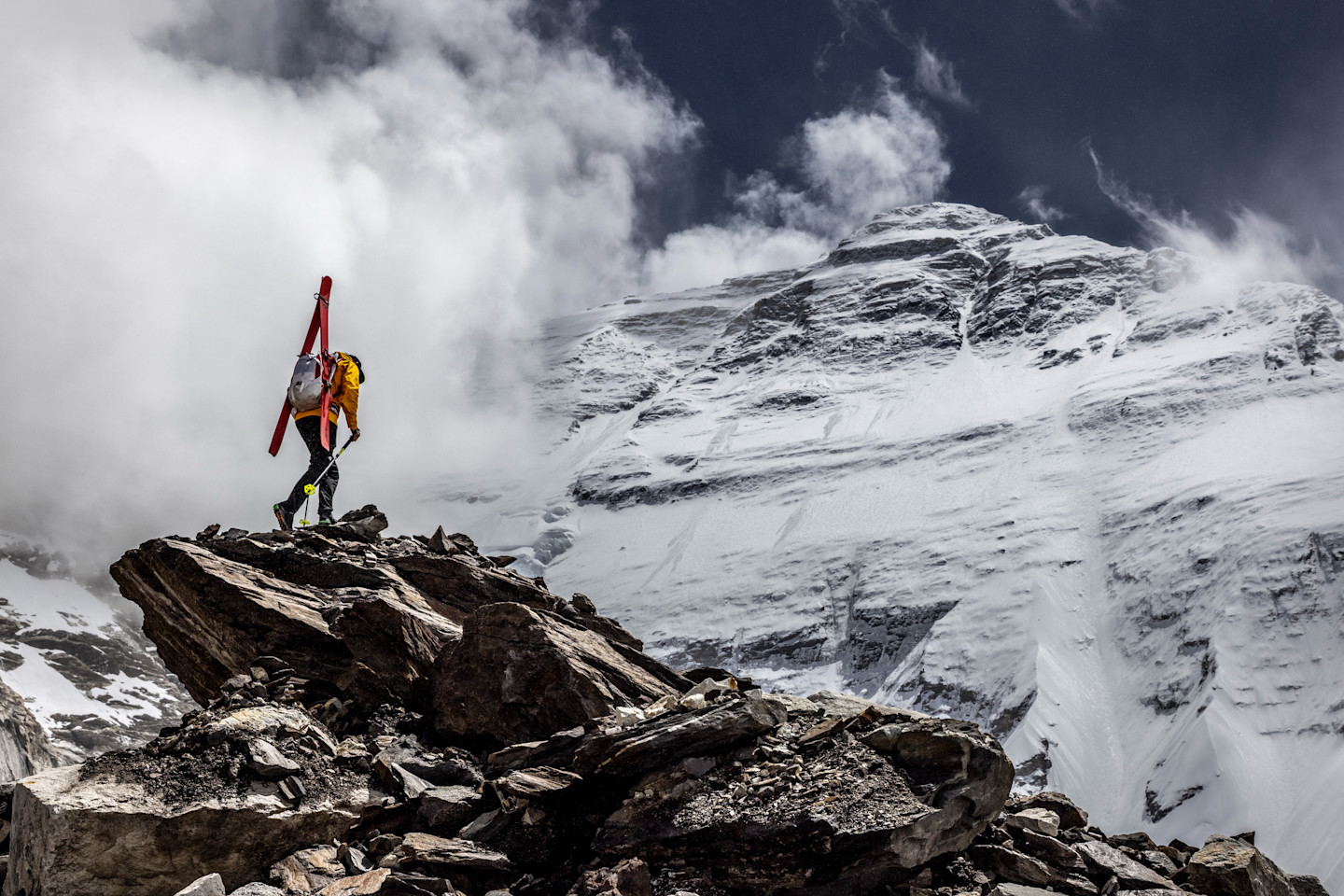
Jim Morrison was standing about 10 metres to the right of his partner when the avalanche swept her off the mountain. The couple, both celebrated ski mountaineers, had just reached the summit of Manaslu, the world’s eighth-highest peak. Like Morrison, Hilaree Nelson had built her career making groundbreaking descents in the Himalayas. In 2005, she’d skied from the summit of Cho Oyu, the sixth-highest mountain in the world. And in 2018, about three years after she and Morrison started dating, they cemented their status as the sport’s ultimate power couple by becoming the first people to ski the Lhotse Couloir — a narrow strip of snow beneath the summit of the world’s fourth-highest peak dubbed “the dream line”.
But even being the best in the world wasn’t enough to save Nelson on September 26 2022, when she made a turn just beneath Manaslu’s summit and triggered a small avalanche. In footage captured on helmet cameras, the slide looks relatively innocuous but it carried enough force to knock Nelson off her feet in what ski mountaineers call a “no fall zone”, dragging her over a cliff to her death. Nelson was 49 years old. As well as Morrison — who eventually managed to recover her body two days later and some 1,500 metres below — she left behind two sons, aged 13 and 15.
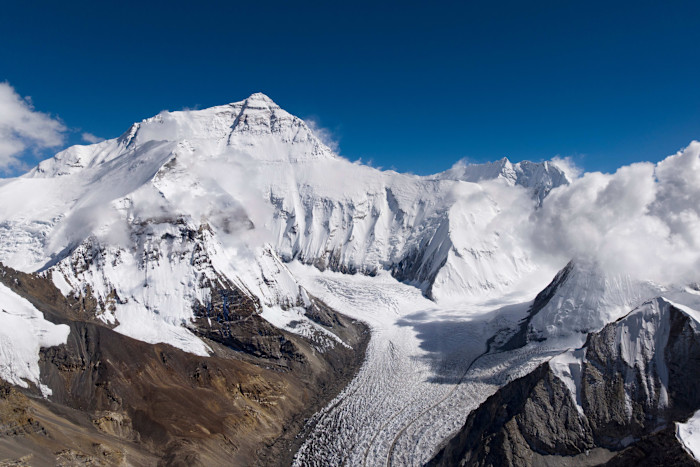
Before her death, Morrison and Nelson had been planning what would have been the crowning achievement of their careers: an audacious ski descent straight down the north face of Everest. Their proposed line through the Japanese and Hornbein Couloirs was once described by the pioneering climber Reinhold Messner as “the most beautiful route on Everest”. It had only been climbed by five people before — and no one had ever skied it. Their attempt (including the fateful, preparatory mission to Manaslu) was being documented by Oscar-winning film-makers Jimmy Chin and Elizabeth Chai Vasarhelyi, close friends of the couple.
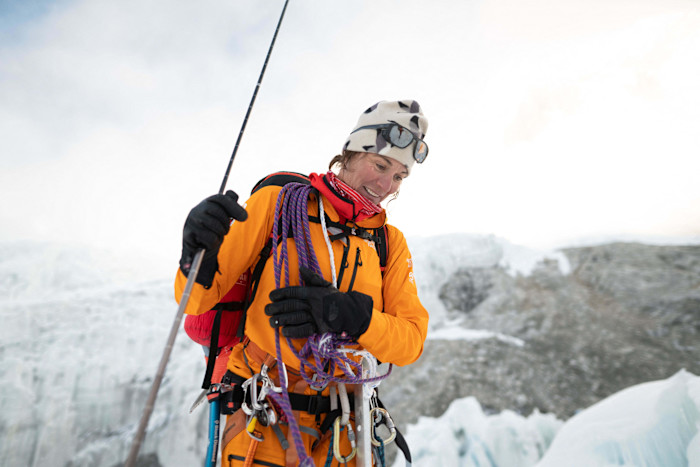
Last month, I watched the premiere of the resulting documentary at the Venice Film Festival. It opens with a tender portrait of Nelson’s relationship with her kids, as well as her and Morrison’s burgeoning romantic and professional partnership. There was an audible gasp in the 1,000-seat Sala Grande theatre when the avalanche hit. The incident itself is shockingly brief: one moment she’s there, chatting breezily into her microphone. And then, before Morrison can even move to help her, she’s gone. The film, titled Everest: The Other Side, then follows Morrison’s attempt to push through the grief and complete their shared mission in Nelson’s memory. Released at the end of this month, it’s already being talked about as a successor to Chin and Vasarhelyi’s last surprise hit, the rock-climbing documentary Free Solo.
In February, months before the glitzy Venice screening, I met Jim Morrison, now 51, near his home in Tahoe, California. It was pouring with rain, ruling out any adventurous skiing, but we spent an amusing few hours cruising round the sopping-wet pistes of Palisades, before eventually bowing to the inevitable and heading inside to wring ourselves out. Morrison is well over six feet tall, with a languid, deliberate way of speaking and a one-sided, Bruce Willis smile. He appeared relaxed and at ease. But, over the course of our conversation, it became clear the process of getting to this point had been a long one.
After Nelson’s death, “I really didn’t want to ever ski again, or climb a mountain again, or be in an unsafe situation of any kind ever again,” Morrison says. She was his soulmate — or as he put it in an Instagram post, “my life partner, my lover, my best friend, and my mountain partner”. The loss was “indescribable” and the grieving process was long. “Day by day I started to just keep moving forward,” he says. “Eventually, I started finding myself looking at making ski turns again, and said: ‘I still want to do this. I want to finish this goal because it meant a lot to us, and I wanted to do it in her honour.’”
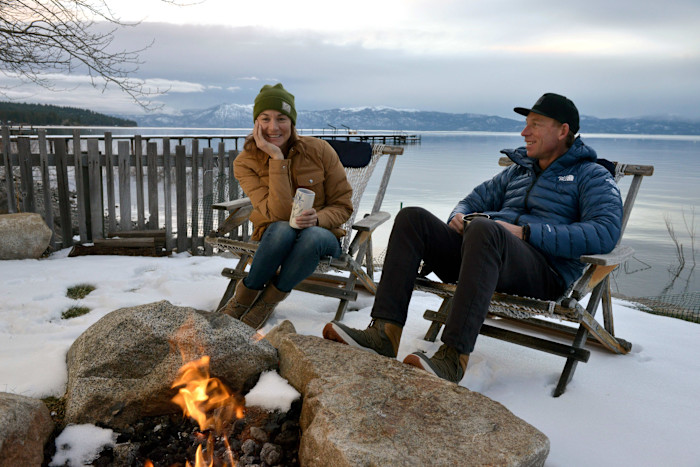
There’s a moment in Everest: The Other Side after Nelson’s death, where Morrison is sitting around a fire with friends and tells them he wants to go for it. Chin says he’ll support him not just by filming but by climbing in Nelson’s stead, and his brotherly role becomes central to the film’s dynamic. Shortly afterwards, it cuts to Vasarhelyi, who was then married to Chin, sitting him down at their kitchen table, and asking him to name all the people who had sat there and subsequently died. Like Nelson, Chin and Vasarhelyi have two children. The question both she and the film are asking is obvious: are the risks really worth it?
Chin himself never explicitly responds. But for Morrison, the desire to push himself to such heights runs deep. “To a big degree, I think the mountains kind of rescued me,” he told me the first time we met, on an expedition organised by The North Face to the Arctic archipelago of Svalbard, in 2019. For Nelson’s death wasn’t the first tragedy to befall Morrison: in 2011 his wife and two children died in a plane crash. “I’ve suffered some pretty serious loss in my life,” he said.
Morrison had met his wife Katie when he was 22, and they married shortly afterwards. At the time, he’d recently founded Jim Morrison Construction, which still builds luxury homes around Lake Tahoe, and when their two children were born, he pulled back from skiing and threw himself into family life. “My kids were the best thing that ever happened to me,” he says in Everest: The Other Side. But on March 20 2011, Katie, an experienced recreational pilot, was flying home from a trip to Southern California when her Cessna 210 hit bad weather. She and their kids, Hannah, aged five, and Wyatt, aged six, were all killed in the crash.
In the film, Morrison recalls being almost physically paralysed by the grief. Just walking up his driveway and putting one foot in the road felt like an achievement. “I really only found myself in a good place when I was back in the mountains,” he told me. He threw himself back into climbing and skiing at the highest level — finding that the intense concentration required didn’t leave much room for intrusive thoughts. “I continued to spend more and more time getting back to that conscious, present state,” he said. “And going on the trip to Lhotse, doing the whole expedition was really, to a degree [about putting myself in] a meditative, positive place.”
If he was initially reluctant to ski again after Nelson’s death, by the time he’d decided to climb Everest, he was once again hoping the Himalayas could bring him some kind of solace. “It’s more the going after it than the actually doing it,” he explains — the focus on a physical objective helping to restore some sense of purpose. “I like the hard challenge.”
In the end, the challenge was harder than he, Chin, or anyone else involved could have imagined. Their first attempt, in 2023, was thwarted because Chin’s permit kept getting turned down by the Chinese authorities (“we think because of this non-profit work he’d done with different Tibetan organisations,” says Morrison). When they returned in 2024, “we made really good progress and things were going really well, but then Yukta [Gurung, one of their leading guides] was fixing ropes at almost 8,000 metres and broke his femur.” Getting an immobilised climber down from that altitude required a huge effort. “We probably had 40 plus people involved,” he says. All thoughts of the summit were set aside while the rescue took place, momentum stalled, and before they could try again the weather window had passed.
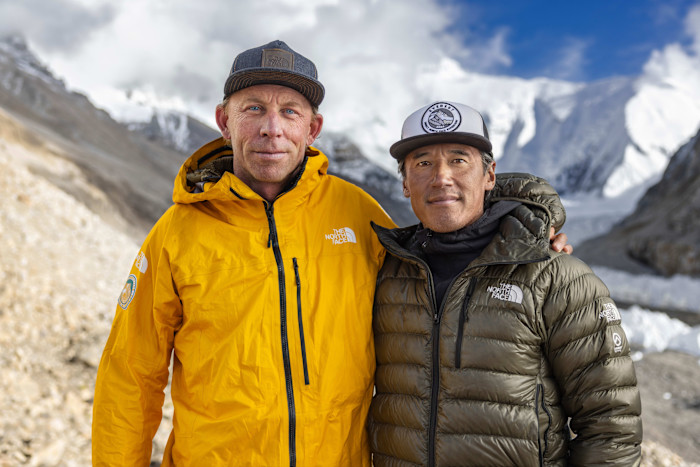
By the time they made their third attempt in October 2025, Morrison had spent months of his life on the mountain. Despite their prior experience, the ascent up the face was far from plain sailing. “We spent two nights in camp two [because] there was a ton of spindrift coming down, hitting our tents,” he says. “Jimmy and I were roped-in, harnesses on, inside of our tent”. The film shows them lying shoulder-to-shoulder as the ice and snow ping off the flimsy fabric — two old friends, pinned down like Butch Cassidy and the Sundance Kid, debating the life choices that have led them there.
Having endured so much, the final push scarcely felt real, Morrison said. “Hour by hour making it higher on summit day, making it through the crux of the Hornbein, getting up to a place where I was like, ‘OK, we got this. Like, I have this, no matter what.’ It was a surreal moment,” he says. “I was super lucid and in a really good place physically, which had been my goal all along. I had built the team around me with this mentality of sort of being the yellow jersey in the Tour de France, so that when the time came I’d have the most energy I could to go win my race.” In the end, 11 other members of the team, including a recovered Yukta Gurung and Jimmy Chin, made it to the top of the world with him — an incredible achievement given that only five people had ever climbed that route before.
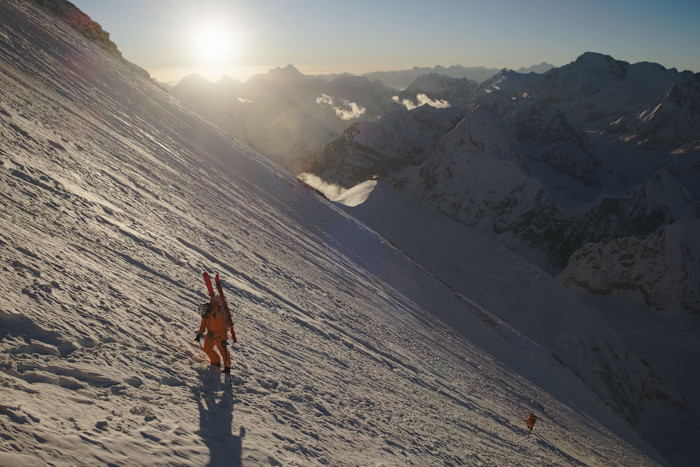
“It felt amazing,” Morrison remembers. “Jimmy was so emotional when he got there. And I had planned to spread some of Hilaree’s ashes. I poured them out into the wind, and the wind blew all the ashes out over the Kangshung Face.” In the film, Morrison whispers “I love you Hil” as he watches them swirl away. But he didn’t have much time to dwell on the moment. “I had to transition from being a climber and using a rope to, like, ‘I’m gonna put my skis on and ski off this,’” Morrison said. “And things got really serious for me.”
Though no one had climbed the route since 1991, in 2002 a French snowboarder called Marco Siffredi ascended via a different route, then set off from the summit into the Hornbein. He never made it to the meeting point with a waiting Sherpa teammate stationed below; his tracks just stopped halfway down, and his body was never recovered.
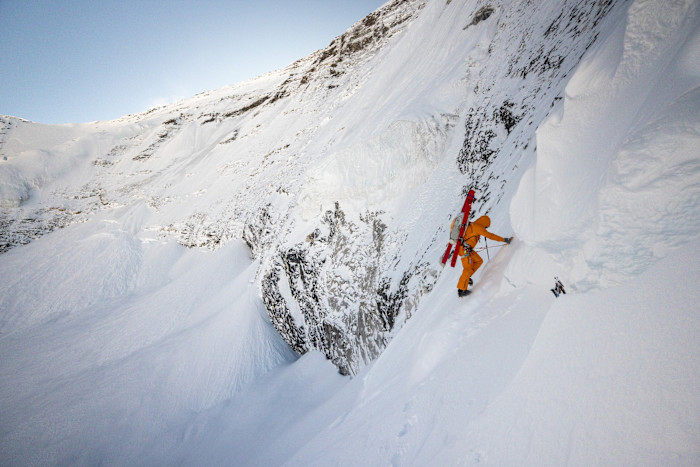
Morrison found the storms they’d climbed through had stripped much of the snow off the face, meaning he would essentially be skiing lumpy ice. “When I was getting ready, I looked through a telescope and I was like, ‘I’m gonna have to rappel the whole thing. I’m not gonna be able to ski it’,” he says. The gradient on the route “probably averages 45 degrees,” with sections as steep as 60 and most of it was a no fall zone. “I remember making a turn next to this arête and looking down into this . . . I don’t know what you would call it, just like a void.”
In the film, Morrison gives a voiceover as he descends, saying: “If I lose an edge or it slips, I’m just gonna relax. I’ve lived a good life.” But at the time, he tells me, he was concentrating too hard on staying alive for much else to enter his thoughts. “Every turn was like, just pay attention to what’s in front of me.” He told himself: “I can ski steep ice. I’ve been doing it at my home mountain my whole life. So just do it, and don’t think about what’s going to happen.”
The descent took four leg-burning, lung-busting hours. When he reached the bottom, it was the feelings, as much as the exhaustion, that left him reeling. “I had just a crazy emotional release at the base of the whole face. Just above camp one, there’s a flat glacier, and when I skied across the bergschrund [on to it] I was screaming and crying and talking to Hilaree, and having just . . . ” he tails off. “At one point, I was like, ‘I don’t know how I’m still standing.’ I was just in this state of disbelief at this euphoric moment.” In the film, he’s half panting, half sobbing. “That one’s for you, Hil,” he gasps, his voice garbled by the oxygen mask.
At the Venice premiere, there was a standing ovation as the credits rolled. Morrison and Chin embraced, just as they had done on the summit. As I filed out of the cinema, I overheard two older Italian women who looked like they’d never been near a mountain. “Che roba!” said one (roughly: “Well! That was quite something”). To which her companion replied, “Devo fumare una sigaretta”.
Find out about our latest stories first — follow FT Weekend Magazine on X and FT Weekend on Instagram