It is the artistic equivalent of squeezing a quart into a pint pot. When Fondation Cartier pour l’art contemporain opens its exhibition Ibrahim Mahama: The Harvest Season in its new gallery opposite the Louvre in Paris this month, it will endeavour to compress works from the Ghanaian artist’s 100-acre Red Clay studio into an incomparably smaller space.
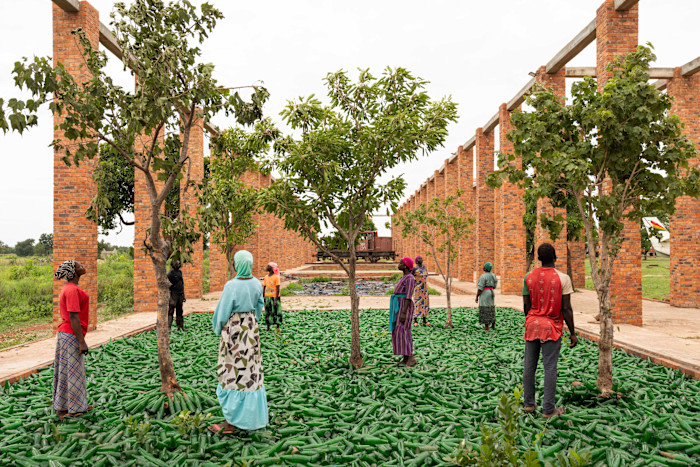
The word “studio” does little justice to the semi-open-air, red-earthed patch on the outskirts of Mahama’s hometown of Tamale where the artist’s pharaonic-scale obsessions take shape under a jackhammer sun. When he started acquiring land a decade ago, it was set beside two villages lacking either electricity or running water. Today, it looks more like an abandoned factory, though in reality the red-brick warehouses are recently constructed.
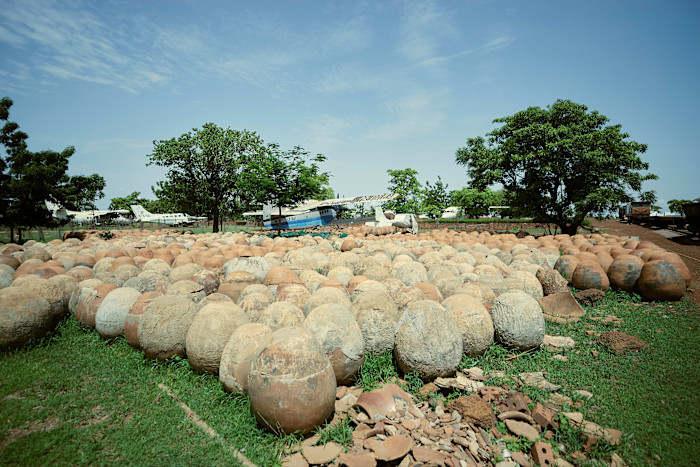
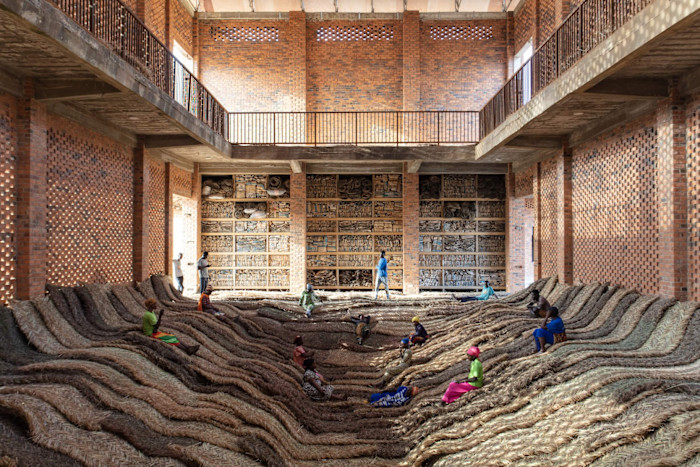
Red Clay is located in the poorer, harsher north of Ghana. The complex is so large that a collection of old train carriages and broken plane carcasses are scattered outside in the fields like toys. When, before the roof was constructed, rainwater collected in one building — containing Mahama’s art installation “Parliament of Ghosts”, a parliamentary chamber created out of salvaged furniture — children used it as an impromptu swimming pool. Bats and birds have taken up residence in the walls. Local villagers continue to live, almost unnoticed, among the installations, children tramp home from school past the buildings and goats wander between the artworks.
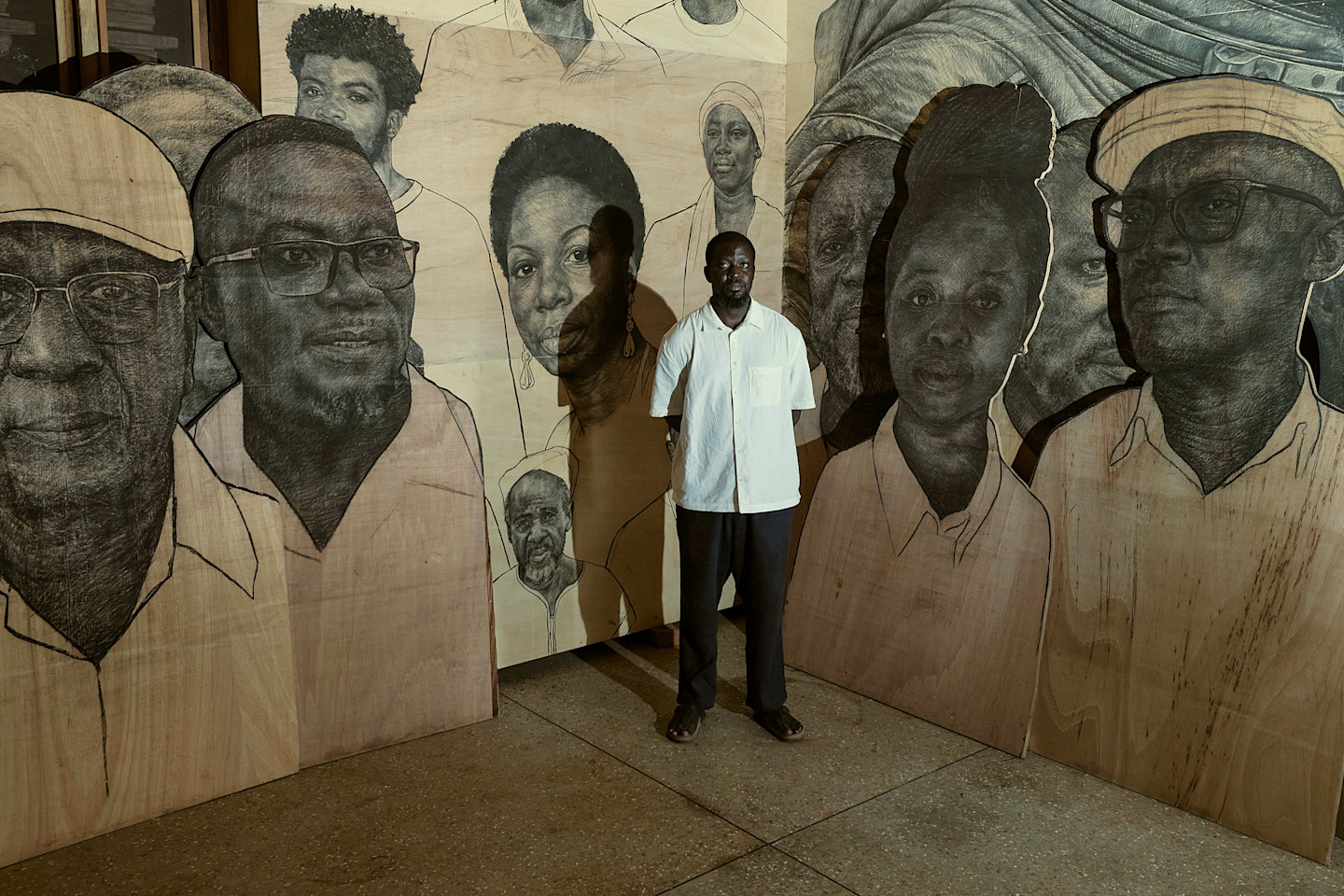
In one building, the interior walls are painted with figures of inspiration for the artist, including Martin Luther King, Arundhati Roy (dressed incongruously as an astronaut) and Mahama’s muse Kwame Nkrumah, who in 1957 became Ghana’s first prime minister, later its president. In another are Diego Rivera-like charcoal drawings on old factory invoices of the muscular Ghanaian labourers who, under British colonial rule, laid track for the railway in the late 19th century to haul precious metals to the coast for export to Europe.
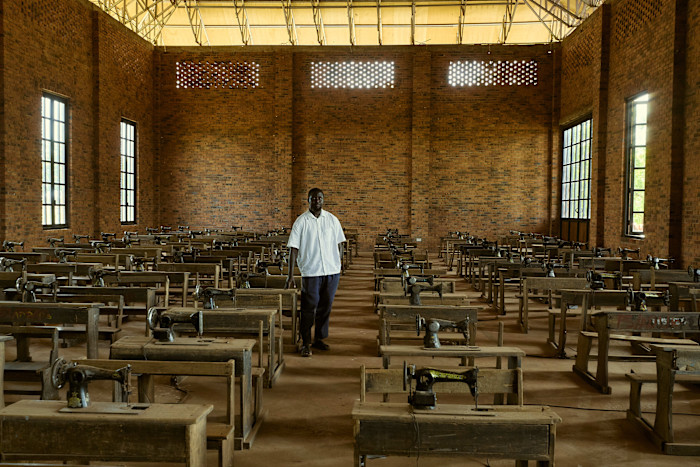
The artist is a collector of discarded objects, often replicated hundreds of times over in his work, from industrial scraps and clay pots to wooden shoeshine boxes and green bottles. One of the most striking installations in Tamale is a large classroom with row-upon-row of wooden school desks, each fitted with a battered, but still functioning, sewing machine. A switch is flicked and they chatter into life, creating an eerie symbol of mass production — of minds as well as textiles.
Aborted industrialisation is a recurring motif. “A lot of the work that we are doing is somehow revisiting the legacy of President Nkrumah in terms of the promises around his work,” he says, adding that the overthrow of Ghana’s socialist president in a 1966 CIA-backed coup goes a long way to explaining the country’s arrested development.
For Mahama, such objects — whether found, rescued, acquired or fabricated — are “charged” with history, brought into existence by labour, or “bodies” as he puts it. Typical is the oil-stained “dark tar material” used in the fish-smoking process, which Mahama attaches to hospital stretchers.
On my visit to Red Clay, the artist tells me how, traditionally, women trapped heat to smoke fish with second-hand clothing known as obroni wawu, literally “dead white man’s clothing”, or cast-offs from the west. Over many years, smoke and oil transformed the cloth into a yellowed, leathery material. “I like the idea that there is this residue of the body that is transferred on to the fabric,” he says, in a description typical of the interconnected, often grotesque, histories he sees imprinted on objects.
The challenge for the curators of Mahama’s The Harvest Season show is to conjure up a sense of all this in Paris. This will be the Fondation Cartier’s first major solo exhibition since it moved into its new premises, a repurposed 19th-century department store, Les Grands Magasins du Louvre.
Aby Gaye-Duparc, curator of the show, says she wants to convey a sense of the Tamale community where schoolchildren are regularly bussed in to explore the artworks. One idea is to invite French schoolchildren for classes that take place in a reconstruction of Mahama’s “Parliament of Ghosts”, set with stools from Ghana’s ancient Ashanti kingdom, before doors open to the general public each morning. There will be talk programmes and workshops as well as immersive video to help visitors visualise the multi-faceted, even chaotic, set-up in Tamale. The exhibition will also include charcoal drawings, new textile pieces and a reconstruction of the abandoned Aboso Glass factory (one of Nkrumah’s industrial projects).
Mahama’s artmaking is frequently collaborative. For Paris, he is bringing nine other artists and collectives from Africa and Europe — including the Ghanaian-German textile artist Zohra Opoku and the evocative Accra-based painter Gideon Appah — to co-exhibit.
As well as the audacious scale of Mahama’s artistic enterprise, Fondation Cartier will have to contend with the fact that many of his projects are unfinished, both because Mahama is forever distracted by new ideas — he recently bought a flooded grain silo in Tamale that he intends to adapt into a community learning centre — and also because he is more interested in the process of creation (and accumulation) than in the act of completion.
“When you’re talking about something which is yet to be, it’s not the same as when it becomes,” he says in a cryptic explanation typical of the running commentary he provides on his own artwork.
Mahama was born in Tamale in 1987, but he was brought up mainly in Accra, where he attended boarding school. His father, a road contractor who had benefited from a free school education thanks to a Nkrumah scholarship, had four wives and Mahama was one of 10 children.
Drawn to art from an early age, his artistic education was forged at the Faculty of Art at Kwame Nkrumah University of Science and Technology (KNUST) in Kumasi. There he was part of the on-campus art collective blaxTARLINES, which championed “emancipatory art”: the idea that students should free themselves from accepted notions of art, including those inherited from colonialism, in order to define their own way of seeing the world.
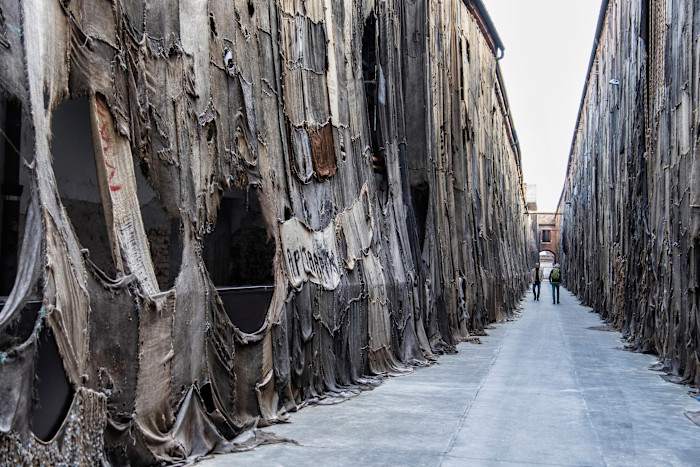
Mahama first gained international recognition in 2015, aged just 28, with his Venice Biennale installation “Out of Bounds”, a giant quilt of stitched-together jute sacks draped over a medieval passageway in Venice’s Arsenale. The sacks, made in Asia and used to transport Ghana’s raw cocoa beans to the west, established many of the themes that still dominate his work: manual labour, industrial history, extraction and global trade. It’s important for Ghanaians to know, he says, “that a lot of money from the industrial revolution was also born out of capital from slavery”.
If the Venice Biennale was an early breakthrough, Mahama’s reputation among western critics has soared since then. Last December, the artist, who is represented by White Cube in the UK and Apalazzo Gallery in Brescia, Italy, was awarded the top spot in ArtReview’s annual Power 100 list, which ranks the most influential figures in the art world, making him the first African to be so honoured.
Mahama is known for reinvesting profits from selling his art to the west back into projects in Tamale — a reverse globalisation of sorts. Mahama describes part of his artistic purpose as protecting historical monuments, including an old Russian cemetery and a colonial building on Tamale’s outskirts.
“That’s why I would use capital residue from the art world in order to intervene within the state protocol and collect objects that the state is supposed to save,” he says, in a circumlocutory explanation that reflects the radicalised language he picked up at KNUST.
Some artists like their work to do the talking, but Mahama is definitely not in this category. His installations may be steeped in history, but they require explanation. “In the previous generation, the artist’s canvas had to speak for him, the artist’s voice didn’t mean much,” he says. “But in our generation, we think that our intellect and our voice matters.”
October 22-February 28, fondationcartier.com