With Murder School (Drawn & Quarterly £22/$35) the prizewinning British cartoonist Paul B Rainey transports us back to his schooldays. Part memoir, part fiction, all wrapped up in a (possible) murder mystery with a slightly fantastical edge, this portrait of scholastic life is both violent and mundane.
In a striking palette of blue, orange and beige — contrasted with black and white sections set in the present day as he looks back on his adolescence — Rainey brings to life a now-bygone world of abusive teachers, bullying and hands-off parenting. But there are formative friendships and experiences here too. It’s a worthy addition to the pantheon of classic English school stories; think Lindsay Anderson’s If . . . but starring Adrian Mole.
Like Rainey, Eleanor Crewes mined her own life when it came to her 2020 debut, the graphic memoir The Times I Knew I Was Gay. But her follow-up, Ghosts in My House (Virago £18.99) is a work of fiction; a queer haunted-house tale told through the linked stories of different residents in an imposing terraced house, across a number of decades.
The creepy atmosphere is much helped by the fact that the images are produced entirely in monochrome, faces, figures and objects eerily emerging out of a surrounding deep inky blackness. Visually arresting and genuinely spooky, it’s the perfect Halloween read, and an intriguing new take on the classic haunted-house story.
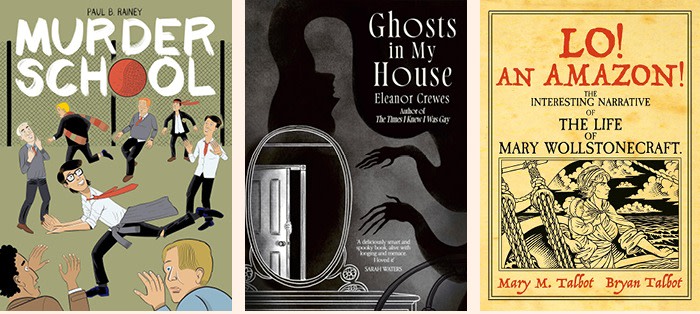
Illustrator Bryan Talbot and his wife and creative partner Mary M Talbot also eschew colour in Lo! An Amazon! The Interesting Narrative of The Life of Mary Wollstonecraft (SelfMadeHero £17.99), the sepia and greyscale tones of which reinforce the cunning efforts made to present the work as an 18th-century period piece.
The duo previously brought to life the stories of Lucia Joyce (in the Costa Biography Award-winning Dotter of Her Father’s Eyes), the fictional suffragette Sally Heathcote, and surrealist artist Leonora Carrington, so the author of the trailblazing 1792 feminist manifesto A Vindication of the Rights of Woman is a fitting subject for them. Clearly deeply researched, this is a skilfully presented portrait of a pioneering woman and her social-political engagement.
By comparison, I Can’t Stop Thinking About Horses and Sex (Drawn & Quarterly £23) by Lisa Hanawalt, the visual designer of the Netflix show BoJack Horseman, is a riot of colour. In some ways a straightforward memoir, it’s also luridly alive with Hanawalt’s particular brand of charming weirdness.
A self-confessed “creepy horse girl” — who spent so much time “galloping” round her back yard during her childhood, her knees grew calluses — she combines an exploration of this now 40-odd year obsession with post-break-up meditations on sex, and the question of whether or not to have children. It’s odd, delightful and icky; both deeply revealing and carefully constructed, no more so than in Hanawalt’s representation of herself as possessing a bird’s head atop a human body. The fragmented style makes the reading experience feel like you really are wandering through her buzzing mind.
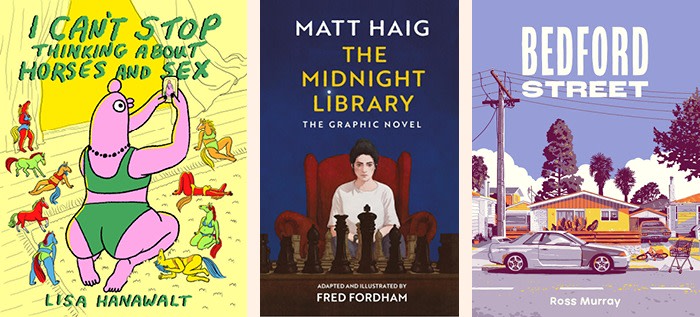
The adaptation of Matt Haig’s bestselling novel The Midnight Library (Canongate £20/Penguin Books $35) is the work of a seasoned practitioner of this particular corner of the graphic novel market: Fred Fordham, whose previous adaptations include To Kill a Mockingbird, Brave New World, and A Wizard of Earthsea.
But there’s also something about the story itself that allows the form to shine. It’s the tale of an unhappy woman named Nora, who, on the stroke of midnight on what’s shaping up to be her last day on earth, finds herself mysteriously transported to a special library, where books offer her myriad opportunities to try out the lives she could have lived. Summing up these varied existences by means of a shorthand of images is perhaps quicker and more evocative than reams of paragraphs.
The standout title of this assortment though is Ross Murray’s Bedford Street (Fantagraphics £17.99), a collective portrait of the lives of residents on an unassuming down-at-heel New Zealand suburban street. The vignettes therein include that of an alcoholic father struggling to connect with his anger-filled son, a single mother with a bad back, and belligerent pensioners.
Domestic violence, loneliness, infidelity and poverty all loom large, and Murray’s characters are besieged by guilt, exasperation and despair. The emotional punch is in the detail of his clean drawing style (reminiscent of that of Nick Drnaso, whose Sabrina (2018) is the only graphic novel to date that’s been nominated for the Booker Prize): the nuance of a facial expression, the rusty junk piled up in a front yard, a pair of sneakers caught in the telephone wires high above the street. It’s a bleak study of a community, but it’s brilliantly done; every bit as affecting as John Cheever or Richard Yates’ tales of mid-century American suburban malaise and disappointment.
Join our online book group on Facebook at FT Books Café and follow FT Weekend on Instagram, Bluesky and X