The flow of competitive Chinese exports into Europe continues to fuel fears about the continent’s economic future. The EU’s goods trade deficit with China has hit €1bn a day.
The bloc has responded by developing a protective arsenal, from tariffs to local content requirements. Last week, France and Germany pressed Brussels to adopt powers that could restrict countries from accessing the single market.
Yet the prevailing narrative of cheap Chinese goods flooding Europe and driving widespread industrial decline needs qualifying. A more precise diagnosis would help the EU sharpen its offensive strategy, not just its defences.
First, the effect of the “China shock” on Europe is more concentrated than widely assumed. In 2025, almost two-thirds of the goods imported into the EU from China fell into just five product categories, such as machinery, chemicals and cars.
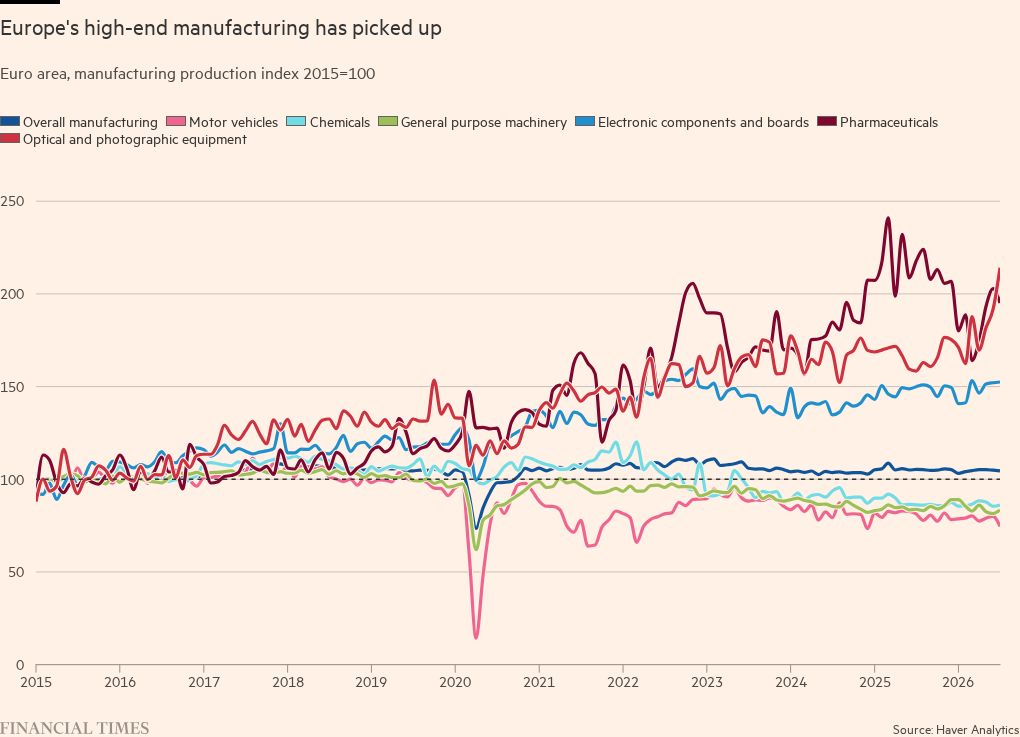
Euro area output in these sectors has shrunk since 2015, when Beijing launched its “Made in China 2025” industrial policy. But activity has risen in high value-added industries, including pharmaceuticals and specialist electronics. As a result, across the currency union, manufacturing output, gross real value added and employment have all edged up over the past decade.
Second, many European businesses benefit from Chinese imports. Cheap Chinese components compete with Europe-made supplies, but also lower production costs for the continent’s advanced manufacturing companies. Research by the European Central Bank links EU sectors with increased exposure to imports of Chinese intermediate goods between 2000 and 2022 to a 0.6 percentage point boost in annual industrial production growth.
Lastly, while Beijing is rapidly shifting into more sophisticated final goods production, Europe has remained competitive. Analysis by Simon Evenett, professor at the IMD Business School, finds that China’s expanding global industrial presence since 2015 has led to a comparable increase in competition in third-country markets for only a small number of the EU’s top 500 manufacturing export products.
In recent years, there has been particularly sturdy demand for the continent’s expertise in high-precision manufacturing, from ASML’s lithography machines, which help print the circuitry inside advanced chips, to Zeiss lenses and mirrors, which are used to focus light in them.
More broadly, a recent study by the Geostrategic Europe Taskforce identified 41 critical supply chains in which China depends on the EU for more than 80 per cent of imports. These include medical inputs and specialist machinery.
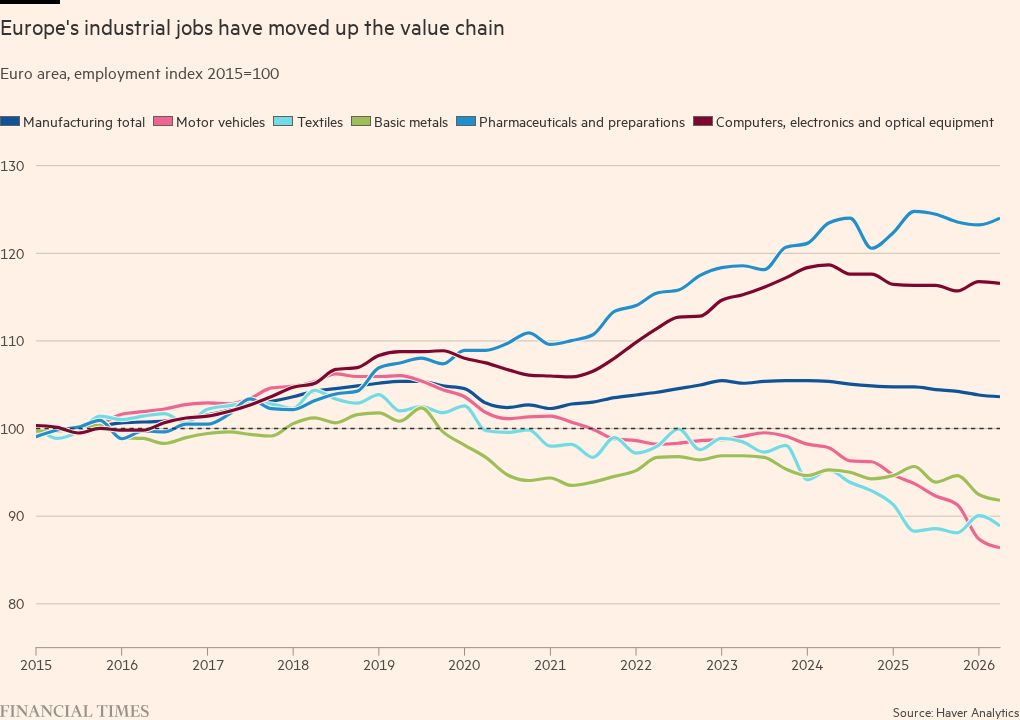
The picture, then, is not one of relentless industrial decline. Europe is holding its own in important areas, its industries are adapting and it retains considerable strengths.
Cheap Chinese goods, backed in part by generous state subsidies and an undervalued currency, pose genuine risks. Calibrated defences are needed to counter unfair competition, strengthen supply-chain resilience and retain capabilities in critical industries. But viewing the China shock chiefly as a threat narrows Europe’s ambitions.
For one, the growth of Europe’s higher value-added industries shows that Chinese competition can spur creative destruction. As cheap imports undercut traditional producers and provide low-cost inputs, labour and capital have shifted towards more productive industries.
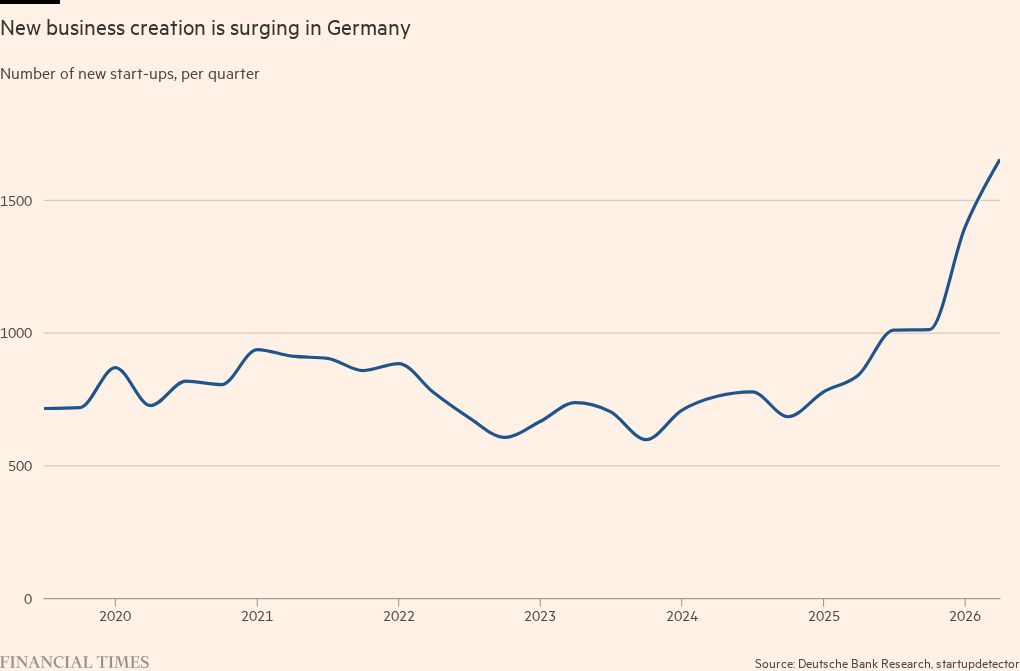
Indeed, in the 1970s, as Japanese producers battered German camera makers, the survivors pivoted into high-end optics, which are now vital to the AI boom. In a similar way, automakers such as BMW are refocusing on premium lines. More generally across Germany, the collapse of factories is giving way to a nascent surge in tech-focused start-ups.
The EU can turn this disruption into a lasting advantage. But it is not doing enough to help businesses adapt and scale, leaving it even more vulnerable to China’s rise up the value chain.
It needs to deepen its capital markets, remove barriers within the single market, boost energy supply and focus on protecting workers rather than jobs through retraining and by making labour markets more flexible. Much of this was outlined in former ECB chief Mario Draghi’s competitiveness report, but just 15.7 per cent of its 383 recommendations had been fully implemented by July this year.
The same reforms would also boost Europe’s existing industrial specialisms, including exports on which China depends. Combined with new trade deals with like-minded partners, Brussels could then turn its commercial strengths into greater geopolitical leverage over Beijing.
“In Europe, the pendulum has now swung from overlooking China’s strengths to being obsessed with them,” says Evenett. The danger is that, in fretting over China’s competitive edge, the continent neglects to sharpen its own.
Send your thoughts via the comments, [email protected] or on X @tejparikh90.
Food for thought
Does bad news stick? This paper uses the complete Wall Street Journal archive from 1990 to 2025 to investigate.
Free Lunch on Sunday is edited by Harvey Nriapia