
Wall Street banks are set to report their worst trading results of the year next week, raising concerns that a record-breaking streak for the business is coming to an end.
Analysts are forecasting the five largest US investment banks — JPMorgan Chase, Goldman Sachs, Morgan Stanley, Citigroup and Bank of America — will collectively report about $38bn in equities and fixed income trading revenues in third-quarter results next week, according to data compiled by Bloomberg.
While that would still be 13 per cent higher than a year ago, it marks a sharp fall from the record $47bn in trading revenues that banks generated in the second quarter and a decline of almost 12 per cent from the first quarter of the year.
The question is “to what extent that these big gains in trading can be sustained or expanded upon,” said Chris Kotowski, a senior analyst at Oppenheimer.
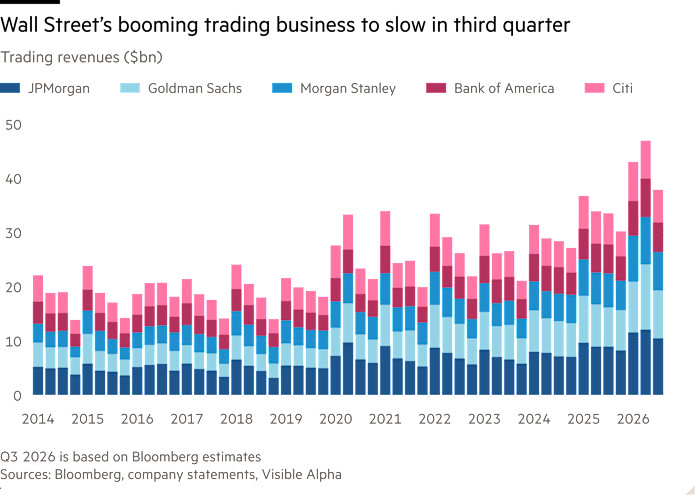
Since 2020, trading has returned to favour after a period of lacklustre returns for banks in the 2010s. In particular, banks have doubled down on financing trades for hedge funds and large asset managers.
This year, US investment banks’ trading arms benefited from AI-linked market volatility, commodity price moves and interest rate shocks.
That generated an equities trading environment that JPMorgan chief executive Jamie Dimon described last quarter as “getting close to as good as it gets”.
But Wall Street bankers at BofA, JPMorgan and Morgan Stanley warned last month that these huge trading gains were unlikely to be repeated. They blamed a pullback in financing trades in Asia and slowdown in fixed income, currencies and commodities trading.
The third quarter can be seasonally slower, since it spans bankers’ summer break, and it is still expected to be banks’ best third quarter on record.
However, the slowdown between the second and third quarters is predicted to be unusually stark, with Barclays analyst Jason Goldberg forecasting a drop-off of about 20 per cent compared with a typical seasonal decline of 6 per cent.
Analysts expect the five banks to generate total profits of $44bn for the third quarter. While that is almost 9 per cent higher than a year ago, it represents a decline of about 20 per cent — or almost $10bn — from the second quarter. Revenues in investment banking are expected to show a similar pattern to trading.
“At the end of the second quarter, the banks were very enthusiastic about the outlook. More IPOs and mergers and acquisitions. We expect the enthusiasm to be dialled down a bit,” said Gerard Cassidy, senior analyst at RBC.
Bank stocks have lagged the broader market in the past month because of worries that revenues from data centre financing may start to fade, as well as fears that AI agents will hit customer loyalty and concerns that rising interest rates will weigh on the value of their securities portfolios.
Analysts expect banks will record unrealised losses on these portfolios, as yields on 10-year Treasuries have increased. The paper markdowns will not impact bottom-line profits but do affect banks’ capital positions.
Unrealised losses in banks’ securities portfolios emerged as a major area of concern during the 2023 regional banking crisis.
Since then, banks have sought to shift their holdings towards short-term debt, which should leave them less exposed to price fluctuations in longer-term rates. Nevertheless, investors were worried about the issue, Cassidy said.
“They remember 2023,” he said. “And I think that’s part of the reason these stocks have been underperforming since the Fed raised rates.”