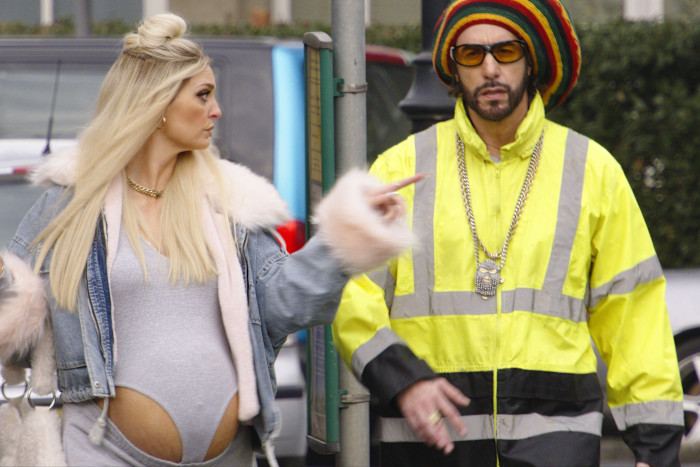
Iz it because I iz painfully earnest? When I think back to Ali G, I remember feeling two things about Sacha Baron Cohen’s comic creation, who returns to the big screen after a two-decade absence in Ali G: Who Iz I? The first was recognition: teenage life in pre-financial crisis London was littered with Ali G figures, who adopted the argot of modern gangsters without any of the credibility. Each was, in their own way, laughable. Come on, Tahir, you’re not from Compton, you’re from Whitechapel. Who do you think you’re fooling, Simon? Your father is a stockbroker and your mother is a lawyer. Or, like Ali G himself, you are a white guy living in Staines, a well-to-do exurb just outside London.
The Ali G-alikes of my youth didn’t want to be gangsters, not really. They wanted the clout and the respect that might come with being gangsters, or at the least, the type of fear that — if you don’t look too closely — resembles clout and respect. These boys were all, in one way or another, somewhat laughable.
Yet my second reaction to Ali G was that I found it sad, rather than funny. It exists in my memory as the first bit of comedy that I remember admiring for its cleverness while intensely disliking it. Sacha Baron Cohen created Ali G — alongside Kazakh journalist Borat and gay Austrian Brüno — to conduct interviews with real people, some famous (Donald Trump, Jacob Rees-Mogg), some unknown, with the aim of using fake characters to expose real bigotries.
One reason why the show didn’t work for me is by my mid-teens, I had already learnt that people needed little provocation to air their hatreds. It wasn’t as if any of the people he interviewed had to resign, apologise or change their ways as a result. And the next day at school, what people laughingly recalled wasn’t who he had interviewed: it was Ali G himself. Some didn’t get the meta joke, and were laughing along with his sexism. Others really didn’t get the joke and simply thought they were laughing at blackface. And some were laughing at Ali G’s self-delusions.
I didn’t enjoy the sexist or racist laughs for the obvious reasons, and I found the laughs at Ali G himself oddly upsetting. The wannabe Ali Gs of my youth were laughable, but who among us as teenagers did not engage in a spot of self-reinvention? We’re all entitled, I think, to a degree of fakery, particularly at the point where we are starting to become adults and to separate from our families. We’re entitled, too, to a degree of self-delusion at the end of our lives even if in reality our time was mostly spent in service to others, whether that be our clients, our children, our mortgage or a combination of all of the above.
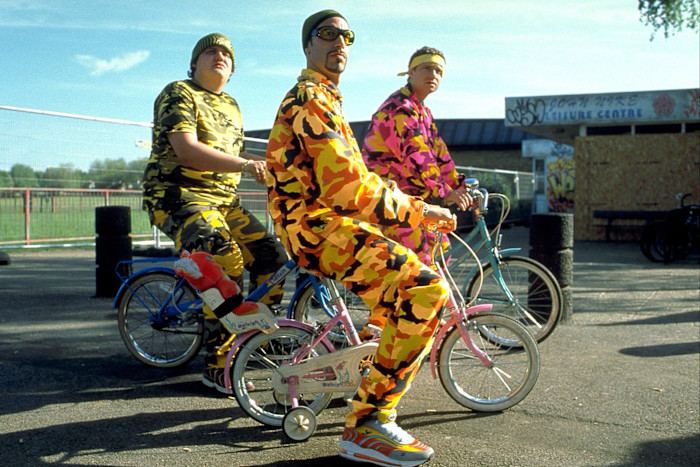
At worst, too, the idea that Ali G’s behaviour would be any less laughable were he actually “black” itself seemed like a tired stereotype. That view has become rather more mainstream in the years since Ali G vanished from view: with the film’s release accompanied by calls for a boycott and a series of articles criticising the act as one that has run out of road.
Most of the wannabe Ali Gs of my youth have ended up with quietly successful lives. But of course, not all of them. Some are scraping by, trying to make a living, and part of why Ali G never sat right with me is that I sensed even then that many of the people he was parodying were, first of all, pitiable. That the new movie sees Ali G still living in Staines with the same self-delusion underlines why, for me, it’s a tragedy, not a comedy.
It has acquired a sadness of its own, because Ali G is a time capsule from an era of TV which sometimes delighted in cruelty. The popular sketch show Little Britain featured a carnival of grotesques. The reality TV show There’s Something About Miriam depicted a group of bachelors pursuing a beautiful Mexican model, while being kept in the dark until the final episode that Miriam Rivera was a trans woman.
In 2026, cruelty dominates the news cycle but terrestrial TV no longer seems to be the platform for ruthless comedy. Mainstream television’s biggest hits are largely cosier. The BBC’s biggest comedy-drama success at the moment is Ludwig, a delightful cosy crime adventure in which a newspaper puzzle-setter solves unusual crimes and conspiracies. If the popular comedy Ted Lasso were any more saccharine, it would cause diabetes. And The Traitors, nominally a story of paranoia and betrayal, is in reality a rather warm affair in which different religions, races and pronouns are bound together in a game of social intrigue.
My earnest dislike of Ali G has become much less lonely. But as Ali G returns to a world that is colder towards him and rather crueller, too, I find myself looking back fondly to a time when I felt like the only one who didn’t enjoy the joke.
‘Ali G: Who Iz I’ is in cinemas from October 23