Shares in one of Australia’s largest data centre companies tumbled on Wednesday after fierce local opposition surrounding a new site triggered a damaging profit warning.
NextDC, one of the country’s established data centre operators, said that works to upgrade the electricity supply needed for its M3 project in Melbourne had been delayed until 2027.
Planning approvals have also been pushed back until after next month’s state election.
NextDC cut its earnings forecast by more than a third and also lowered its revenue projection.
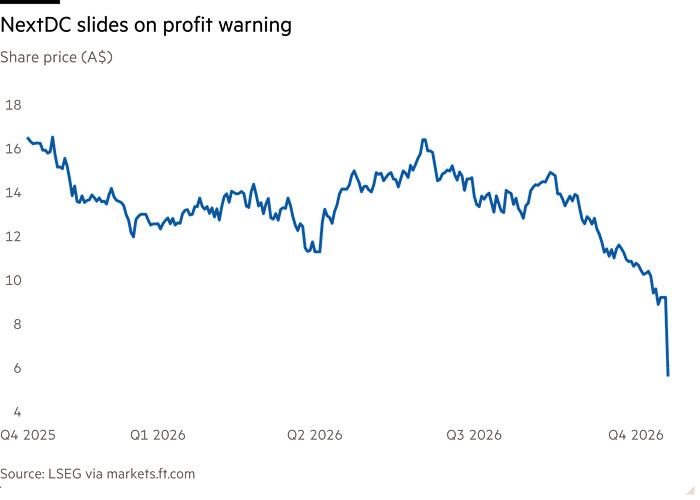
Shares sank as much as 44 per cent and closed at A$5.35, leaving the company worth just over A$4bn ($2.8bn). The shares were above A$16 in early June.
It is the latest blow to Australia’s burgeoning data centre and AI sector after the aborted A$44bn listing of “neocloud” company Firmus on the Australian stock exchange.
AirTrunk, another Australian company, paused the Singapore listing of real estate assets and Goodman Group abandoned plans to build a data centre in inner-suburban Sydney following strong community opposition.
Firmus has said that it will seek funding from public and private sources to fund its expansion into Asia.
The Australian company’s founder held talks with shareholder Nvidia this week in Berlin over a potential fresh injection of more than A$500mn of capital after the IPO’s failure.
A deal would affirm Nvidia’s commitment to backing the “neocloud” companies that have grown in its shadow. The talks were first reported by The Information.
Firmus and Nvidia did not immediately respond to requests for comment.
Australia’s politicians and established companies have argued that the country can play a significant role in global AI infrastructure. That push has been tied to energy policy, with politicians keen to tie data centre projects to commitments to invest in renewable energy plans and grid upgrades.
However, rising local opposition to projects has started to put plans into jeopardy. Jemena Electricity Networks, which is upgrading the west Melbourne network, said last month that a programme to replace wooden electricity poles with concrete pylons at a height of more than 20 metres had been paused due to community resistance.
Craig Scroggie, chief executive of NextDC, said that meant the increase in power to the M3 site was now expected in 2028.
“With M3 revenue deferred, we have paused projects not backed by customer contracts and put that capital behind the capacity behind our customers that have already contracted,” he said.
Scroggie added that the company had liquidity of A$8.7bn at the end of last month.
Tom Beadle, an analyst with RBC, said in a note that the delay was an “incrementally negative development” for the company and the broader sector.
“Whilst out of the company’s control, delays to power supply and development applications relating to NextDC’s M3 data centre is evidence that community concerns around data centre developments present a real risk to the timing of delivery of contracted capacity for data centre owners,” he said.
Separately, shares in South Korean data centre builder Elice rebounded after closing down 32 per cent on their trading debut in Seoul on Tuesday. The stock rose by the daily 30 per cent limit, while the Kospi index gained as much as 3.8 per cent.