Andy Burnham’s government has approved the development of the Jackdaw gasfield in the North Sea, but ministers indicated the decision would not necessarily mean a green light for the larger Rosebank oilfield later this year.
Energy secretary Miatta Fahnbulleh on Wednesday said Jackdaw, which lies 150 miles east of Aberdeen, would help boost Britain’s energy supplies this winter and support jobs and energy security over the longer term.
She also announced the creation of a new Energy Wealth Fund, which will invest tax revenues from the North Sea into renewables and low-carbon energy. It will start with £2bn in seed funding from the Treasury.
But Fahnbulleh warned that Rosebank, 80 miles to the north-west of Shetland, was a “different proposition” from Jackdaw because its oil would mostly not be used in Britain. Her judgment on Rosebank is expected in December, according to officials.
“Jackdaw is producing gas that predominantly is used in the domestic market,” Fahnbulleh told BBC Radio Scotland. “Rosebank is a different proposition because it is oil that is exported.”
Most North Sea oil is exported because Britain has insufficient domestic refining capacity, although much makes its way back in the form of petrol and diesel. Rosebank also has far higher estimated downstream emissions, at 254mn tonnes of CO₂ equivalent over a 25-year period, compared with a maximum 36mn tonnes equivalent over a seven-year period for Jackdaw.
Rosebank and Jackdaw have become a lightning rod for the wider debate around the future of the North Sea and the government’s attitude towards an industry that directly employs about 28,000 people.
Officials were asked months ago to draw up the case for approving both schemes as Burnham responded to criticism that climate policies have hurt British industry and energy security, people familiar with the matter told the FT.
Miatta Fahnbulleh says the tax revenue from the Jackdaw gasfield will be invested in renewables
Burnham is coming under pressure from Labour colleagues to approve Rosebank, with Gary Smith, head of the powerful GMB union, telling the FT the governing party would be “finished” in Scotland if it rejected the scheme.
But climate activists believe there is still an opportunity to convince the government to block Rosebank.
Fahnbulleh said each application would be judged “in its own right” and that it was critical for any decisions to be consistent with Britain’s climate obligations.
Ministers have been under pressure from the Conservatives and Reform UK, as well as US President Donald Trump, to increase fossil fuel production and scrap Britain’s net zero policies.
On Wednesday, Trump wrote on Truth Social that the approval of Jackdaw was “Great news for the wealth and prosperity of the United Kingdom”. More drilling in the North Sea “will make the UK very wealthy again”, he added.
Video description
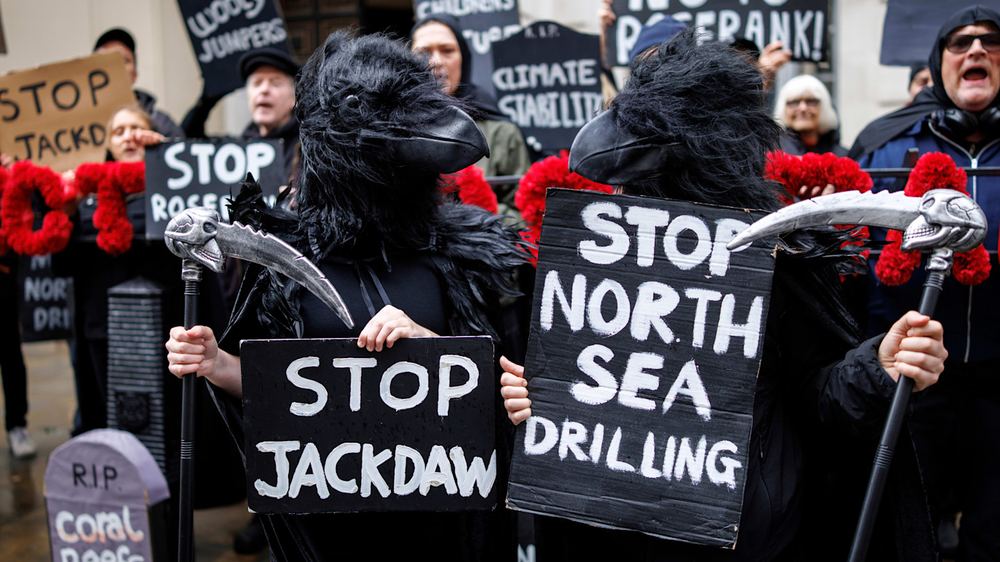
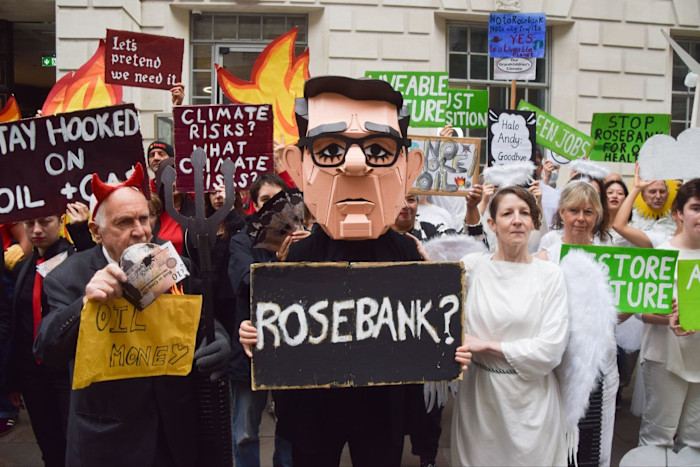
Green activists protest the government decision to approve the Jackdaw gas field in London n Wednesday
Burnham has promised to be “pragmatic” on oil and gas drilling following a sharp rise in energy prices following the US-Israeli war against Iran.
GMB and Unite the Union have pushed ministers to approve both the Jackdaw and Rosebank projects — which are being developed by a joint venture between Shell and Equinor — in order to protect jobs and bolster tax revenue.
Smith said the government deserved “real credit for doing the right thing” for the UK with Jackdaw’s approval, but warned that the decision on Rosebank would be “an existential moment for Scottish Labour”.
Michael Marra, leader of Scottish Labour, has pushed for both Rosebank and Jackdaw to be approved in a “more rational policy” for the Scottish economy.
But Jess Ralston, analyst at the Energy and Climate Intelligence Unit, a non-profit, said the approval would not bring down UK gas and electricity bills or improve the country’s energy security substantially.
Danny Gross, climate campaigner for Friends of the Earth, said: “Jackdaw won’t make a jot of difference to our energy bills, but it will fuel the climate chaos already unfurling in front of us,” he added.
Supporters of the projects argue the fields can help meet the UK’s energy needs with lower carbon emissions than imports, but critics argue they will add to emissions and not bring down energy bills.
The decision on Jackdaw was delayed while Labour fought off the Green Party to retain ex-prime minister Sir Keir Starmer’s Holborn and St Pancras seat in a by-election this month.
Government development consent for both fields was quashed in 2025 following a landmark decision by the Supreme Court, which said authorities had to take into account the greenhouse gas emissions of consumers burning the fossil fuels. Both projects secured exploration licences decades ago.
Neil McCulloch, chief executive of Adura, the joint venture that is developing Jackdaw, said the decision “demonstrates the value of pragmatic, evidence-led decision-making”.
Jackdaw could produce 10bn cubic metres of gas, equivalent to 2 per cent of the UK’s projected gas imports between 2025 and 2050, under an optimistic scenario, according to the House of Commons Library.
Burnham’s aides have made clear he has no plans to end Labour’s 2024 election manifesto pledge to not issue new exploration licences in the North Sea.
Instead he is expected to emphasise the government’s support for greater use of “tiebacks”, which allow further drilling next to existing fields.
The government will lay out more details about how the tiebacks will be approved in legislation set to be published this month.