
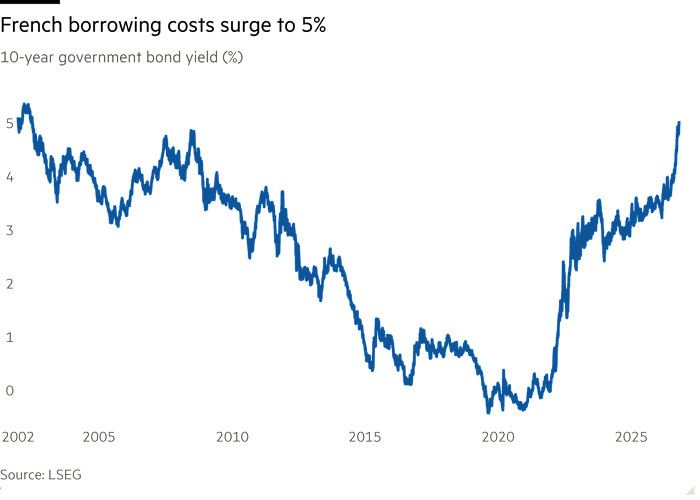
France’s long-term borrowing costs have hit 5 per cent, a benchmark last reached in 2002, as investors grow increasingly concerned about the stability of the country’s politics and the state of its public finances.
A fresh bout of selling on Wednesday pushed French 10-year bond yields up as much as 0.1 percentage points to 5.02 per cent, taking the jump so far this week to more than 0.2 percentage points. The yield closed at 4.99 per cent on Wednesday afternoon.
The moves come after days of unrest and political recriminations in the country, as peaceful demonstrations over the cost of living and education spiralled into widespread rioting and looting.
France’s borrowing costs have surged from 3.2 per cent in late February, having been the hardest hit in a sweeping sell-off in G7 bond markets, as the Iran war has stoked inflation and put economies with large debt piles and wide budget deficits under particular pressure. Bond yields rise as prices fall.
“The political willingness for any fiscal consolidation ahead of the election is very, very low,” said Jeff Mueller, co-head of fixed income at Morgan Stanley Investment Management, adding there was plenty of room for “the situation to worsen from here”.
The closely watched gap, or spread, between French 10-year borrowing costs and Germany’s rose to almost 1.6 percentage points on Wednesday, matching the intraday high reached in volatile trading earlier this month.
Such a level had previously not been seen since the Eurozone debt crisis more than a decade ago.
Other Eurozone bond markets also suffered on Wednesday, with Italy’s 10-year yield rising 0.07 percentage points to 4.59 per cent, although it is below the post-2023 high it hit earlier this month.
Belgium’s 10-year yield jumped as much as 0.12 percentage points to 4.46 per cent, taking its spread with Germany back to just above one percentage point, its highest intraday level since 2013. It later fell back to 4.43 per cent.
The country, which has one of the biggest budget deficits in the euro area and a higher-than-average debt load at 108 per cent of GDP, is at present holding difficult budget talks.
Prime Minister Bart De Wever has vowed to reduce spending, but discussions stalled again this week as leftwing and liberal coalition partners sparred over proposed cuts.
De Wever told parliament on Wednesday that if the financial situation was not stabilised, “I fear the outbreak of a debt crisis, for which we need to prepare”.
Investors view a broader serious downturn in Eurozone government bond markets beyond France as a key precondition for any intervention by the European Central Bank to support the market.
Lorenzo Bini Smaghi, a former ECB board member, wrote in the FT earlier this month that widening spreads showed “the shadows of the 2011-12 crisis are emerging again”. He said the euro area was in a stronger position, but the ECB could support the market by putting on hold its balance-sheet-shrinking programme, known as quantitative tightening.
Moody’s will issue a ratings decision on France on Friday, with a downgrade a real possibility given the outlook is already negative on the current rating of Aa3.
“The political situation is pretty adverse and [it is] difficult to see that improving anytime soon,” said John Stopford, head of multi-asset income at asset manager Ninety One.
The “path of least resistance”, Stopford added, was for a wider French spread heading towards April’s presidential election, arguing that the ECB would be unlikely to step in without a significant deterioration from current levels.