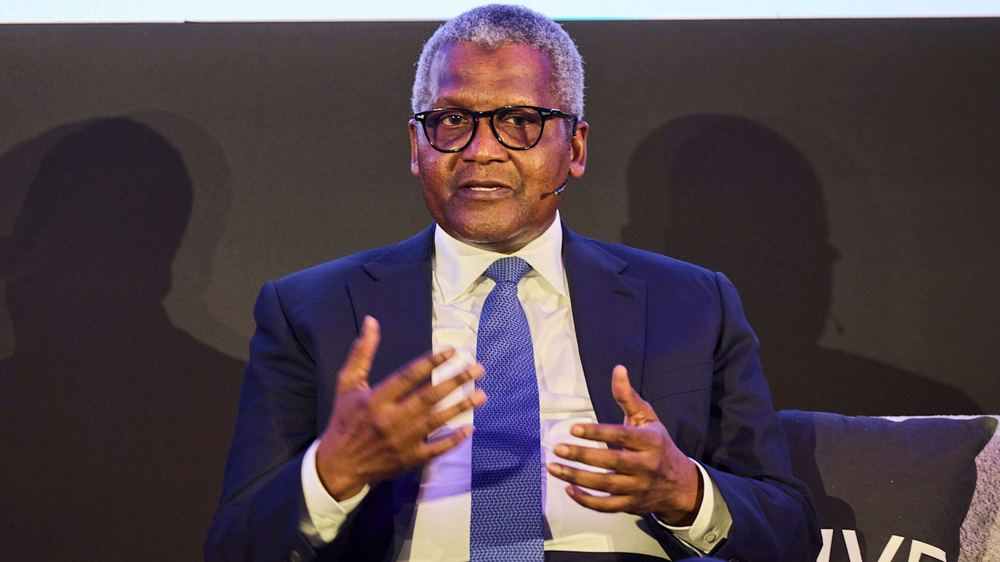
Aliko Dangote, Africa’s richest industrialist, said he planned to invest $1.5bn to expand a Kenyan pipeline network in which his company has taken a 25 per cent stake.
Dangote told the FT Africa summit in London that the purchase this week of a block of 4.5bn shares in Kenya Pipeline for $335mn, a slight premium on the last-traded price, and the planned investment in expanding its network were part of a continent-wide strategy to distribute refined products around Africa. “We are going very aggressively with that,” he said.
The Kenyan pipeline company was state-owned until the government floated 65 per cent of its shares earlier this year.
Dangote Industries owns the biggest refinery in Africa, a 700,000-barrel-a-day complex outside Lagos, which has been working flat out since the war started in Iran in February.
An IPO of the refinery that is expected to raise $2bn and value it at about $50bn has been extended to the end of the month, he said, to allow more people, including those outside Nigeria, to access shares.
The listing would be oversubscribed, Dangote said, meaning it would raise more than the $1.6bn originally pencilled in for Africa’s biggest IPO.
Dangote plans to build a second 700,000 b/d refinery in Lamu, on the east coast of Kenya, on which he said initial work had already started. A dispute over land and a court case would not slow down the project, which was going full steam ahead, he said.
Distribution of oil products was central to his strategy, he said.
The conflict in the Middle East has raised concerns about fuel security and the need for more infrastructure.
Dangote’s plans represent an ambitious attempt to build an integrated African refining, storage and distribution business, with Kenya serving as a regional hub for east Africa and Namibia for southern Africa.
Kenya Pipeline’s 1,300km network transports diesel, petrol and jet fuel from the port of Mombasa across Kenya, supplying both the domestic market and neighbouring countries including Uganda, the Democratic Republic of Congo, South Sudan and Rwanda.
In Namibia, Dangote plans to build fuel storage tanks that would more than triple the capacity of the country’s existing national storage facility. The Atlantic port of Walvis Bay provides a gateway to inland markets including Zambia, Botswana and Zimbabwe, as well as South Africa. Dangote said his company would begin work on the 330mn litre “tank farm” after a groundbreaking early next month.
A second storage facility in Djibouti would supply Ethiopia, he added. The company’s founder also said he was “finalising plans” for another storage facility in Cameroon, west Africa.
Dangote rejected any suggestion that he should be investing in renewables instead of oil refining, saying events in Iran had proved his strategy right.
“What we did in the last couple of months has demonstrated that,” he said. “We supply over 20 per cent of the . . . jet fuel in Europe,” he added, suggesting that European — and other airlines, including Ethiopian Airlines, Africa’s biggest — would struggle to fly without jet fuel from Nigeria.
“Oil is going to continue to be in demand. People who have deceived themselves that there’s going to be [an energy] transition, they can do that. We will go the other way.”
Dangote also defended the protection he has received from the African countries in which he operates, something he has insisted is necessary to make the Kenyan refinery viable.
“It is not about Dangote’s modus operandi. It is the modus operandi of any sensible nation,” he said. “If America is now saying no we are going to protect our industries, who are we in Africa not to protect our industries?”
He predicted that protectionism would continue to gather force. “The entire motor industry in Europe is on the verge of collapse, it’s in big trouble. There will be a heavy duty imposed on the import of Chinese vehicles,” he said.
“People should protect their own market. If you have a common market, you should protect that,” referring to the African Continental Free Trade Area, which theoretically links Africa’s 54 countries in a single market.
In all, he said, his company planned to invest $50bn by 2030 and aimed to reach revenues of $100bn by that date.