By Sana Pashankar and Loren Grush | Updated on Oct 09, 2026 at 10:30 AM
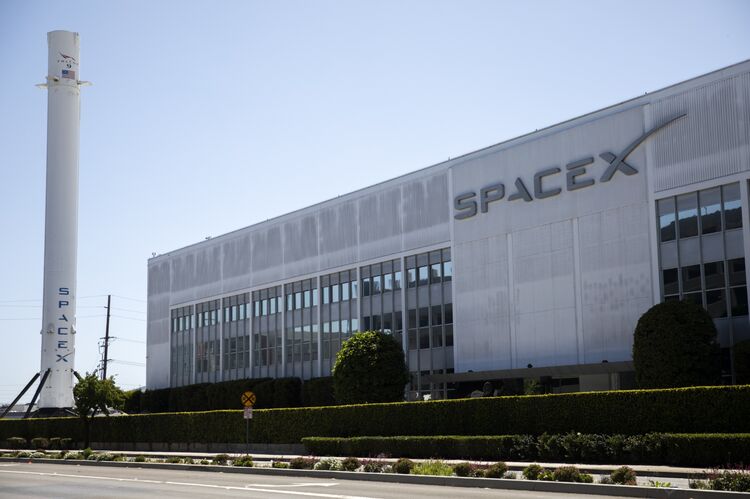
SpaceX is closing in on a crucial swath of spectrum needed to turn Elon Musk’s rocket, satellite and AI company into a “major mobile carrier,” setting the stage for a clash with stalwarts like T-Mobile US Inc., Verizon Communications Inc. and AT&T Inc.
The new spectrum · , which SpaceX is acquiring from investment firm Grain Management LLC, allows the company to beam cell service to devices indoors from its Starlink network of over 10,000 satellites. Once the company receives approval from the Federal Communications Commission, it will combine its satellite-to-cell services with a terrestrial network that can connect devices everywhere.
But building a nationwide service on par with the largest telecom providers will require much more, including launching more satellites, developing the company’s Starship rocket, and building out land-based infrastructure to complement its space-based service. That process could take years and massive investments from the company.
In a post on X on Thursday, Musk said that the low-band spectrum is “the last critical piece of the spectrum puzzle needed for SpaceX to provide complete phone coverage in America.”
Shares of major telecom providers like AT&T plunged as much as 8% after SpaceX’s announcement.
SpaceX’s satellite internet business already beams data directly to mobile phones, providing cell service in dead zones for existing ground-based networks. The company currently doesn’t have any terrestrial infrastructure of its own to pair with its satellite network.
Constructing and operating nationwide networks requires billions of dollars in physical infrastructure, along with scarce government-regulated airwaves.
Read More: Musk’s SpaceX to Buy EchoStar Spectrum for $17 Billion
To speed up that process, SpaceX could partner with one of the large telecom companies today to adopt their terrestrial infrastructure. Last year, Musk said that he hadn’t ruled out acquiring a telecom operator completely to support Starlink Mobile’s efforts.
“This spectrum acquisition is a doubling down on their commitment or threatened commitment to go it alone in the absence of finding a carrier that’s willing to work with them,” said David Barden, an analyst at New Street Research. “It is conclusive evidence that they intend to leverage their balance sheet and their largess to wage maximum leverage warfare” on the incumbent carriers.
We announced an agreement to acquire a nationwide low-band spectrum license portfolio that will pave the way for @Starlink to become a major mobile carrier in the US.
— SpaceX (@SpaceX) October 8, 2026
With this new spectrum and our Gen2 constellation, Starlink Mobile can ensure Americans have access to… pic.twitter.com/uVktZ0g3tu
SpaceX’s mobile ambitions also rely on the success of a key component: Starship. The behemoth rocket is set to become the backbone of SpaceX’s entire future , launching everything from upgraded Starlink broadband satellites to future orbital data centers for artificial intelligence.
The vehicle is also on the hook for launching the much larger Starlink satellites that are specialized for connecting to smartphones.
Starship has been in development for much of the last decade, but in September, SpaceX sent the vehicle to orbit for the first time, where it deployed a batch of upgraded Starlink broadband satellites. However, Starship did suffer some engine issues during the flight, and it’s unclear how that will impact flights of the rocket moving forward.
While announcing the acquisition, SpaceX also highlighted that the FCC had recently given the company the greenlight to launch 15,000 of its next generation Starlink mobile satellites. The company has said its new, larger satellites will be ready to launch on Starship by next year and will “deliver more than 100 times the bandwidth of our current generation.”
Bloomberg News first reported in August that SpaceX was among the companies interested in bidding on Grain’s spectrum. Musk, SpaceX’s chief executive officer, appeared to reject the idea, responding “not true” on his X social media platform to a user’s post referencing the report.
The price of the agreement was not publicly disclosed by SpaceX or Grain.
The 800 MHz-band licenses became available after Grain completed a spectrum swap in August with T-Mobile. The terms of that transaction, approved by the FCC, called for Grain to seek bids to develop the spectrum, which has been underutilized, according to the commission’s order.
The licenses cover nearly the entire US population, and they’re seen as valuable for helping satellite providers establish a ground-based link for voice services, known as a network pilot.
Grain has been confident that satellite and terrestrial services can co-exist in the 800 MHz band even though it’s previously only been used for ground-based mobile services, a person familiar with the company’s thinking told Bloomberg in August.
During SpaceX’s debut quarterly earnings in August, President Gwynne Shotwell fleshed out the company’s plans to become a mobile carrier, saying that the company definitely intends to “build out the terrestrial component.” Shotwell also expressed confidence at rivaling the business of major carriers today.
“I anticipate us being able to acquire quite a few of their customers, because I think our service will be better,” she said. “I’m quite excited about Starlink Mobile going forward.”